Artist / Band
John Kay
Biography
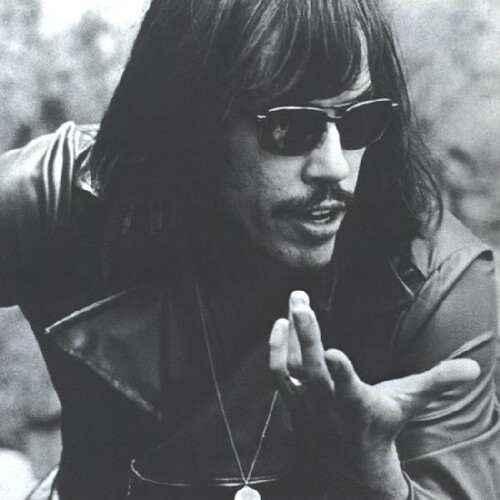
John Kay is one of the most distinctive voices to emerge from Canada's 1960s music scene: a German-born singer, songwriter, guitarist and harmonica player whose journey from wartime Europe to Toronto's folk and R&B community ultimately led to The Sparrow, Steppenwolf, an extensive solo catalogue and more than five decades of music. Behind the black leather, dark glasses and unmistakable rasp was a musician whose work repeatedly reached beyond the conventions of hard rock into blues, folk, country, social commentary and deeply personal songwriting. He was inducted into the Canadian Music Hall of Fame in 1996 and Canada's Walk of Fame in 2004.
Kay was born Joachim Fritz Krauledat on April 12, 1944, in Tilsit, East Prussia, during the final year of the Second World War. His father was killed fighting in Russia shortly before his birth. Kay and his mother subsequently became caught behind the Iron Curtain before escaping to West Germany, eventually settling in Hannover. Those childhood experiences of war, displacement and political division would leave a lasting impression and later surface repeatedly in his songwriting.
While growing up in West Germany, Kay became fascinated by American rock 'n' roll broadcast over U.S. Armed Forces Radio. He did not yet understand English, but the sound itself communicated something powerful to him: excitement, possibility and personal freedom. That association between music and freedom became one of the recurring threads running through his life and work.
In 1958, Kay emigrated with his mother and stepfather to Toronto, Ontario. There he absorbed rock, rhythm and blues, country and gospel from American radio while learning English and becoming increasingly serious about music. Kay was also legally blind from childhood, making the dark glasses that eventually became inseparable from his public image far more than a stage affectation.
Toronto became the place where Kay developed as a working musician. He immersed himself in folk and acoustic blues and became involved in the city's rapidly expanding Yorkville Village music community, part of the remarkable mid-1960s Toronto scene that was producing an extraordinary concentration of future Canadian and international artists. He performed as a folk and blues singer before joining The Sparrow, whose own evolution would take Kay from Yorkville to San Francisco's Haight-Ashbury district and eventually Los Angeles.
The Sparrow represented an important bridge between Toronto R&B, folk-blues and the harder psychedelic music developing on the American West Coast. After the group ran its course, Kay regrouped in Los Angeles. In 1967, a new band emerged around Kay with former Sparrow associates Jerry Edmonton and Goldy McJohn, joined by guitarist Michael Monarch and bassist Rushton Moreve. They became Steppenwolf, taking their name from Hermann Hesse's novel.
Their rise was remarkably fast. Steppenwolf's first album appeared in 1968 and contained ‘Born to Be Wild’, written by former Sparrow member Dennis Edmonton under the name Mars Bonfire. The recording became one of rock music's enduring anthems, while the phrase ‘heavy metal thunder’ became permanently associated with the language of hard rock. Steppenwolf's powerful version of Hoyt Axton's ‘The Pusher’ further demonstrated that the band could combine physical intensity with provocative subject matter. Both songs became central to the soundtrack of Dennis Hopper's Easy Rider in 1969.
Yet reducing John Kay and Steppenwolf to motorcycles and ‘Born to Be Wild’ misses much of what made the group important. Kay's songwriting repeatedly addressed questions of political power, personal freedom, drugs, social conformity, war and responsibility. Songs such as ‘Don't Step on the Grass, Sam’, ‘Power Play’, ‘Move Over’ and particularly the extended ‘Monster/Suicide/America’ reflected the same skepticism toward institutions and authority that can be traced back through Kay's own childhood experiences and the folk tradition that had first attracted him to songwriting.
At the same time, Steppenwolf could produce exceptionally direct rock singles. ‘Magic Carpet Ride’, written by Kay and Rushton Moreve, became another enormous success, while Kay's ‘Rock Me’ further established his ability to write concise, immediately recognizable rock songs. That combination of hard rhythmic impact, unusual keyboard textures, strong guitar work and Kay's instantly identifiable voice made Steppenwolf one of the defining hard-rock groups of the period. The band's documented worldwide record sales eventually exceeded 25 million copies.
Steppenwolf's personnel changed repeatedly, but Kay remained its principal voice and increasingly its central creative figure. Albums including The Second, At Your Birthday Party, Monster, Steppenwolf Live, Steppenwolf 7 and For Ladies Only showed a band capable of moving between concise singles, blues-derived rock, extended compositions and explicitly political material. By the beginning of the 1970s, however, the relentless cycle of recording, touring and personnel changes had taken its toll.
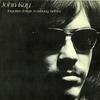
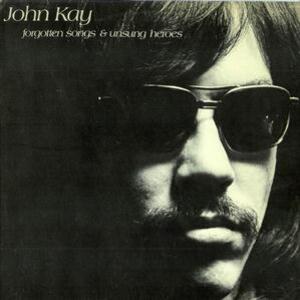
The original major phase of Steppenwolf ended in 1972, opening the way for Kay to more fully explore musical influences that the band's larger-than-life hard-rock identity had sometimes obscured. His first solo album, Forgotten Songs & Unsung Heroes, deliberately placed his own writing beside songs associated with Patrick Sky, Hank Williams, Richard Fariña, Robert Johnson and Hank Snow. Rather than presenting a lighter imitation of Steppenwolf, Kay returned to the folk, blues and country traditions that had shaped him before the band existed.
The result exposed another John Kay — less concerned with sheer amplification and more interested in songs, space and storytelling. Working with producer Richard Podolor and engineer Bill Cooper, Kay regarded Forgotten Songs & Unsung Heroes as one of the most satisfying recordings he had made. Its warm production and mixture of originals and carefully chosen outside material established that his musical identity extended considerably beyond hard rock.
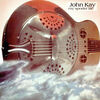
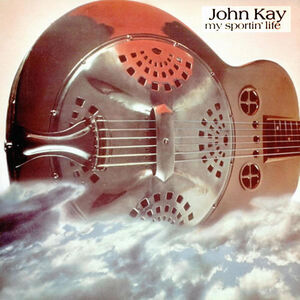
My Sportin' Life followed in 1973, again pairing Kay with Podolor and an exceptional group of musicians. The record continued the mixture of original writing and outside compositions, drawing on blues, country, roots music and the emerging Southern California studio sound. Together, Kay's first two solo albums revealed how closely the apparent contradictions in his music actually belonged together: the Steppenwolf frontman, acoustic blues singer, folk-influenced songwriter and interpreter of country music were all parts of the same musician.
Steppenwolf reconvened during the mid-1970s, resulting in another succession of recordings and performances before that incarnation ended in 1976. Kay then entered another transitional period, one that produced some of the most intriguing recordings in his catalogue.
In September 1976, Kay and Morgan Cavett produced a group of recordings at Heritage Recorders in Hollywood. The sessions included contributions from an extraordinary collection of musicians including Lowell George and Bill Payne of Little Feat, Nicky Hopkins, Jim Gordon, Jerry Edmonton and the Tower of Power Horns. Changes in record-company and management affiliations caused the recordings to be shelved, and they remained unheard for more than two decades.
Several of those compositions refused to disappear. Kay carried ‘Business Is Business’, ‘Down in New Orleans’ and ‘Hey I'm Alright’ into his next project, where they were recorded again with entirely different musicians.
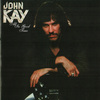
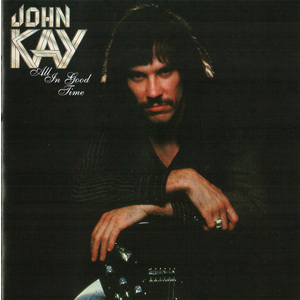
That project became All In Good Time, Kay's third solo album. Recorded at Wishbone Recording Studios in Muscle Shoals, Alabama, it deliberately placed his music in an environment closely connected to many of his earliest influences. Working with producers Clayton Ivey and Terry Woodford, a Muscle Shoals rhythm section and former Steppenwolf guitarist Larry Byrom, Kay arrived at the relaxed, Southern groove he had long admired in records from Muscle Shoals and Memphis.
Unlike his first two solo albums, All In Good Time consisted entirely of John Kay compositions. The result brought his songwriting into particularly sharp focus. Rather than attempting to reproduce Steppenwolf, Kay allowed the rhythms, horns, keyboards and guitars of Muscle Shoals to reshape his material. He later remembered the album as one of his personal favourites.
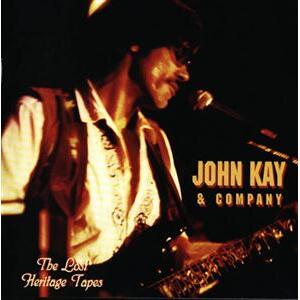
The unreleased 1976 recordings eventually resurfaced after being rediscovered during Kay's move to a new studio in Tennessee. They finally appeared in 1997 as John Kay & Company – The Lost Heritage Tapes, restoring a missing chapter between his early solo work and All In Good Time. The album also preserved performances by several musicians who had died during the intervening years.
Meanwhile, another problem had pulled Kay back toward Steppenwolf. By the late 1970s, unauthorized groups containing former members were touring under variations of the Steppenwolf name. Kay and Jerry Edmonton, as co-owners of Steppenwolf Productions, attempted to stop the misuse. When those efforts proved inadequate, Kay decided to reclaim the identity himself. In January 1980, he returned to the road as John Kay & Steppenwolf.
It was not an easy return. Kay later described the early 1980s as a period in which the Steppenwolf name had to be rebuilt almost from the ground up. Rather than stepping immediately back into the prestige associated with the band's classic years, John Kay & Steppenwolf toured almost continuously for roughly four-and-a-half to five years, gradually restoring credibility to the name. Kay later regarded the experience as humbling but valuable, giving him a renewed appreciation for the success he had experienced so quickly as a young man.
The rebuilt band also produced substantial new music. Wolftracks was recorded at Ocean Way in Los Angeles using the then-new Soundstream two-track digital format. Because conventional overdubbing was impossible, the musicians, lead vocals and backing vocals were essentially recorded together as a live studio performance. Kay regarded the album as evidence that the reborn band was looking forward rather than merely trading on its past.
Paradox followed in 1984 and became the final project recorded at the original American Recording Studio in Studio City, where much of Steppenwolf's earlier recording history had been created. The album's deliberately varied material reflected Kay's continuing resistance to reducing the band to one narrow formula.
John Kay & Steppenwolf continued recording and touring through the following decades. Later work gave Kay another vehicle for the subjects that had long concerned him — independence, war, social responsibility, political power and the individual's place within larger institutions. Rise & Shine, recorded at his Tennessee studio, was particularly important to Kay; he singled out ‘Rock and Roll War’ and ‘The Wall’, the latter again drawing upon his memories of life behind the Iron Curtain.
Through this later period, Steppenwolf also developed an unusually loyal community of followers known as the Wolfpack, reinforcing the fact that the band's history had become considerably larger than a handful of late-1960s hits. The later John Kay & Steppenwolf years ultimately lasted far longer than Steppenwolf's original commercial peak.
Kay's autobiography, Magic Carpet Ride: The Autobiography of John Kay and Steppenwolf, first appeared in 1994. A later expanded edition added a new final chapter extending the story through Steppenwolf's 50th-anniversary period and the band's last performance in 2018.
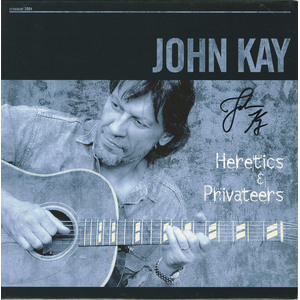
Kay also returned decisively to his original folk and blues instincts with his fourth solo album, Heretics & Privateers, originally released in 2001. Its twelve compositions concentrated on contemporary society, institutional indifference, consumer culture, inequality, personal responsibility and compassion. Rather than attempting to recreate his earlier solo records, Kay used the music's roots-oriented setting as a vehicle for some of his most direct later-period writing.
In that respect, Heretics & Privateers completed a remarkable circle. The young immigrant who had discovered American music before he could understand its language, the Yorkville folk-blues performer, the singer of Steppenwolf, the author of ‘Monster’, and the older songwriter examining modern society were not separate artistic identities. The underlying concerns had remained surprisingly consistent.
Recognition of Kay's place in Canadian music became increasingly formal. He entered the Canadian Music Hall of Fame in 1996, while Canada's Walk of Fame inducted him in 2004. The latter specifically recognizes the central importance of his Canadian years: Kay emigrated to Toronto as a teenager, developed musically there, joined The Sparrow and carried that experience into the band that would eventually become Steppenwolf.
The Rock & Roll Hall of Fame has not inducted Steppenwolf as a band, but in 2018 ‘Born to Be Wild’ was inducted in the Hall's Singles category. The Hall also preserves a John Kay Collection, including archival material associated with his songwriting and career.
By then, Kay's priorities had extended well beyond music. In 2004, he and his wife Jutta Maue Kay established the Maue Kay Foundation, supporting wildlife conservation, environmental protection and human-rights work. Increasingly, Kay redirected the independence and social conscience that had characterized his songs toward practical advocacy and philanthropy. The Canadian Music Hall of Fame specifically identifies the foundation as one of the principal focuses of his later life.
Steppenwolf retired as a touring act in 2018, ending a performing history that had begun more than half a century earlier. Kay nevertheless continued to make occasional solo acoustic appearances, returning once again to the folk and blues setting from which his professional journey had begun.
In 2025, he began another form of storytelling with The John Kay Podcast: Rockstar to Wildlife Advocate, using his own recollections and archival material to trace the path from wartime refugee and Toronto musician to international rock star and conservation advocate.
John Kay's importance to Canadian music is consequently larger than the nationality of the band with which he became famous. Canada was where he became a musician. Toronto gave the teenage immigrant a musical community and provided the environment in which his fascination with American blues, folk, R&B and rock could become something of his own. The Sparrow carried that development outward; Steppenwolf transformed it into international success.
And his career cannot adequately be summarized by one song, however enormous that song became. ‘Born to Be Wild’ will always stand at the centre of the Steppenwolf story, but Kay's catalogue also contains the social confrontation of Monster, the introspection and roots music of Forgotten Songs & Unsung Heroes and My Sportin' Life, the Southern groove of All In Good Time, the rediscovered history of The Lost Heritage Tapes, decades of John Kay & Steppenwolf recordings and the mature social observations of Heretics & Privateers.
Across those very different settings, the same themes repeatedly surface: freedom, skepticism toward authority, empathy for outsiders, individual responsibility and the belief that music can say something meaningful without surrendering its power as entertainment.
The circumstances surrounding John Kay changed enormously — wartime Europe, Toronto coffeehouses, psychedelic California, international rock stardom, solo records, Muscle Shoals, decades on the road and eventually wildlife advocacy — but the fundamental impulse remained remarkably consistent.
For John Kay, music began as the sound of freedom. Over the course of a lifetime, that idea expanded into something larger: the freedom to question, to choose one's own course, and ultimately to accept responsibility for the world beyond oneself.
-Robert Williston
Tracks
52 tracks
-
Square Headed People
Forgotten & Unsung Heroes (1972)
9 tracks
-
Many a Mile
-
Walk Beside Me
-
You Win Again
-
To be Alive
-
Bold Marauder
-
Two of a Kind
-
Walkin' Blues
-
Somebody
-
I'm Movin' On
My Sportin' Life (1973)
9 tracks
-
Moonshine (Friend of Mine)
-
Nobody Lives Here Anymore
-
Drift Away
-
Heroes and Devils
-
My Sportin' Life
-
Easy Evil
-
Giles of the River
-
Dance to My Song
-
Sing With the Children
All in Good Time (1978)
10 tracks
-
Give Me Some News I Can Use
-
The Best is Barely Good Enough
-
That's When I Think of You
-
Ain't Nobody Home in California
-
Ain't Nothing Like it Used to be
-
Business is Business
-
Show Me How You'd Like it Done
-
Down in New Orleans
-
Say You Will
-
Hey, I'm Alright
The Lost Heritage Tapes (1997)
10 tracks
-
Down in New Orleans
-
Business is Business
-
Captain of Your Destiny
-
Live Your Life
-
Sweet Memories
-
Nothing But
-
Hey I'm All Right
-
Sound of the Crowd
-
You've Had Your Fun
-
Hurricane Maryann
Heretics & Privateers (2000)
Showing 10 of 13 tracks
-
Heretics & Privateers
-
Don't Waste My Time
-
Ain't that a Shame
-
Dodging Bullets
-
She's Got the Goods
-
For the Women in My Life
-
I Will Not be Denied
-
To be Alive
-
She's Got the Goods
-
Endless Commercial
Discography
Featured Titles

Albums
Singles
Gallery
Images
1 image
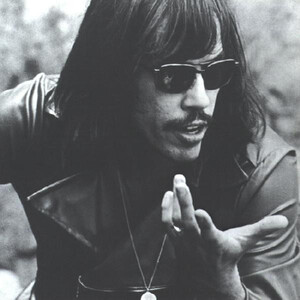
John Kay
Media
Videos
0 videos
No videos available for this artist.