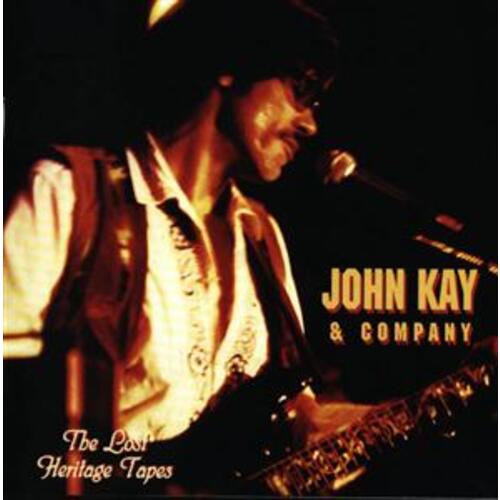
Album / Title
The Lost Heritage Tapes
By: John Kay
Origin: East Prussia, Germany → Toronto, Ontario, 🇨🇦
Insight
The Lost Heritage Tapes is one of the more revealing entries in John Kay’s catalogue, not because it was conceived as an archival release, but because it was originally intended to be heard in its own time. Recorded in September 1976 at Heritage Recorders in Hollywood, while Steppenwolf was on hiatus, the sessions were produced by Kay and Morgan Cavett and then shelved as management and record-company relationships changed. Rediscovered years later during Kay’s move to a new studio in Tennessee, the recordings finally surfaced in the 1990s as an intact glimpse of a musical chapter that had effectively disappeared.
That distinction matters. These are not assorted demos, alternate takes or unfinished fragments assembled decades after the fact. The Lost Heritage Tapes represents a coherent 1976 recording project, built around Kay and a core group of Steve Palmer on drums, Michael Palmer on lead guitar, Kenny Blanchet on bass and Wayne Cook on keyboards. Around them is an extraordinary collection of guests whose contributions give individual songs strikingly different personalities.
The opening ‘Down in New Orleans’ immediately places Kay outside the harder Steppenwolf framework. There is still weight in his voice and guitar, but the song leans toward a looser American roots sound, with Brent Lewis adding African hand percussion. Kay would return to the song two years later for All in Good Time, but this earlier version captures it closer to its point of origin.
‘Business Is Business’ broadens the palette dramatically. The Tower of Power horn section and backing vocals from Clydie King, Shirley Mathews and Vanetta Fields push the arrangement toward funk and soul without overwhelming Kay’s characteristic delivery. Beneath the polish is one of his recurring concerns: the compromises and hypocrisies that appear when financial interests become more important than people. It is one of the tracks Kay himself later singled out among his favourites from the sessions.
The album’s diversity becomes even clearer with ‘Captain of Your Destiny’. Co-written with Morgan Cavett and featuring Bill Payne of Little Feat on keyboards, it has a reflective quality that contrasts sharply with the harder edges elsewhere. Kay’s songwriting was increasingly comfortable moving beyond straightforward rock structures, allowing atmosphere and narrative to carry as much weight as guitar attack.
That willingness to change texture reaches a high point on ‘Live Your Life’. Here the personnel are remarkable: Lowell George contributes slide guitar, Jerry Edmonton of Steppenwolf plays drums, Jack Ryland handles bass and Jim Gordon adds horns. Yet the importance of the track is not the collection of recognizable names. The musicians serve the song, and George’s slide in particular gives it an earthy, distinctly American character without turning the performance into a showcase.
‘Sweet Memories’ and ‘Nothing But’ move into more introspective territory, with Tret Fure contributing backing vocals. ‘Nothing But’ is especially effective because it gives Kay room to stretch out; at nearly six minutes, it is the album’s longest performance and allows the arrangement to develop gradually rather than forcing the song into a conventional radio format.
On ‘Hey I’m All Right’, the presence of Nicky Hopkins adds another distinctive colour. One of rock’s great keyboard accompanists, Hopkins had an extraordinary ability to strengthen a recording without drawing attention away from the singer, and that instinct is well suited to Kay. Like ‘Down in New Orleans’ and ‘Business Is Business’, the song was important enough for Kay to revisit when he recorded All in Good Time in 1978 with a different group of musicians.
That overlap with the later album makes The Lost Heritage Tapes particularly valuable. Hearing the original versions of ‘Down in New Orleans’, ‘Business Is Business’ and ‘Hey I’m All Right’ shows that Kay did not abandon these songs when the Heritage project was shelved. He carried them forward and reconsidered them under different circumstances. The 1976 recordings therefore document an important transitional stage rather than a creative dead end.
‘Sound of the Crowd’ and ‘You’ve Had Your Fun’ return the album toward tougher rock territory. The latter, written by Kay with Michael and Steve Palmer, has more of the direct muscularity associated with his heavier work, demonstrating how naturally the Heritage sessions move between roots music, soul, blues and hard rock without sounding like an attempt to cover every style available.
The closing ‘Hurricane Maryanne’, written by Kay, Michael Palmer, Steve Palmer and Willie Dee, provides an appropriately forceful finish. By this point the album’s breadth is unmistakable. What holds the record together is not a single production style but Kay’s voice, writing and musical personality.
That voice is crucial. Kay had already established one of rock’s most immediately recognizable vocal sounds, but the Heritage recordings demonstrate how effective it could be outside Steppenwolf’s familiar framework. His rough-edged delivery works just as naturally against horns, piano, slide guitar and backing singers as it does against distorted electric guitars.
The guest list inevitably attracts attention — Lowell George, Bill Payne, Nicky Hopkins, the Tower of Power horns, Clydie King, Shirley Mathews, Vanetta Fields, Jerry Edmonton, Jim Gordon and Tret Fure constitute an exceptional collection of musicians — but The Lost Heritage Tapes succeeds because the performances never feel assembled merely for prestige. Each guest supplies a particular texture needed by a particular song.
There is also something poignant about hearing these musicians together decades after the sessions were made. Several were no longer alive by the time the recordings finally appeared. What had once been an unreleased project consequently became an accidental historical document, preserving combinations of musicians that could never be recreated.
The album also fills an important gap in Kay’s chronology. The recordings were made after Steppenwolf’s mid-1970s activity had paused and before Kay formally returned to solo recording with All in Good Time. Heard in that context, The Lost Heritage Tapes reveals an artist testing how far he could move beyond the expectations attached to Steppenwolf while still retaining the blues, rock and social awareness at the centre of his writing.
What makes the album compelling is precisely what Kay later identified in it: the contrasts. ‘Business Is Business’ does not sound like ‘Live Your Life’; ‘Captain of Your Destiny’ occupies different territory from ‘Hurricane Maryanne’; and the quieter material sits comfortably beside the harder rock songs. Rather than weakening the album, that variety gives it character.
The Lost Heritage Tapes ultimately feels less like a rescued collection of forgotten recordings than the missing John Kay album of 1976. Had business circumstances been different, these songs might simply have entered his catalogue at the time they were made. Instead, their long disappearance gives us the unusual opportunity to hear a fully developed musical moment decades after it should originally have arrived.
For anyone approaching John Kay primarily through Steppenwolf, the album reveals another side of the same artist: still unmistakably rooted in blues and rock, but comfortable with soul, Southern textures, singer-songwriter material and a much wider range of arrangements than his best-known recordings might suggest. The tapes may have been lost for years, but the music itself never sounds disposable.
-Robert Williston
Gallery
Images
2 images
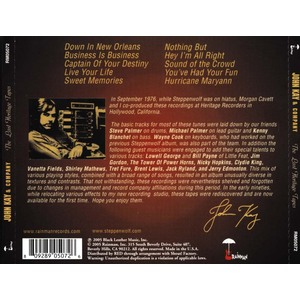
John Kay - The Lost Heritage Tapes
The Lost Heritage Tapes
Media
Videos
0 videos
No videos available for this title.
Credits
Musicians
John Kay: vocals, guitar, harmonica
Steve Palmer: drums
Michael Palmer: lead guitar
Kenny Blanchet: bass
Wayne Cook: keyboards
Additional Musicians
Brent Lewis: Ika Umas African hand drum on ‘Down in New Orleans’
Tower of Power Horn Section: horns on ‘Business Is Business’
Clydie King: backing vocals on ‘Business Is Business’
Shirley Mathews: backing vocals on ‘Business Is Business’
Vanetta Fields: backing vocals on ‘Business Is Business’
Bill Payne: keyboards on ‘Captain of Your Destiny’
Lowell George: slide guitar on ‘Live Your Life’
Jack Ryland: bass on ‘Live Your Life’
Jerry Edmonton: drums on ‘Live Your Life’
Jim Gordon: horns on ‘Live Your Life’
Tret Fure: backing vocals on ‘Sweet Memories’ and ‘Nothing But’
Nicky Hopkins: keyboards on ‘Hey I’m All Right’
Songwriting
‘Down in New Orleans’ written by John Kay
‘Business Is Business’ written by John Kay
‘Captain of Your Destiny’ written by John Kay and Morgan Cavett
‘Live Your Life’ written by John Kay
‘Sweet Memories’ written by John Kay
‘Nothing But’ written by John Kay
‘Hey I’m All Right’ written by John Kay
‘Sound of the Crowd’ written by John Kay
‘You’ve Had Your Fun’ written by John Kay, Michael Palmer and Steve Palmer
‘Hurricane Maryanne’ written by John Kay, Michael Palmer, Steve Palmer and Willie Dee
Publishing
All songs published by Rambunctious Music, ASCAP
‘Captain of Your Destiny’ published by Rambunctious Music, ASCAP / Belly King Music, BMI
Production
Produced by John Kay and Morgan Cavett
Recording
Recorded at Heritage Recorders, Hollywood, California
Recorded September 1976
Engineered by Randy Nicklaus
Mastering
Mastered by Glen Meadows at Masterfonics, Nashville
Artwork
Cover photography by Jutta Maue-Kay
Art direction by Celeste Johnson
Graphic design and layout by Cindy Dannat, Nashville
2005 Reissue Artwork
Art direction for Rainman Records by Ed Spyra
Liner Notes
John Kay explains that the recordings were made in September 1976 while Steppenwolf was on hiatus. The basic tracks for most of the material featured Steve Palmer, Michael Palmer, Kenny Blanchet and Wayne Cook, with the various guest musicians subsequently added to individual tracks.
Kay states that the recordings were shelved following changes in management and record-company affiliations. He rediscovered the tapes in the early 1990s while moving equipment and effects to a new recording studio, allowing the previously unreleased sessions to finally be issued.
2005 Reissue Copyright
℗ 2005 Black Leather Music, Inc.
© 2005 Rainman, Inc.
2005 Reissue Distribution
Distributed by RED through arrangement with Shout! Factory
Made in the U.S.A.
No Comments