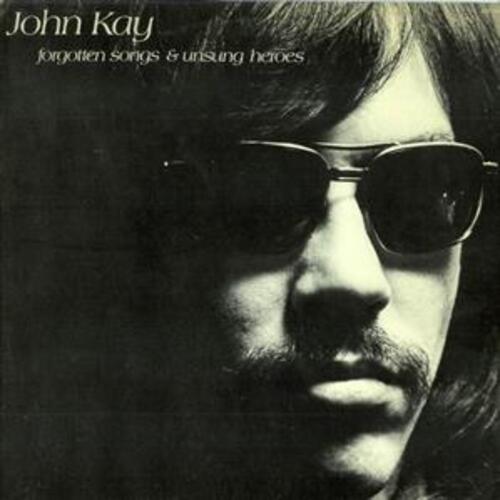
Album / Title
Forgotten & Unsung Heroes
By: John Kay
Origin: East Prussia, Germany → Toronto, Ontario, 🇨🇦
Insight
Forgotten Songs & Unsung Heroes is less a departure from John Kay’s musical identity than an excavation of what had always been underneath it. After several years as the unmistakable voice of Steppenwolf, Kay used his first solo album to strip away much of the volume and mythology surrounding the group and return to the music that had formed him: folk, blues, country, roots music and songs built to survive without spectacle.
The title explains the concept. Some of these are Kay’s own compositions; others belong to writers whose work had accompanied him long before ‘Born to Be Wild’. Hank Williams, Hank Snow, Robert Johnson, Patrick Sky and Richard Fariña are not treated as historical curiosities. Their songs sit beside Kay’s own material because, for him, they belong to the same musical conversation.
That relationship is particularly evident in ‘Many A Mile’, Patrick Sky’s road song. Kay’s liner note says he had been humming it since the folk-revival years, and it is easy to understand why he chose it to open the record. Its endless towns, departures and goodbyes could almost function as an autobiography for a musician who had spent much of the previous decade moving between cities, countries, bands and stages.
The personnel provide an important bridge between Kay’s Canadian musical beginnings and his Steppenwolf years. Penti ‘Whitey’ Glan and Hugh O’Sullivan came from the Toronto R&B world of The Rogues, Mandala and Bush, while Kent Henry and George Biondo were current Steppenwolf associates. Kay was not abandoning one musical life for another; he was bringing different chapters of that life into the same room. His official history similarly places his pre-Steppenwolf development in Toronto’s folk, blues and R&B environment.
‘Walk Beside Me’ establishes another important side of the album: intimacy. Much of Steppenwolf’s best-known material addressed society from the stage outward; here Kay frequently turns inward. The songs deal with companionship, fear, conscience, loneliness and the search for something durable beneath the noise of ordinary life.
That inward turn becomes particularly powerful on ‘To Be Alive’. Kay introduced the song in the liner notes as one of those occasions when his conscience frightened him, and the lyric bears that out. Rather than celebrating survival in the easy rock-and-roll sense, the song confronts mortality, suffering and the uncomfortable obligation to recognize the pain of other people. Its eventual movement toward compassion makes it one of the record’s clearest demonstrations that Kay’s social concerns did not disappear when the electric volume came down.
The covers are equally revealing.
Hank Williams’ ‘You Win Again’ connects directly to Kay’s adolescence. He recalled learning his first guitar chords from Williams songbooks while still struggling with English. The choice therefore feels less like a genre exercise than an acknowledgement of one of the musicians who taught him how songs worked in the first place.
Robert Johnson’s ‘Walkin’ Blues’ reaches even further toward the foundation. Kay reduces the equation to voice, bottleneck guitar, harmonica and George Biondo’s bass. Whatever distance existed between the frontman of a major rock band and the itinerant blues music that fascinated him as a young man becomes very small here.
Then there is Richard Fariña’s ‘Bold Marauder’, perhaps the record’s most striking selection. Kay admired Fariña’s lyrics and dulcimer playing, and the song’s dark imagery gives the album an edge quite different from conventional singer-songwriter introspection. It is violent, allegorical and unsettling — a reminder that folk music could be every bit as confrontational as amplified rock.
A contemporary 1972 review also singled out the contrast between Kay’s established reputation and how naturally he inhabited older American forms, particularly Hank Snow’s ‘I’m Movin’ On’. It is an ideal closing choice. After an album filled with roads, memory, relationships and self-examination, Kay finishes with a song literally built around departure.
The original compositions are strong enough that the album never becomes a collection of favourite covers. ‘Two Of A Kind’ stretches beyond six minutes, allowing Kay and producer Richard Podolor to work with space rather than force. ‘Somebody’ adds female voices and a fuller arrangement, while ‘Walk Beside Me’ and ‘To Be Alive’ show that Kay could write personally without losing the directness that distinguished his work with Steppenwolf.
The sound is an essential part of the record’s character. Kay later remembered Forgotten Songs & Unsung Heroes as one of the most satisfying recordings he had made, praising its wide, full and warm quality. That was not an accidental result. By this point his relationship with Richard Podolor and engineer Bill Cooper had already been developed through Steppenwolf sessions, and Kay later described Podolor and Cooper as creative collaborators who became close friends.
Podolor’s greatest achievement here is restraint. Nothing about the album suggests an attempt to prove that Kay can be sophisticated without Steppenwolf. Acoustic instruments, organ, electric piano, dulcimer, mandolin, harmonica and percussion are used as colours rather than ornaments. The production gives the songs weight without burying their origins.
That may be why the record has aged particularly well. There is relatively little about it that depends upon the fashions of 1972. It draws instead upon musical traditions already decades old when it was recorded.
The album also appeared at exactly the moment when Kay’s public identity was changing. Steppenwolf officially disbanded on February 14, 1972, after an exhausting run of albums and touring, while Forgotten Songs & Unsung Heroes opened his solo catalogue that same year. The official Steppenwolf history now describes it and the following My Sportin’ Life as albums in which Kay explored new musical and lyrical territory.
Yet calling this a reinvention would miss the point.
Forgotten Songs & Unsung Heroes reveals that the bluesman, folk singer and country listener had been inside John Kay all along. Steppenwolf amplified some parts of his musical personality until they became enormous; this record simply allows the quieter foundations to be heard again.
And that is what makes the album more than a side project from a famous frontman. Kay places his own songs alongside the writers who helped shape him and, importantly, does not suffer by comparison. The covers tell us where he came from. ‘Walk Beside Me’, ‘To Be Alive’, ‘Two Of A Kind’ and ‘Somebody’ tell us where his own writing had arrived.
More than fifty years later, Forgotten Songs & Unsung Heroes remains one of the clearest portraits of John Kay the musician rather than John Kay the rock icon: the immigrant teenager absorbing Hank Williams, the young blues singer discovering Robert Johnson, the Toronto musician shaped by Canadian R&B, the songwriter behind Steppenwolf, and the man who still understood that sometimes a voice, a guitar and a good song were enough.
-Robert Williston
My first solo album, as it’s title implies, is a collection of songs written by some of my influences (Hank Williams, Robert Johnson, etc), as well as tunes I’d written which were rooted in those influences. Aided by Penti “Whitey” Glan ,drums and Hugh O’Sullivan, keyboards, both of whom had been members of fine Canadian R&B bands called “The Rogues”, “The Mandela” and “Bush”, as well as Kent Henry and George Biondo from The Wolf. I recorded once again at “American” with Richie Podolor producing and Bill Cooper engineering. The result was one of the best sounding recordings I’ve been involved with. It has a wide, full and warm sound and contains some of my most personal writings. All in all I felt satisfied with this record and I still do.
-John Kay
Gallery
Images
2 images
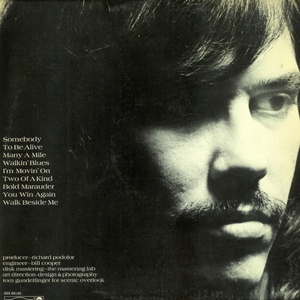
John Kay - Forgotten & Unsung Heroes
Forgotten & Unsung Heroes
Media
Videos
0 videos
No videos available for this title.
Credits
Musicians
‘Many A Mile’: John Kay: vocal, guitar; Kent Henry: acoustic lead guitar; Hugh O’Sullivan: organ; George Biondo: bass; Penti (Whitey) Glan: drums
‘Walk Beside Me’: John Kay: vocal, harp, 12 string guitar; Kent Henry: lead guitars; Hugh O’Sullivan: organ; George Biondo: bass; Penti (Whitey) Glan: drums
‘You Win Again’: John Kay: vocal, guitar; Kent Henry: simulated steel guitar; Hugh O’Sullivan: electric piano; George Biondo: bass; Penti (Whitey) Glan: drums
‘To Be Alive’: John Kay: vocal, guitar; Kent Henry: lead guitar; Hugh O’Sullivan: organ; George Biondo: bass; Penti (Whitey) Glan: drums
‘Bold Marauder’: John Kay: vocal, dulcimer; Kent Henry: acoustic guitar; Hugh O’Sullivan: organ; George Biondo: bass; Penti (Whitey) Glan: hand drums; Richard Podolor: jaw bone, tambourine
‘Two Of A Kind’: John Kay: vocal, guitar; Richard Podolor: organ, mandolin
‘Walkin’ Blues’: John Kay: vocal, bottleneck guitar, harp; George Biondo: bass
‘Somebody’: John Kay: vocal, guitar; Marsha Jo Tremmer: vocals; Joan Sliwin: vocals; Alexandra Sliwin: vocals; Kent Henry: lead guitar; Hugh O’Sullivan: organ; George Biondo: bass; Penti (Whitey) Glan: drums; Richard Podolor: guitar break
‘I’m Movin’ On’: John Kay: electric guitar; Kent Henry: slide guitar; Hugh O’Sullivan: organ, electric piano; George Biondo: bass; Penti (Whitey) Glan: drums
Songwriting
‘Many A Mile’ written by Patrick Sky
‘Walk Beside Me’ written by John Kay
‘You Win Again’ written by Hank Williams
‘To Be Alive’ written by John Kay
‘Bold Marauder’ written by Richard Farina
‘Two Of A Kind’ written by John Kay
‘Walkin’ Blues’ written by Robert Johnson
‘Somebody’ written by John Kay
‘I’m Movin’ On’ written by Hank Snow
Production
Produced by Richard Podolor
Technical
Engineered by Bill Cooper
Disk mastering by The Mastering Lab
Lacquer cut at RCA Studios, Toronto
Pressed by RCA Records Pressing Plant, Smiths Falls, Ontario
Artwork
Art direction, design and photography by Tom Gundelfinger for Scenic Overlook
Manufacturing
Licensed from RCA Limited
Distributed by RCA Limited
Copyright
℗ ABC Records, Inc.
Liner Notes
This album (Forgotten Songs & Unsung Heroes) is partly comprised of my own songs and also those written by musical heroes who influenced me along the way. I hope this record can give you some of what I got from most of theirs. To all who helped make this album... “thanks for the way you cared”.
John Kay, 1971
‘Many A Mile’
Written by Patrick Sky whom I know little about, except that he is an American Indian whose song I’ve been humming ever since the days of the folk revival.
‘Walk Beside Me’
“There’s nothing like the serenity of the ocean to help one remember or forget.”
‘You Win Again’
Written by Hank Williams, whose songbooks showed me my first guitar chords when I was fourteen and could barely speak English.
‘To Be Alive’
“…one of those times when my conscience got a hold of me and I scared myself.”
‘Bold Marauder’
Written by Richard Farina, who had a way with lyrics equalled by few and whose music and dulcimer style were as unique as any I’ve heard.
‘Two Of A Kind’
“Few ever find the missing half of their coin, and some find it before their time.”
‘Walkin’ Blues’
Written by Robert Johnson… every self-respecting blues fan is familiar with his legend by now; to me he’ll remain as special as on the first day I heard him.
‘I’m Movin’ On’
Written by Hank Snow, a veteran Country & Western artist known as the Singing Ranger, although this version is closer to the one by Ray Charles.
Additional Information
Gatefold sleeve
Side A matrix: DSX-50120-A T.G.
Side B matrix: DSX-50120-B T.G.
Both runouts etched
‘T.G.’ identifies the lacquer cut at RCA Studios, Toronto
No Comments