Insight
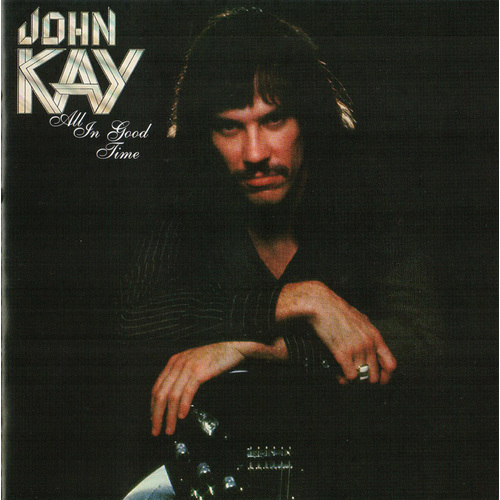
All In Good Time finds John Kay doing something that suited him unusually well: taking his unmistakable voice and songwriting out of California and placing them squarely inside the relaxed rhythmic language of Muscle Shoals, Alabama. Recorded in 1978 at Wishbone Recording Studios, the album was Kay’s third solo release and his first made outside California. The change of surroundings is audible almost immediately.
For Kay, recording in Muscle Shoals was more than a fashionable choice of studio. Much of the music that had shaped him — blues, R&B, country, soul and early rock and roll — had originated in the American South. By the late 1970s, Muscle Shoals had become one of the great recording centres for precisely that mixture of styles. Kay later remembered arriving there with considerable anticipation and leaving completely satisfied with the experience.
The sessions paired him with producers Clayton Ivey and Terry Woodford, while Ivey also played keyboards alongside bassist Bob Wray and drummer Roger Clark. Most significantly for longtime listeners, Larry Byrom, a former member of Steppenwolf and an important contributor to the Monster era, returned on guitar. The Muscle Shoals Horns added another distinctly Southern element to the arrangements.
Kay remembered the recording process as remarkably efficient. After brief rundowns of the songs, tape was rolling, and within roughly three weeks the album had been recorded, mixed and completed. That speed is reflected in the performances. All In Good Time does not sound laboured over or overly constructed. The musicians play as though they are reacting to one another in the room, leaving space around Kay’s voice and allowing the rhythm section to establish the record’s character.
The opening ‘Give Me Some News I Can Use’ immediately announces that difference. Rather than the hard, straight-ahead attack associated with Steppenwolf, the groove sits back. Kay still sounds forceful, but he no longer has to fight his way through a wall of guitars. The arrangement gives his phrasing room to breathe.
That relaxed approach is one of the album’s greatest strengths. Kay later described the record as possessing the slinky, funky groove and lazy feel he admired in recordings from Muscle Shoals and Memphis, and that description is remarkably accurate. The music never sounds lazy in the sense of being careless; it is lazy in the Southern sense of knowing exactly where the beat is and deliberately refusing to rush toward it.
‘The Best Is Barely Good Enough’ brings out Kay’s dry sense of humour. Its title is already a contradiction, and the song plays with the idea of ambition, status and changing fortunes rather than delivering a grand statement. It shows another dimension of his writing — observational, slightly sarcastic and capable of telling a story without becoming ponderous.
‘That’s When I Think Of You’ moves in a more personal direction. One of the notable things about All In Good Time is that all ten songs were written by Kay. His first solo album, Forgotten Songs & Unsung Heroes, deliberately placed his own compositions beside songs by Hank Williams, Robert Johnson, Hank Snow, Patrick Sky and Richard Fariña. My Sportin’ Life again combined originals with outside material. Here there are no covers. Whatever musical traditions surround him, the writing is entirely his.
That gives the album a particularly clear identity. Kay is absorbing Southern musical vocabulary without borrowing someone else’s songs to establish it.
‘Ain’t Nobody Home (In California)’ also benefits from the geographical shift. The title itself seems appropriate for an album made thousands of kilometres from Kay’s usual recording environment. Whether taken literally or simply as another piece of Kay’s songwriting, the song reinforces the feeling that All In Good Time represents a temporary departure from familiar territory.
By ‘Ain’t Nothin’ Like It Used To Be’, another recurring Kay theme comes into focus: the uneasy relationship between the present and the past. His writing had long contained skepticism about progress, institutions and the assumption that newer automatically meant better. Here those concerns fit naturally within music that itself draws heavily upon older American traditions.
The second side contains the album’s most fascinating connection to another chapter in Kay’s career.
‘Business Is Business’, ‘Down in New Orleans’ and ‘Hey, I’m Alright’ had already been recorded in 1976 during the sessions that would eventually surface decades later as The Lost Heritage Tapes. Those earlier recordings were made in Hollywood with a very different group of musicians. When that project was shelved following changes in management and record-company relationships, Kay did not discard the songs. He brought them with him to Muscle Shoals and recorded them again.
That makes the two sets of recordings especially revealing.
‘Business Is Business’ had previously been surrounded by the Tower of Power horn section and backing singers including Clydie King, Shirley Mathews and Vanetta Fields. On All In Good Time the song is rebuilt within the tighter Wishbone environment. The composition remains the same, but the rhythmic personality changes.
Likewise, ‘Down in New Orleans’ seems almost destined for the Muscle Shoals treatment. The earlier Heritage recording already leaned toward Southern roots music, but returning to the song in Alabama gives Kay the opportunity to place it within an ensemble whose musical instincts naturally occupied that territory.
The existence of these two versions is useful because it demonstrates something easily overlooked when discussing songwriting: a song and a recording are not the same thing. Kay carried the compositions from California to Alabama, but different musicians, different rooms and different regional traditions produced different records.
That is especially significant given the return of Larry Byrom. Byrom had been part of one of Steppenwolf’s most musically ambitious periods, contributing to the group around Monster and Steppenwolf 7. His presence on All In Good Time provides continuity without dragging the album backwards. He understood Kay’s musical instincts, but the Muscle Shoals rhythm section allowed the partnership to operate in another setting entirely.
‘Show Me How You’d Like It Done’ continues the record’s loose, conversational quality before ‘Down in New Orleans’ brings the Southern connection directly into the song itself. By this point the record feels entirely comfortable in its surroundings.
‘Say You Will’ provides another reminder that beneath Kay’s reputation for hard rock and social commentary was always a songwriter capable of working effectively with relationships and personal material. One of the virtues of his solo albums is that they allow those different sides of his writing more room than Steppenwolf’s larger identity sometimes permitted.
The closing ‘Hey, I’m Alright’ is therefore an appropriate conclusion. It had survived the abandoned Heritage project and found another life two years later. There is something fitting about ending All In Good Time with a song whose very existence demonstrates persistence.
The production deserves particular credit. Clayton Ivey and Terry Woodford did not try to manufacture another Steppenwolf record around John Kay. Nor did they bury him beneath the glossy production techniques increasingly common by the late 1970s. Instead, the arrangements rely upon rhythm, keyboards, guitars, horns and carefully judged spaces between them.
Kay’s voice remains the defining instrument.
Few singers could be identified as quickly from a single line. That deep, rough-edged delivery inevitably carries some of Steppenwolf with it, but here it interacts differently with the music. Against the looser rhythm section, Kay can pull behind the beat, soften phrases and allow the grain of his voice to provide intensity rather than relying upon sheer volume.
The album also occupies an interesting place in his chronology. Forgotten Songs & Unsung Heroes and My Sportin’ Life had established Kay as a solo artist in the early 1970s before he returned to Steppenwolf. Another period with the band followed, ending in 1976. The Heritage sessions came next but remained unreleased. All In Good Time therefore became his first commercially issued solo statement in several years.
Rather than returning to the formula of his first two solo albums, Kay changed the environment completely.
That decision is what gives the record its character. The songs remain recognizably John Kay — direct, melodic, occasionally cynical, frequently personal — but the Muscle Shoals pulse changes the way they move. Bass and drums settle into the pocket, keyboards slip around the vocal, guitars answer rather than dominate, and the horns appear as part of the rhythm instead of decoration.
Kay later said that, aside from a couple of minor reservations, he still enjoyed the record and regarded it as one of his favourites. That affection is understandable. There is an ease to All In Good Time that cannot easily be manufactured. It sounds like an artist entering a musical environment he had admired for years and discovering that his instincts belonged there.
The title consequently feels appropriate. After Steppenwolf, two earlier solo albums, another incarnation of the band, and an entire 1976 project that disappeared into the vaults, Kay eventually arrived in Muscle Shoals.
And all in good time, the combination worked.
All In Good Time may not possess the cultural mythology attached to John Kay’s best-known Steppenwolf recordings, but it reveals something equally valuable: a mature songwriter confident enough to leave his familiar surroundings, trust a great Southern rhythm section, and let the groove do part of the talking.
It remains one of the most naturally flowing records in his catalogue.
-Robert Williston
This was my third solo album and the first one recorded outside California, namely Muscle Shoals, Alabama, which at that time was a hot bed of recording activity. Since most of my musical influences are of southern origin, I looked forward to this experience and I was not disappointed. In addition to working with such fine musicians as Clayton Ivey, keyboards; Roger Clark, drums and Bob Wray, bass, as well as the Muscle Shoals Horns. I had the pleasure of once again playing with Steppenwolf alumni Larry Byrom , lead guitar. After quick rundowns we had tape rolling and in no more than 3 weeks the LP was mixed and done. It has that slinky, funky groove and lazy feel which I admired so much on many of the recordings from Muscle Shoals and Memphis. With a couple of minor exceptions I still enjoy the music on this record and it remains one of my favorites to this day...
-John Kay
Gallery
Images
4 images
John Kay / All in Good Time inside
John Kay / All in Good Time back
John Kay / All in Good Time inlay
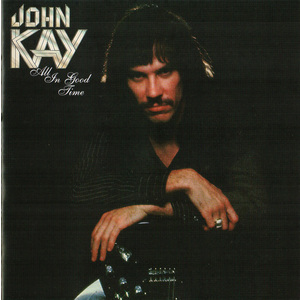
All in Good Time
Media
Videos
0 videos
No videos available for this title.
Credits
Musicians
John Kay: vocals, guitar, harmonica
Songwriting
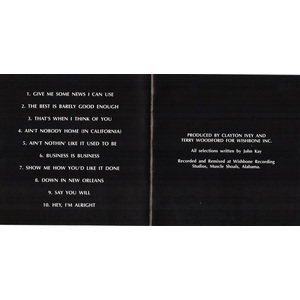
All selections written by John Kay
Production
Produced by Clayton Ivey and Terry Woodford for Wishbone Inc.
Recording
Recorded and remixed at Wishbone Recording Studios, Muscle Shoals, Alabama
Mastering
Mastered at Masterfonics
Manufacturing
Manufactured by Phonogram, Inc.
Distributed by Phonodisc, Inc.
Pressed by Columbia Records Pressing Plant, Santa Maria, California
Physical Release
Mercury
Santa Maria pressing
Side One and Side Two designations appear on the labels
Side A runout: 1S SRM-1-3715-CS-A5
Side B runout: 1S SRM-1-3715-CS-B5
‘Masterfonics’ stamped in both runouts
2004 CD Reissue
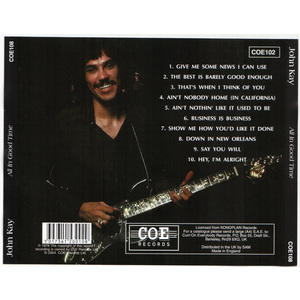
COE Records
Licensed from Konoplan Records
Distributed in the UK by SAM
Made in England
℗ 1978 The copyright of this sound recording is owned by LUV Records Ltd.
© 2004 COE Records Ltd.
Catalogue number COE102
Barcode: 5 017361 200108
No Comments