Artist / Band
Peter Appleyard
Biography
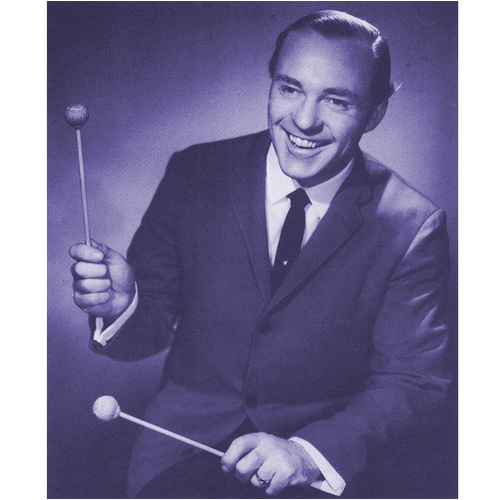
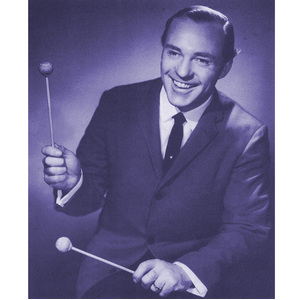
Peter Appleyard was one of Canada’s great jazz vibraphonists: a polished swing player, percussionist, bandleader, broadcaster, composer, and studio musician whose career stretched from British dance bands and Canadian radio studios to international tours with Benny Goodman. Known for his bright tone, rhythmic lift, showmanship, and command of the vibraphone, Appleyard became one of the most visible jazz instrumentalists in Canada while also maintaining a long career in television, radio, club performance, and recording.
Peter Appleyard was born in Cleethorpes, Lincolnshire, England, on August 26, 1928. He entered music as a drummer, beginning as a teenager in local dance bands and later playing in RAF bands. His early path followed the British big-band tradition, a demanding apprenticeship that gave him a strong rhythmic foundation before he ever became known for the vibraphone. After the Second World War, Appleyard moved to Bermuda in 1949, where he spent two years working in dance-band settings. In 1951 he settled in Toronto, a move that placed him inside one of Canada’s most active postwar jazz and broadcast communities.
By the mid-1950s Appleyard had become an established part of Toronto’s professional music world. He performed with Billy O’Connor, then worked from 1954 to 1956 with American pianist Calvin Jackson at the Park Plaza Hotel, also appearing with Jackson on CBC Radio. This period helped establish Appleyard as both a musician and personality: technically assured, rhythmically buoyant, and comfortable in front of an audience. In 1957 he formed his own group, which travelled widely in North America, appeared on American television, and accompanied singer Gloria DeHaven for a year.
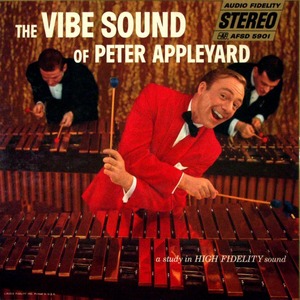
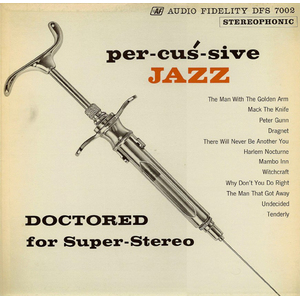
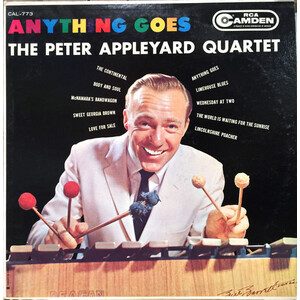
Appleyard’s early recordings helped introduce him as a featured Canadian vibraphonist. His RCA Victor album Anything Goes appeared in the late 1950s, followed by releases such as The Vibe Sound Of Peter Appleyard and Percussive Jazz on Audio Fidelity. These recordings placed him within the hi-fi and stereo demonstration era, where the vibraphone’s clarity, sustain, and percussive attack made it a natural feature instrument. Appleyard’s playing fit that world well: clean, swinging, melodic, and alert to texture.
Through the 1960s, Appleyard became a familiar presence in Canadian broadcasting. He co-hosted Patti and Peter with singer Patti Lewis for CBC Radio in 1961–1962, and in 1969 co-hosted CBC Television’s Mallets and Brass with trumpeter and flugelhornist Guido Basso. He was also active in Toronto nightclubs, hotel lounges, radio, television, commercial work, and studio orchestras. Like many of the strongest Canadian jazz musicians of his generation, he combined public performance with extensive studio work, moving easily between jazz, light instrumental music, popular song, and broadcast entertainment.
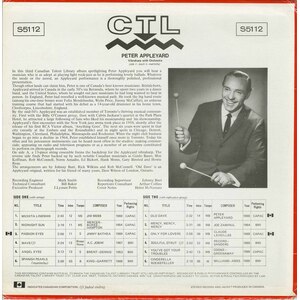
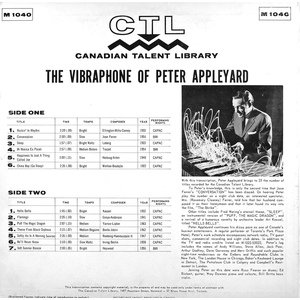
Appleyard’s relationship with the Canadian Talent Library became especially important in the 1960s and 1970s. The Vibraphone Of Peter Appleyard, issued by CTL in 1963, appears in multiple configurations, including the mono M 1040 edition featuring Appleyard with Russ Fearon, Ed Bickert, Wray Downes, and Bill Britto. The album mixed standards, light instrumental repertoire, Latin material, novelty pieces, and popular themes, showing the CTL’s role in documenting professional Canadian musicians who were otherwise often heard anonymously in broadcasts, lounges, and recording sessions.
By 1969’s Polished Appleyard, the CTL positioned him as a versatile light-jazz instrumentalist capable of handling ballads, pop material, and contemporary repertoire. That album placed Appleyard’s vibraharp and marimba against a 13-piece string ensemble on one side and a small group of major Canadian players on the other, including Guido Basso, Moe Koffman, Rob McConnell, Norm Amadio, Ed Bickert, Hank Monis, Gary Binsted, and Howie Reynar. The liner notes emphasized both his musicianship and showmanship, qualities that remained central to his public identity.
Appleyard came to wider international attention in the early 1970s as a member of Benny Goodman’s sextet. He toured Europe with Goodman in 1972 and 1974, Australia in 1973, and continued to work with him intermittently through the decade, including appearances at Carnegie Hall. The association was significant: Goodman’s circle carried a direct link to the swing era, and Appleyard’s style, rooted in players such as Lionel Hampton, Red Norvo, Milt Jackson, and Terry Gibbs, fit naturally into that lineage without becoming mere imitation.
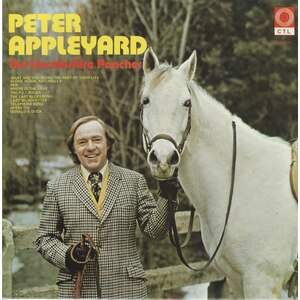
His 1973 Canadian Talent Library album The Lincolnshire Poacher connected Appleyard’s personal history to his Canadian career. The title track was an English folk song associated with Lincolnshire, the county of his birth, and Appleyard noted that many listeners knew it as one of his signature themes. The album also included his own ‘The P.E.I. Polka’ and ‘Donald S. Duck’, alongside contemporary popular material such as ‘Alone Again, Naturally’, ‘Ben’, ‘Where Is The Love’, and ‘What Are You Doing The Rest Of Your Life?’ Recorded at RCA, Toronto, with arrangements and conducting by Milan Kymlicka and Rick Wilkins, it reflected Appleyard’s ability to turn light instrumental repertoire into polished, personal performance.
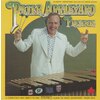
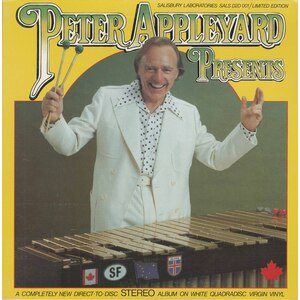
In 1977, Salisbury Laboratories Presents placed Appleyard at the centre of a direct-to-disc recording featuring a who’s who of Canadian jazz musicians. The album included Rick Wilkins, Dorothy White, Guido Basso, Arnie Chycoski, Rob McConnell, Moe Koffman, Eugene Amaro, Bernie Senensky, Jerry Fuller, Ed Bickert, Andy Krehm, Pete Magadini, Gary Gross, and David Young. Recorded at Phase One Studios in Scarborough, the project captured Appleyard in a high-end audiophile setting, with jazz-funk, orchestral colour, and direct-to-disc immediacy.
Appleyard also became a television host in his own right. From 1977 to 1980 he hosted Peter Appleyard Presents, a jazz and variety program produced in Toronto and syndicated in North America. The show reflected the same quality that defined much of his career: Appleyard could operate as both serious jazz musician and personable public communicator. He understood how to present jazz to wider audiences without flattening the music’s character.
In 1982 Appleyard formed the All Star Swing Band, capitalizing on the renewed affection for swing and big-band music. With arrangements often by Rick Wilkins, the group performed medleys of older popular songs and appeared in Toronto, New York, and at festivals in Canada and abroad. The project also demonstrated Appleyard’s gift for gathering strong players around a clear musical idea, a trait visible throughout his recording career.
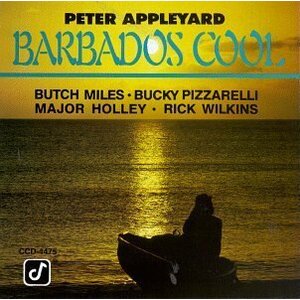
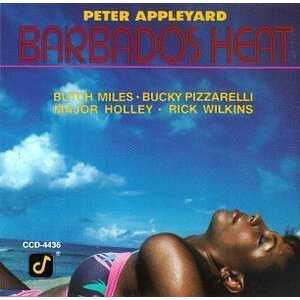
Appleyard continued recording into the 1990s and 2000s. His Concord albums Barbados Heat and Barbados Cool showed a later-career ease with relaxed, melodic, warm-weather jazz settings. He also appeared on projects such as Cookin’ On All Burners, Great Vibes with Strings, Day In The Sun, and The Lost Sessions, while continuing to perform at festivals and clubs in Canada, the United States, Europe, and Japan. His circle included many of the leading names in Canadian jazz and popular music, including Oscar Peterson, Diana Krall, Rob McConnell, Guido Basso, Moe Koffman, Anne Murray, and Hagood Hardy.
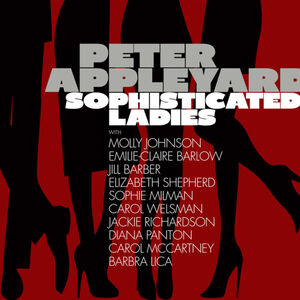
One of Appleyard’s final major recordings was Sophisticated Ladies, released in 2012. The album paired him with a remarkable group of Canadian female jazz vocalists: Emilie-Claire Barlow, Elizabeth Shepherd, Jill Barber, Jackie Richardson, Sophie Milman, Molly Johnson, Carol Welsman, Barbra Lica, Carol McCartney, and Diana Panton. With John Sherwood, Reg Schwager, Neil Swainson, Terry Clarke, and arrangements by Rick Wilkins, the album served as both a late-career statement and a generational bridge between Appleyard and younger Canadian jazz voices.
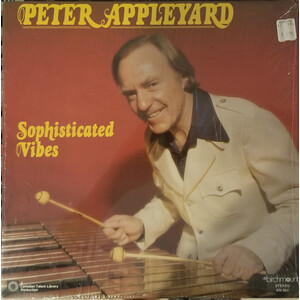
Appleyard’s playing was built on taste, touch, and swing. He could dazzle when required, but his strongest quality was often his ability to make the vibraphone sing without excess. Whether playing standards, ballads, novelty pieces, light jazz, swing, or studio arrangements, he brought clarity and elegance to the instrument. He was also a natural entertainer, able to connect with audiences through humour, warmth, and a polished stage presence developed over decades of club, hotel, radio, television, and festival work.
In 1992, Peter Appleyard was appointed an Officer of the Order of Canada, recognizing his international stature and his contribution to Canadian jazz. He died on July 17, 2013, in Eden Mills, Ontario, leaving behind a long discography and a career that connected British dance-band tradition, Canadian broadcasting, Toronto studio culture, swing revival, and international jazz performance.
-Robert Williston
Tracks
104 tracks
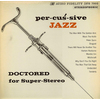
Per-cus-sive Jazz (1957)
Showing 10 of 12 tracks
-
The Man With The Golden Arm
-
The Man That Got Away
-
Dragnet
-
Witchcraft
-
Harlem Nocturne
-
There Will Never Be Another You
-
Peter Gunn
-
Mack The Knife
-
Why Don't You Do Right
-
Tenderly
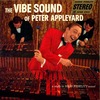
The Vibe Sound Of (1959)
Showing 10 of 12 tracks
-
Strike Up the Band
-
Avalon
-
Just In Time
-
Satin Doll
-
Liza
-
The Blue Room
-
Get Happy
-
Moon Glow
-
Fascinating Rhythm
-
Don't Get Around Much Anymore
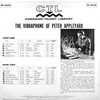
The Vibraphone Of (1963)
Showing 10 of 13 tracks
-
Rockin' in Rhythm
-
Conversation
-
Sleep
-
Mi Musica es Parati
-
Happiness is a Thing Called Joe
-
China Boy (To Sleep)
-
Hells Bells
-
Flamingo
-
Puff the Magic Dragon
-
Theme from Black Orpheus
Vibraphone of Peter Appleyard (1963)
Showing 10 of 12 tracks
-
Bye Bye Blues
-
Moon Of Manakoora
-
Hindustan
-
Early Autumn
-
South Sea Medley - Aloha Beloved - By The Lazy Lagoon
-
Avalon
-
Caravan
-
Never On Sunday
-
Denise
-
Yellow Bird
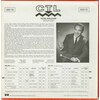
The Many Moods Of (AKA Polished Appleyard) (1969)
Showing 10 of 12 tracks
-
Wichita Lineman
-
Midnight Sun
-
Passion Eyes
-
Wave
-
Angel Eyes
-
Spanish Pearls
-
Old Dave
-
Mercy, Mercy, Mercy
-
Only For Lovers
-
Soulful Strut
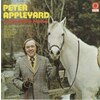
The Lincolnshire Poacher (1973)
Showing 10 of 11 tracks
-
The Linconshire Poacher
-
Alone Again, Naturally
-
Ben
-
Where is the Love
-
What Are You Doing the Rest of Your Life?
-
The P.E.I. Polka
-
The Last Blues Song
-
Lazy Silhouettes
-
Telephone Song
-
Apres Toi
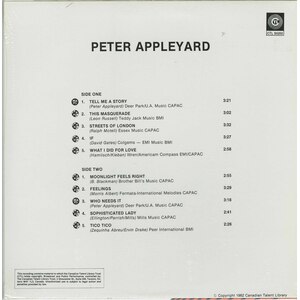
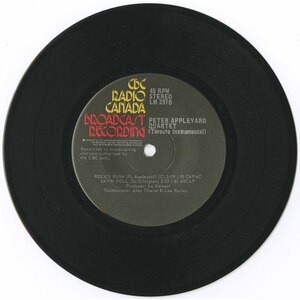
Toronto Instrumental (1974)
4 tracks
-
Conversation
-
Yesterday & Tomorrow
-
Rock's Push
-
Satin Doll
-
Tell Me A Story
-
This Masquerade
-
Streets of London
-
If
-
What I Did For Love
-
Moonlight Feels Right
-
Feelings
-
Who Needs It
-
Sophisticated Lady
-
Tico Tico
Peter Appleyard Presents (1977)
8 tracks
-
Open the Gates of Love
-
A Face Like Yours
-
You Put the Shine on Me
-
Pavanne pour une infante défunte
-
Mambo #V
-
Swinging Shepherd Blues
-
Who Needs It
-
Night Journey
Sophisticated Ladies (2012)
10 tracks
-
After You've Gone (feat Emilie-Claire Barlow)
-
It's Only a Paper Moon (feat Elizabeth Shepherd)
-
Love for Sale (feat Jill Barber)
-
Georgia On My Mind (feat Jackie Richardson)
-
If You Could See Me Now (feat Sophie Milman)
-
Sophisticated Lady (feat Molly Johnson)
-
Night and Day (feat Carol Welsman)
-
Satin Doll (feat Barbra Lica)
-
Mood Indigo (feat Carol McCartney)
-
Smile (feat Diana Panton)
Discography
Featured Titles

Albums
Singles
Compilation Tracks
Gallery
Images
1 image
Appleyard, Peter
Media
Videos
0 videos
No videos available for this artist.