Album / Title
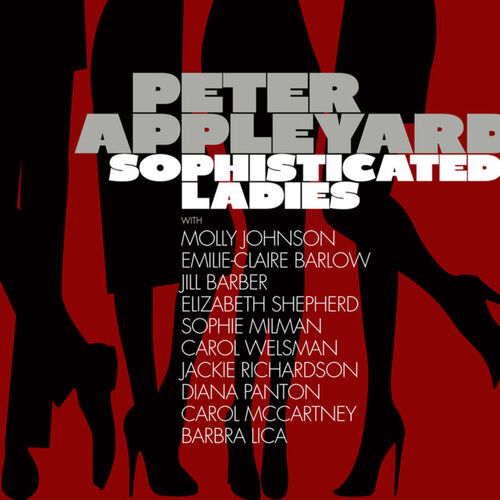
Sophisticated Ladies
By: Peter Appleyard
Origin: Cleethorpes, England, UK → Toronto, Ontario, 🇨🇦
Insight
Peter Appleyard was one of Canada’s great jazz vibraphonists: a polished swing player, percussionist, bandleader, broadcaster, composer, and studio musician whose career stretched from British dance bands and Canadian radio studios to international tours with Benny Goodman. Known for his bright tone, rhythmic lift, showmanship, and command of the vibraphone, Appleyard became one of the most visible jazz instrumentalists in Canada while also maintaining a long career in television, radio, club performance, and recording.
Peter Appleyard was born in Cleethorpes, Lincolnshire, England, on August 26, 1928. He entered music as a drummer, beginning as a teenager in local dance bands and later playing in RAF bands. His early path followed the British big-band tradition, a demanding apprenticeship that gave him a strong rhythmic foundation before he ever became known for the vibraphone. After the Second World War, Appleyard moved to Bermuda in 1949, where he spent two years working in dance-band settings. In 1951 he settled in Toronto, a move that placed him inside one of Canada’s most active postwar jazz and broadcast communities.
By the mid-1950s Appleyard had become an established part of Toronto’s professional music world. He performed with Billy O’Connor, then worked from 1954 to 1956 with American pianist Calvin Jackson at the Park Plaza Hotel, also appearing with Jackson on CBC Radio. This period helped establish Appleyard as both a musician and personality: technically assured, rhythmically buoyant, and comfortable in front of an audience. In 1957 he formed his own group, which travelled widely in North America, appeared on American television, and accompanied singer Gloria DeHaven for a year.
Appleyard’s early recordings helped introduce him as a featured Canadian vibraphonist. His RCA Victor album Anything Goes appeared in the late 1950s, followed by releases such as The Vibe Sound Of Peter Appleyard and Percussive Jazz on Audio Fidelity. These recordings placed him within the hi-fi and stereo demonstration era, where the vibraphone’s clarity, sustain, and percussive attack made it a natural feature instrument. Appleyard’s playing fit that world well: clean, swinging, melodic, and alert to texture.
Through the 1960s, Appleyard became a familiar presence in Canadian broadcasting. He co-hosted Patti and Peter with singer Patti Lewis for CBC Radio in 1961–1962, and in 1969 co-hosted CBC Television’s Mallets and Brass with trumpeter and flugelhornist Guido Basso. He was also active in Toronto nightclubs, hotel lounges, radio, television, commercial work, and studio orchestras. Like many of the strongest Canadian jazz musicians of his generation, he combined public performance with extensive studio work, moving easily between jazz, light instrumental music, popular song, and broadcast entertainment.
Appleyard’s relationship with the Canadian Talent Library became especially important in the 1960s and 1970s. His 1963 album The Vibraphone Of Peter Appleyard featured Appleyard on vibraphone with Ed Bickert, Bill Britto, Russ Fearon, Johnny Niosi, Richard Smith, Len Moss, and Rudy Toth. It mixed standards and light instrumental repertoire with Canadian studio-jazz personnel, showing the CTL’s role in documenting professional Canadian musicians who were otherwise often heard anonymously in broadcasts, lounges, and recording sessions.
By 1969’s Polished Appleyard, the CTL positioned him as a versatile light-jazz instrumentalist capable of handling ballads, pop material, and contemporary repertoire. That album placed Appleyard’s vibraharp and marimba against a 13-piece string ensemble on one side and a small group of major Canadian players on the other, including Guido Basso, Moe Koffman, Rob McConnell, Norm Amadio, Ed Bickert, Hank Monis, Gary Binsted, and Howie Reynar. The liner notes emphasized both his musicianship and showmanship, qualities that remained central to his public identity.
Appleyard came to wider international attention in the early 1970s as a member of Benny Goodman’s sextet. He toured Europe with Goodman in 1972 and 1974, Australia in 1973, and continued to work with him intermittently through the decade, including appearances at Carnegie Hall. The association was significant: Goodman’s circle carried a direct link to the swing era, and Appleyard’s style, rooted in players such as Lionel Hampton, Red Norvo, Milt Jackson, and Terry Gibbs, fit naturally into that lineage without becoming mere imitation.
His 1973 Canadian Talent Library album The Lincolnshire Poacher connected Appleyard’s personal history to his Canadian career. The title track was an English folk song associated with Lincolnshire, the county of his birth, and Appleyard noted that many listeners knew it as one of his signature themes. The album also included his own ‘The P.E.I. Polka’ and ‘Donald S. Duck’, alongside contemporary popular material such as ‘Alone Again, Naturally’, ‘Ben’, ‘Where Is The Love’, and ‘What Are You Doing The Rest Of Your Life?’ Recorded at RCA, Toronto, with arrangements and conducting by Milan Kymlicka and Rick Wilkins, it reflected Appleyard’s ability to turn light instrumental repertoire into polished, personal performance.
In 1977, Salisbury Laboratories Presents placed Appleyard at the centre of a direct-to-disc recording featuring a who’s who of Canadian jazz musicians. The album included Rick Wilkins, Dorothy White, Guido Basso, Arnie Chycoski, Rob McConnell, Moe Koffman, Eugene Amaro, Bernie Senensky, Jerry Fuller, Ed Bickert, Andy Krehm, Pete Magadini, Gary Gross, and David Young. Recorded at Phase One Studios in Scarborough, the project captured Appleyard in a high-end audiophile setting, with jazz-funk, orchestral colour, and direct-to-disc immediacy.
Appleyard also became a television host in his own right. From 1977 to 1980 he hosted Peter Appleyard Presents, a jazz and variety program produced in Toronto and syndicated in North America. The show reflected the same quality that defined much of his career: Appleyard could operate as both serious jazz musician and personable public communicator. He understood how to present jazz to wider audiences without flattening the music’s character.
In 1982 Appleyard formed the All Star Swing Band, capitalizing on the renewed affection for swing and big-band music. With arrangements often by Rick Wilkins, the group performed medleys of older popular songs and appeared in Toronto, New York, and at festivals in Canada and abroad. The project also demonstrated Appleyard’s gift for gathering strong players around a clear musical idea, a trait visible throughout his recording career.
Appleyard continued recording into the 1990s and 2000s. His Concord albums Barbados Heat and Barbados Cool showed a later-career ease with relaxed, melodic, warm-weather jazz settings. He also appeared on projects such as Cookin’ On All Burners, Great Vibes with Strings, Day In The Sun, and The Lost Sessions, while continuing to perform at festivals and clubs in Canada, the United States, Europe, and Japan. His circle included many of the leading names in Canadian jazz and popular music, including Oscar Peterson, Diana Krall, Rob McConnell, Guido Basso, Moe Koffman, Anne Murray, and Hagood Hardy.
One of Appleyard’s final major recordings was Sophisticated Ladies, released in 2012. The album paired him with a remarkable group of Canadian female jazz vocalists: Emilie-Claire Barlow, Elizabeth Shepherd, Jill Barber, Jackie Richardson, Sophie Milman, Molly Johnson, Carol Welsman, Barbra Lica, Carol McCartney, and Diana Panton. With John Sherwood, Reg Schwager, Neil Swainson, Terry Clarke, and arrangements by Rick Wilkins, the album served as both a late-career statement and a generational bridge between Appleyard and younger Canadian jazz voices.
Appleyard’s playing was built on taste, touch, and swing. He could dazzle when required, but his strongest quality was often his ability to make the vibraphone sing without excess. Whether playing standards, ballads, novelty pieces, light jazz, swing, or studio arrangements, he brought clarity and elegance to the instrument. He was also a natural entertainer, able to connect with audiences through humour, warmth, and a polished stage presence developed over decades of club, hotel, radio, television, and festival work.
In 1992, Peter Appleyard was appointed an Officer of the Order of Canada, recognizing his international stature and his contribution to Canadian jazz. He died on July 17, 2013, in Eden Mills, Ontario, leaving behind a long discography and a career that connected British dance-band tradition, Canadian broadcasting, Toronto studio culture, swing revival, and international jazz performance.
-Robert Williston
Vibraphonist Peter Appleyard's Sophisticated Ladies is a feature for ten Canadian female vocalists, many of whom aren't widely known outside of their homeland. The rhythm section includes pianist John Sherwood and guitarist Reg Schwager, plus two veterans who add spark to any date, bassist Neil Swainson (who long worked with George Shearing) and drummer Terry Clarke (who has worked with countless greats). There are no liner notes to give background on the vocalists, each of whom is featured on an individual standard or pop song of yesteryear, arranged by Rich Wilkins. As a result, there isn't a lot of risk-taking and the music tends toward the predictable, though Jill Barber's seductive vocal in the funky treatment of "Love for Sale" breaks the mold. The up-and-coming vocalist Sophie Milman has gotten quite a publicity push with her first three CDs; she tackles Tadd Dameron's longing ballad "If You Could See Me Now," occasionally getting overdramatic but capturing the song's essence. Carol Welsman's playfulness comes out in the breezy samba treatment of "Night and Day," accompanying herself on piano in Sherwood's place. Barbra Lica is assigned the unenviable task of tackling "Satin Doll" and does a respectable job, though Molly Johnson's raspy treatment of "Sophisticated Lady" is unremarkable. If Peter Appleyard's goal was to simply give greater exposure to these Canadian vocalists, he has succeeded, though it could have been improved with a more diverse selection of material.
Gallery
Images
1 image
Sophisticated Ladies
Media
Videos
0 videos
No videos available for this title.
Credits
Musicians
Peter Appleyard: vibraphone
Emilie-Claire Barlow: vocals on ‘After You've Gone’
Elizabeth Shepherd: vocals on ‘It's Only A Paper Moon’
Jill Barber: vocals on ‘Love For Sale’
Jackie Richardson: vocals on ‘Georgia On My Mind’
Sophie Milman: vocals on ‘If You Could See Me Now’
Molly Johnson: vocals on ‘Sophisticated Lady’
Carol Welsman: vocals and piano on ‘Night And Day’
Barbra Lica: vocals on ‘Satin Doll’
Carol McCartney: vocals on ‘Mood Indigo’
Diana Panton: vocals on ‘Smile’
John Sherwood: piano on ‘After You've Gone’, ‘It's Only A Paper Moon’, ‘Love For Sale’, ‘Georgia On My Mind’, ‘If You Could See Me Now’, ‘Sophisticated Lady’, ‘Satin Doll’, ‘Mood Indigo’, and ‘Smile’
Reg Schwager: guitar
Neil Swainson: double bass
Terry Clarke: drums
Songwriting
‘After You've Gone’ written by Henry Creamer and Turner Layton
‘It's Only A Paper Moon’ written by Billy Rose, Edgar Yip Harburg, and Harold Arlen
‘Love For Sale’ written by Cole Porter
‘Georgia On My Mind’ written by Hoagy Carmichael and Stuart Gorrell
‘If You Could See Me Now’ written by Carl Sigman and Tadd Dameron
‘Sophisticated Lady’ written by Duke Ellington, Irving Mills, and Mitchell Parish
‘Night And Day’ written by Cole Porter
‘Satin Doll’ written by Billy Strayhorn, Duke Ellington, and Johnny Mercer
‘Mood Indigo’ written by Barney Bigard, Duke Ellington, and Irving Mills
‘Smile’ written by Charlie Chaplin, Geoffrey Claremont Parsons, and John Turner
Production
Produced and mixed by Anthony Montano
Executive produced by Brad Barker and Geoff Kulawick
Associate produced by Michael Nunan
Assistant produced by Sarah Summers
Arranged and conducted by Rick Wilkins
Arranged by Elizabeth Shepherd and Rick Wilkins on ‘It's Only A Paper Moon’
Recording tracking engineered by Ron Skinner
Recording DAW engineered by Chris Berry
DAW and systems engineered by Doug Smith
Additional recording by Chad Irschick, Steve Dawson, and Will Shaw
Recorded at CBC Studio 211
Mixed at Lawo North America Studios
Artwork
Design by Antoine Moonen
Photography by Ian Mazoff
Publishing
℗ & © Linus Entertainment Inc.
Notes
Linus Entertainment 270151
LAWO Montano Recordings 270151
Made in Canada
No Comments