
Insight
The Crew-Cuts were one of the most commercially successful and culturally emblematic vocal groups to emerge from Canada during the first wave of postwar popular music. Formed in Toronto in the early 1950s, the quartet—Pat Barrett, Rudi Maugeri, Johnnie Perkins, and Jay Perkins—combined collegiate polish, tight harmony singing, and a keen instinct for contemporary pop trends, allowing them to cross national borders at a time when few Canadian acts could do so consistently.
Their rise coincided with a pivotal moment in North American music history, when traditional pop, novelty songs, and early rhythm-and-blues influences were beginning to merge into a new youth-driven marketplace. The Crew-Cuts positioned themselves squarely at that intersection. Clean-cut in appearance yet rhythmically alert, they adapted material from Broadway, Tin Pan Alley, jazz, and early R&B into accessible, radio-ready performances that appealed to both teenage listeners and adult audiences.
Signed to RCA Victor, the group quickly became a fixture on charts in both Canada and the United States. Their recordings were marked by buoyant tempos, precise vocal blend, and an unforced sense of swing—qualities that made songs such as “Sh-Boom,” “I’ve Got a Crush on You,” “Ain’t She Sweet,” and “You Must Have Been a Beautiful Baby” enduring staples of mid-1950s pop culture. Unlike many contemporaries, the Crew-Cuts sustained momentum across multiple releases, establishing themselves not as a novelty act but as reliable interpreters of the era’s evolving songbook.
Beyond record sales, the Crew-Cuts were central to the sound of early television and radio variety programming. Their music captured a moment when vocal groups functioned as cultural translators—bridging jazz, pre-rock pop, and emerging youth sensibilities—while maintaining a distinctly professional, pan-North-American appeal. Though their success unfolded largely within the U.S. market, their roots and identity remained firmly Canadian, making them one of the earliest examples of a Canadian vocal group achieving sustained international visibility.
Today, the Crew-Cuts are remembered not only for their chart hits but for their role in establishing a pathway for Canadian artists in the pre-CanCon era. Their recordings document a formative chapter in Canada’s recorded-music history, when ambition, adaptability, and vocal craftsmanship allowed a Toronto quartet to leave a lasting imprint on the sound of 1950s popular music.
-Robert Williston
Liner notes
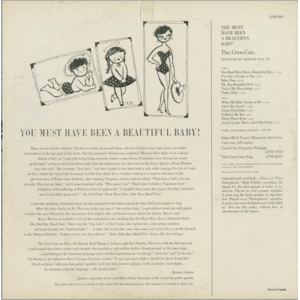
YOU MUST HAVE BEEN A BEAUTIFUL BABY!
There are two kinds of babies. The first is small, plump and damp; the second kind wears high heels, low lashes and walks as if she has sand in her shoes. The Encyclopedia Americana, subtitled “How to Tell a Baby from a Book,” defines a baby as “a gal with boing-boing eyes who makes a man feel as if someone were driving hot rivets up his spine” and goes on to note historically that the endearment was first used in the Stone Age by a Rock Hudson type who said, “Me, caveman. You, baby,” and then bashed her head with a club while singing I’ve Got a Crush on You (which the Crew-Cuts documented on Side One, Band Two). Further reference is made to the term in the glorious days of Rome when Anthony, after stealing Cleopatra, said to jealous Julius, “That was my baby,” and Caesar retaliated with, “Who asped you?” Much later in history Napoleon wrote Josephine while suffering at Waterloo from an apple-ache, “I shouldn’t have eaten the pippins that reminded me of your baby-green eyes.” (Re-Crew-Cuts Them There Eyes, Side Two, Band Five.)
Culturally speaking, American music became populated with babies about the time Ted Lewis began to sing When My Baby Smiles at Me. This was in the jazz age of “the red hot baby,” a gal without mink but with plenty of slink. She followed by the depression doll, slightly thin and hollow-eyed, which led Johnny Mercer and Harry Warren to tactfully overlook her malnutrition by recalling You Must Have Been a Beautiful Baby. (Re Side One, Band One.) There was the “bop baby” of the Forties who backed into a threshing machine, and most recently the “beatnik baby”—a man, like it’s kookie, man, blue stars over zorchville, or as the cat said to the Statue of Liberty, “Infant, you’re very big with me.” (Ibid., Side One, Band Five—You’re My Everything.)
The Crew-Cuts are four: Pat Barrett, Rudi Maugeri, Johnnie and Jay Perkins. The boys with the flat tops and round sounds have been rockin’ and swingin’ the population with million-dollar vibrations and, at the same time, contributing to the American language such colorful expressions as “oo-shoopy,” “uh-boom” and “ko mo.” Pat Barrett, in his definitive thesis Goo-goo Eee-scoo, writes, “To me a goo-goo (baby) should be about doozie-dee (five-foot-three) with eyes that splish (sparkle) and hair that swizzles (glows) in the shadwah (moonlight). In common, everyday language—she should splat.”
MARTIN COHEN
Author, magazine writer and Baby Editor Emeritus of the zorchville police gazette
Musicians
Pat Barrett: vocals
Rudi Maugeri: vocals
Johnnie Perkins: vocals
Jay Perkins: vocals
Production
Produced by Herman Diaz, Jr.
Engineered by Bob Simpson
Conducted by Morty Jay
Recorded at RCA Victor Studio A, New York City
Artwork
Cover dolls courtesy of Elizabeth Dollis, Hospital Equipment, Inc., New York
Notes
IMPORTANT NOTICE — This is a New Orthophonic High Fidelity recording, designed for the phonograph of today or tomorrow. Played on a conventional phonograph, it gives you the finest quality of reproduction. Played on a “Stereophonic” machine, it gives even more brilliant true-life fidelity. You can buy today, without fear of obsolescence in the future.
Printed in Canada
LPM-2067
Gallery
Images
2 images
Crew Cuts - You Must Have Been a Beautiful Baby BACK2
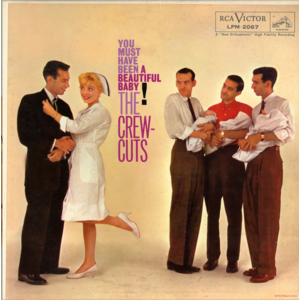
You Must Have Been a Beautiful Baby
Media
Videos
0 videos
No videos available for this title.
Credits
In Transit
No Comments