Insight
Cool Blue Halo began in Halifax in September 1991 with singer-songwriters Barry Walsh and Paul Boudreau. The two had gone from busking together to writing songs, arriving just as the city's independent scene was beginning to attract attention far outside Nova Scotia. Walsh already had some history behind him. In 1985 he had played guitar in The October Game, whose original singer was a young Sarah McLachlan. By the time Cool Blue Halo started, he and Boudreau were entering a scene crowded with new bands, cheap recordings, all-ages shows and clubs where everybody seemed to know everybody else.
The first years were restless, and almost everything the band recorded in that period went onto somebody else's compilation. Halifax in 1992 was documenting itself at speed, and Cool Blue Halo turned up on three separate collections in a single year.
The first was Hear & Now '92: The Best Of The East Coast's Independent Bands, put out by DTK Records as KILCD 010. Cool Blue Halo opened the disc with "Sheila Comes Around," recorded at SoundMarket, one track ahead of Sloan's "Underwhelmed." Spike N, Thrush Hermit, Mod'rn World Thang, Weasel Faced Judge and fifteen others followed. Leading off a regional survey of the East Coast underground, in front of the song that was about to take Sloan to Geffen, is a good measure of where the band stood locally at the time.
The second came from the same label a catalogue number later. Over four nights at the end of June and the beginning of July 1992, DTK recorded the Halifax Independent Music Festival live at the Double Deuce Roadhouse and released twenty-one of the performances as Cod Can't Hear. The running order reads now like a map of everything that was about to happen. Thrush Hermit sat at track three, Spike N at four, Cool Blue Halo at ten with Walsh's "Some Other World," Sloan at twelve and Jale at twenty-one. The Cool Blue Halo lineup that night had Walsh on vocals and lead guitar, Boudreau on vocals and guitar, Tom Carroll on bass and Dave Brennan on drums.
The third took them out of the region entirely. Intrepid Records assembled Indie-Can '92, a two-disc promotional sampler of thirty-nine Canadian bands compiled by Andy McLean and circulated to the industry for licensing and publishing. Cool Blue Halo appear near the end of the second disc with "History Lesson," four minutes and sixteen seconds, credited to Walsh and Boudreau. Billboard later singled out the Halifax compilations and the Double Deuce all-ages shows as part of the surge that put the city on the industry's radar, and this is what that surge looked like from the inside: a band barely a year old, with no record of its own yet, sitting on a national sampler that A&R departments were being handed for free.
Two of those three tracks are the only place those songs exist. "Sheila Comes Around" and "History Lesson" were never re-recorded, never carried onto a cassette, a single or the album, and never reissued. They survive on compilations and nowhere else.
The rhythm section kept moving. By the time the band went into SoundMarket Studios with Terry Pulliam to make their first cassette, Melanie Rusinak was playing bass and singing and Cliff Gibb was on drums, while two of the five songs still carried Carroll and Brennan from the older lineup. The self-titled tape came out in 1993 with no label behind it, five songs across two sides: "Go And Get It," "Come With Me If You Wanna Live" and "3 A.M." on the A side, "Supercindy" and "Some Other World" on the B. The insert carried a Gottingen Street address, a phone and fax number and a contact at Hal Harbour, which was about as much apparatus as a Halifax band needed in 1993.
That cassette is the first place several things in the Cool Blue Halo story appear at full length. "Some Other World" moves off the live compilation and into a studio version. "3 A.M." arrives three years before it turns up on the album as "3am," which is why Tom Carroll still holds a writing credit on a 1996 record he had left long before it was made. And the tape itself became the thing people were chasing. A March 1993 Dalhousie Gazette interview dates the band's formation precisely to September 1991 and reports that the new five-song cassette was already becoming difficult to find. The writer heard guitar-driven melodic pop with enough weight behind it to sit comfortably beside the Pixies and the Breeders. The band was receiving record-company interest, although Boudreau was careful to say that no deal existed. Sloan's success had changed the atmosphere around Halifax, and Cool Blue Halo knew labels were suddenly looking east.
That version of the group did not last. Rusinak left and went on to Chaz Rules. With Boudreau on guitar, Walsh moving to bass and Gibb still on drums, they recorded "52 Pickup" with Pulliam at SoundMarket, one of the small rooms where much of early-1990s Halifax independent music was being made. Gibb then left amicably to join Thrush Hermit. After several years of personnel changes, Boudreau and Walsh put Cool Blue Halo on hold.
The song that brought the band back began while there was barely a band to bring back.
Walsh was working as a DJ at the Double Deuce and Club Flamingo and spending his nights absorbing records by My Bloody Valentine, Swervedriver, Radiohead, Suede and the other groups stretching guitar music into stranger shapes. After work one night he wrote "Sweetie Said" on bass at around three in the morning. He booked time with Pulliam and treated the session almost as an experiment. They borrowed a drum loop, ran guitars and bass through boxes of old effects and built something much more atmospheric than the Cool Blue Halo that had been playing Halifax clubs. Walsh later described the recording as a necessary therapy session that he had not expected to release.
Other musicians passing through SoundMarket heard it and began asking about it. Pulliam offered to put "Sweetie Said" out with "52 Pickup" through his Release Records imprint. The 7-inch appeared in 1994 on blue vinyl under the title Goes Like This, with "52 Pickup" running three minutes and four seconds on one side and "Sweetie Said" four minutes and twenty-one seconds on the other. Walsh, Gibb and Boudreau are the players credited, the production is shared between Pulliam and the band, the sleeve was designed by Nodesign and Todd Hawkins, and United Record Pressing stamped U-38984-M into the run-out. Whoever laid out the back of the sleeve labelled the first side "Side one" and the second side "Side a," which is the kind of small permanent error that only ever happens on records made quickly by people with other jobs. No Records eventually picked the single up for distribution and gave it a catalogue number of its own, NOVN10. That was the first thread between Cool Blue Halo and Waye Mason's label, two years before the album.
Then Walsh's friend James Parker, studying film in Toronto, asked to turn "Sweetie Said" into a school project with Shannon Duhasky. Their video was shown on a loop at an art opening and somehow found its way to MuchMusic. Sook-Yin Lee became an early supporter and played it repeatedly.
The little film travelled farther than the band had. In 1995 Walsh received a call at home from a PolyGram A&R representative in Toronto who had seen the video and wanted to know more about the mystery group from Halifax. Nothing came of the call, but the attention confirmed there was still life in the name. Contemporary RPM coverage places "Sweetie Said" in three categories at the 1996 MuchMusic Video Awards: Alternative Video, Independent Video and Concept Video.
Walsh and Boudreau decided to rebuild. Walsh had been watching other musicians around the Double Deuce and chose two of them. Jason Ives came from Spike N, the same band that had appeared four slots above Cool Blue Halo on Cod Can't Hear. Glenn MacCulloch came from the Booming Airplanes. Walsh met each of them at Halifax's Trident Café and asked them to join. By 1995 the four-piece lineup of Walsh, Boudreau, Ives and MacCulloch had settled into place.
They got to work almost immediately, and the first evidence is a cassette that most accounts of the band skip over. Just For You came out in 1995 on No Records with six songs: "Agenda," "Laundry" and "Sweetie Said" on the A side, "Katie Be Careful," "Closer" and "Helpless" on the B. It was recorded and mixed at SoundMarket by Terry Pulliam and Laurence Currie together, which makes it the handover point between the engineer who had carried the band through its first four years and the producer who would shape the album. It may have been nothing more than a promo tape for CKDU, and it may have had a small retail run. Either way it captures the Kangaroo lineup a year early, working through material that was still finding its final form. Three of its six songs went on to the album. "Agenda," "Closer" and "Helpless" stayed on the tape and have never appeared anywhere else. No Records was still a cassette label at that point, releasing Hip Club Groove, Essen, Donner Party Reunion and Stinkin' Rich before it moved to CDs in 1996, so Just For You sits at the end of one era of the label and points directly at the next.
The timing was almost absurdly good. Halifax had become the place Canadian and American record people were flying in to investigate. The Double Deuce, Club Flamingo and Birdland had created a small circuit capable of producing bands quickly, and Sloan's Geffen deal had shown that a Halifax group could escape it. Cool Blue Halo had been around long enough to remember the scene before the rush, and now they had their strongest lineup just as the attention peaked.
They went into Idea Of East Recording with Currie producing and engineering. Currie was working in the same studio period on Sloan's One Chord to Another. Cool Blue Halo and Currie produced Kangaroo together and mixed it together, building the record around three singers and a lineup loose enough to switch instruments when a song required it. Walsh handled vocals and lead guitar, Boudreau moved among vocals, guitar, bass and piano, Ives sang and played bass and guitar, and MacCulloch supplied drums, percussion and the album's wonderfully specific credit for air guitar.
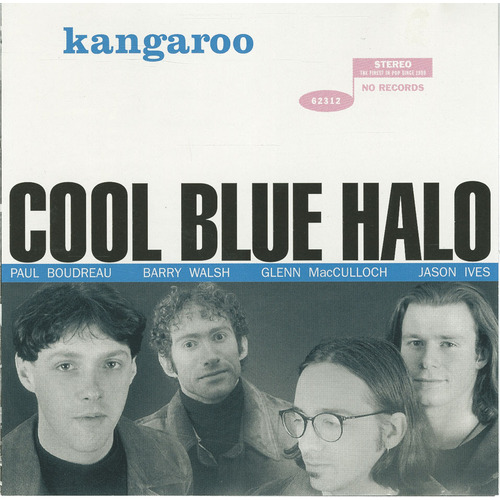
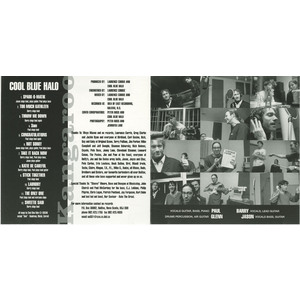
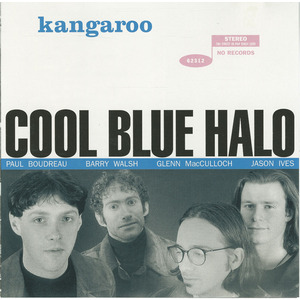
Kangaroo appeared in June 1996 as NOCD12, one of the first CDs issued by No Records, manufactured by Amtech and distributed by Ozone. The twelve songs move freely through power pop, fuzzier alternative rock, early-1960s pop instincts and the occasional dreamier detour. Eleven of them are credited to the band as a whole, with "3am" the exception, still carrying Carroll's name from the 1992 lineup. The lead vocal moves around constantly. Ives sings "Spark-o-matik" and "Not Sorry," Boudreau takes "3am," "Congratulations," "Stick Together" and "The Only One," and Walsh sings "Too Much Kathleen," "Throw Me Down," "Take It Back Now," "Katie Be Careful," "Laundry" and "Sweetie Said." Boudreau plays the lead guitar on "Katie Be Careful" rather than Walsh, and the whole band is credited for handclaps on "The Only One." The variety came naturally from having three people capable of fronting a song, while the group harmonies kept the record sounding like one band rather than three writers sharing a disc. The cover and graphics were built by the band with Peter Ross and Todd Hawkins, who had laid out the single sleeve two years earlier, and the photography came from Ross and Jenny Lane.
AllMusic gave it four stars, heard Sugar, the Doughboys and the Jesus and Mary Chain in the guitars and called it one of the most refreshing power-pop records to appear in several years. The University of Western Ontario's Gazette called it one of the greatest pop albums to come out of Canada in a long time. It reached the top twenty on Canadian campus radio and sold somewhere around 2,500 copies.
"Too Much Kathleen" became the song most closely associated with the album. Walsh later remembered writing it after developing a crush on a woman working at a Halifax café, putting the melody and chords down over coffee and taking the song to the band that week. It received substantial local radio play, including heavy rotation on Q104, and the video reached MuchMusic. By September 1997 a Dalhousie Gazette writer could simply refer to it as the band's most popular song.
The song carried the band onto other people's records again. "Too Much Kathleen" went onto Impact Music Vol. 12 in 1996 and onto the Popcan Canadian pop collection in 1997, moving Kangaroo out through the compilation and radio-service channels that were how a small label reached programmers across the country.
Cool Blue Halo spent 1996 and 1997 working well beyond the one-album discography. They remained fixtures at Birdland and other Halifax rooms, travelled west to Vancouver for a June 1997 Starfish Room show with Treble Charger and Transistor Sound & Lighting Co., opened for Big Sugar at Dalhousie, and appeared at the 1997 Halifax On Music Festival on a bill that included Ron Sexsmith and the Deadly Snakes. A Gazette review of an Oasis show that September described a quiet room gradually being pulled to its feet as the band played two sets of almost entirely original material.
The recognition kept coming after Kangaroo. "Too Much Kathleen" was nominated for Video of the Year at the 1998 East Coast Music Awards. The other nominees included Sloan's "Everything You've Done Wrong" and Sarah McLachlan's "Building a Mystery," an unusual piece of Halifax history considering Walsh had played beside McLachlan in The October Game more than a decade earlier.
There was no second album. Cool Blue Halo dissolved in 1998, the same year No Records looked back at itself and issued It's Been About Five Years, Hasn't It?, a label retrospective catalogued as NORE18. Cool Blue Halo sit at track eight with "Take It Back Now," produced and engineered by Laurence Currie and mastered by Marc Wilder. Their first compilation appearance had opened a survey of an East Coast scene that had not happened yet. Their last closed the account of the label that scene produced. No Records itself wound down its operations over the following years before closing in 2004.
The short catalogue understates how long the group had actually been working. Seven years had passed since the first Boudreau-Walsh version, taking in several rhythm sections, two cassettes, a blue vinyl single, six compilation appearances across seven years, a studio experiment that accidentally became a MuchMusic video, and hundreds of nights spent in the clubs that defined the Halifax period.
The songs did not disappear with the band. In 2012 Cool Blue Halo reunited for the twentieth anniversary Halifax Pop Explosion, sharing a bill with The Super Friendz, Hip Club Groove and the Stratejackets. They played Kangaroo from beginning to end at the Marquee, returning to the same Gottingen Street neighbourhood where much of the original scene had happened.
Kangaroo received another life in October 2017, when Toronto's DWRecordings reissued it on CD, digital and, for the first time in the album's life, vinyl. João Carvalho remastered it at his Toronto studio that June. The package was rebuilt around previously unpublished photographs by Katherine Pittman, with art direction by Barry Walsh and AutomanicArts and reissue layout by Kayla Johnson. The LP came out as DWRLP117, plated by GZ Media, pressed by Precision Record Pressing, given a printed inner sleeve and a new cover, and limited to three hundred copies worldwide. The CD and digital editions also carried the original 1994 "Sweetie Said" from the Release Records single, which until then had existed only on the blue seven-inch. The strange late-night studio experiment that restarted the band could at last be heard beside the album it helped create.
Another reunion followed at the Halifax Urban Folk Festival in 2018. It was their first performance since the 2012 Pop Explosion show and only their second in more than twenty years. They played songs from Kangaroo, added covers and introduced new material. The set made it clear that the four musicians still had unfinished songs between them.
During the 2020 lockdown they finally recorded some of that music. Working from separate rooms in Halifax, Toronto and Fredericton, the members made two acoustic songs built around ringing guitars and the same close harmonies that had defined Kangaroo. The recordings were remixed in 2023 and released on June 27 through Automanicarts as Songs from Four Rooms, containing "On Your Side" and "Home To You," both credited to all four members. It was the first newly released Cool Blue Halo music in twenty-seven years, with proceeds directed to Canadian Red Cross relief for the Nova Scotia wildfires.
They were back onstage again that November at the Painted Lady in Toronto, where the set moved from "Congratulations" and "Spark-o-matik" through the new "On Your Side" before closing with "Too Much Kathleen" and "Sweetie Said."
Boudreau has remained a familiar figure in Halifax music, playing with Dave Marsh and The True Love Rules, The Navy Brats and The Jack Willows and later backing musicians including Dave Pirner, Tommy Stinson, Matthew Sweet and Norman Blake. Walsh continued writing through Galore and Mammoth Gardens, the latter reconnecting him with Laurence Currie years after Kangaroo.
Cool Blue Halo's story is unusually well preserved because the band lived through the exact years when Halifax changed around them, and because so much of it was recorded by other people. They opened an East Coast compilation ahead of "Underwhelmed" and were taped live at the Double Deuce on another that caught Sloan, Jale, Thrush Hermit and Spike N in the same week. Two of their songs exist only on those 1992 discs. Their five-song cassette was hard to find while labels were still learning how to get to Nova Scotia. Their single came out on blue vinyl with the sides labelled wrong and travelled to MuchMusic anyway. A second cassette, barely documented, quietly introduced the lineup and the producer who would make the album. And Kangaroo turned out strong enough to pull those four people back into rooms together decades later.
One album turned out to be enough to keep the conversation going.
-Robert Williston
Gallery
Images
6 images
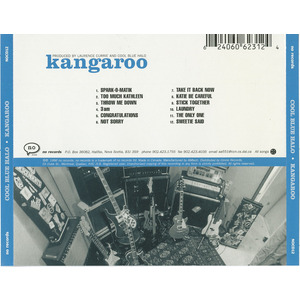
CD-Cool Blue Halo - Kangaroo INLAY BACK
CD-Cool Blue Halo - Kangaroo BACK
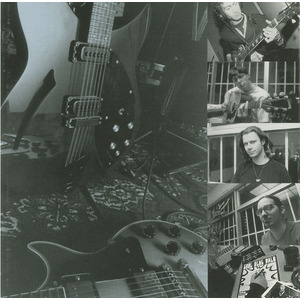
CD-Cool Blue Halo - Kangaroo INLAY INSIDE
CD-Cool Blue Halo - Kangaroo INSIDE
CD-Cool Blue Halo - Kangaroo CD
Kangaroo
Media
Videos
0 videos
No videos available for this title.
Credits
Musicians
Jason Ives: vocals, bass, guitar
Paul Boudreau: vocals, guitar, bass, piano
Barry Walsh: vocals, lead guitar
Glenn MacCulloch: drums, percussion, air guitar
Production
Produced by Laurence Currie and Cool Blue Halo
Engineered by Laurence Currie
Mixed by Laurence Currie and Cool Blue Halo
Recorded at Idea Of East Recording, Halifax, Nova Scotia
Songwriting
“Spark-o-matik” written by Cool Blue Halo
“Too Much Kathleen” written by Cool Blue Halo
“Throw Me Down” written by Cool Blue Halo
“3am” written by Paul Boudreau, Barry Walsh and Tom Carroll
“Congratulations” written by Cool Blue Halo
“Not Sorry” written by Cool Blue Halo
“Take It Back Now” written by Cool Blue Halo
“Katie Be Careful” written by Cool Blue Halo
“Stick Together” written by Cool Blue Halo
“Laundry” written by Cool Blue Halo
“The Only One” written by Cool Blue Halo
“Sweetie Said” written by Cool Blue Halo
All songs © SOCAN
Track-specific credits
Spark-o-matik
Jason Ives: lead vocals, guitar
Paul Boudreau: bass
Too Much Kathleen
Barry Walsh: lead vocals
Throw Me Down
Barry Walsh: lead vocals
3am
Paul Boudreau: lead vocals
Congratulations
Paul Boudreau: lead vocals
Not Sorry
Jason Ives: lead vocals, guitar
Paul Boudreau: bass
Take It Back Now
Barry Walsh: lead vocals
Paul Boudreau: bass
Jason Ives: guitar
Katie Be Careful
Barry Walsh: lead vocals
Paul Boudreau: lead guitar
Stick Together
Paul Boudreau: lead vocals
Laundry
Barry Walsh: lead vocals
The Only One
Paul Boudreau: lead vocals
Cool Blue Halo: handclaps
Sweetie Said
Barry Walsh: lead vocals
Artwork and photography
Cover conspirators: Peter Ross and Cool Blue Halo
Photography by Peter Ross and Jennifer Laine
Thanks
Waye Mason and No Records
Laurence Currie
Greg Clarke and Jackie Ryan and everyone at Birdland
Carl Gosine
Rick, Guy and Gaby at Original Ozone
Terry Pulliam
Jim Parker
Mike Campbell and Jeff Semple
Shannon Duharsky
Nick Holmes
Coyote
Pete Ross
Jenny Lane
Cleveland Steamer
Leonard Conan
The Posies
Jim and Pam at the Feast
Everyone at Duffy's
Jen and the Swiss army knife
Jason, Joyce and Chaz
Pete Carlos
Erin Lawless
Deah Sutton
Bird
Mandi Irwin
Tasha
Claire
Megan
T.B.
P.L.
Mike G.
Kudzul
All Moms, Dads, Brothers and Sisters
Our favourite bartenders all over Halifax
All those who have supported and never given up on us
Special thanks
“Steevo” Moore
Dave and Dwayne at Musicstop
John Church and Paul McCartney for the bass
C.J. Leblanc
Philip Pilgrim
Chris Logan
Patrick Pentland
Jay Ferguson
Kurt Hahn
Our Saviour - Kate The Great
Original label contact information
No Records
P.O. Box 36082
Halifax, Nova Scotia B3J 3S9
Phone: 902-423-1755
Fax: 902-423-4035
Email: aa551@ccn.cs.dal.ca
Release notes
Made in Canada
Barcode: 624060623124
Manufacturing and distribution
Manufactured by Amtech
Distributed by Ozone Records, 55 Duke St., Montréal, Québec H3C 2L8
© ℗ 1996 No Records
No Records is a trademark of No Records Ltd.
No Comments