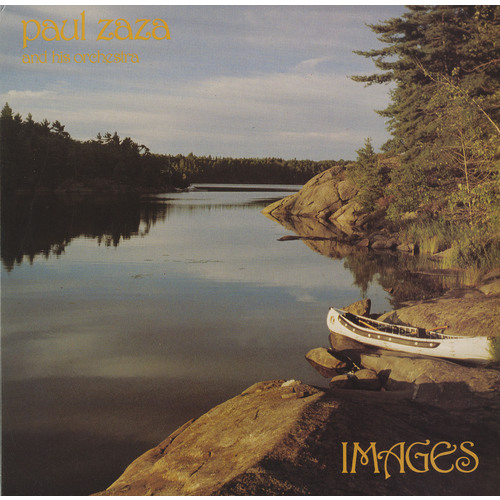
About This Title
Paul James Zaza (born December 28, 1952, Toronto, Ontario) is one of the most prolific and quietly influential composers in Canadian screen music history. Trained as a classical pianist yet shaped by the realities of studio work, touring, and production deadlines, Zaza built a career that bridges concert-hall discipline, popular music pragmatism, and industrial-scale film and television scoring. Over several decades, his music has underscored more than 160 film and television productions, placing his work at the core of Canada’s modern screen-music legacy.
Born in Toronto, Ontario, Zaza gravitated early toward music and pursued advanced training at the Royal Conservatory of Music, where he studied piano, harmony, orchestration, and formal composition. That classical foundation would remain central to his work, but from the outset Zaza showed little interest in a purely academic path. Instead, he entered the professional music world directly, developing the practical skills that later made him indispensable to producers and directors.
During the late 1960s and early 1970s, Zaza worked as a performing musician, including playing bass in the Toronto production of the musical Hair at the Royal Alexandra Theatre. He also toured as a rock musician with The 5th Dimension, an experience that exposed him to large-scale touring, pop arrangements, and the mechanics of live performance under pressure. These years placed Zaza squarely inside the working musician’s economy, where adaptability, speed, and clarity mattered as much as musical sophistication.
By the mid-1970s, Zaza had settled fully into Toronto’s studio ecosystem. In 1977, he released a series of instrumental jazz-funk and disco-era records, including Le Payback, Zaza, and Hot in Here. Long overlooked outside collector circles, these albums reveal a composer already fluent in groove construction, tight ensemble writing, and polished studio production. In retrospect, they function as an early blueprint for Zaza’s later screen work: rhythmically direct, economically arranged, and designed to serve a specific function.
At the same time, Zaza was building infrastructure. He founded Zaza Sound Productions Ltd., initially as a full-scale 24-track recording studio. Designed with synchronization and film work in mind, the facility soon evolved into a post-production and scoring operation as Zaza’s career shifted increasingly toward screen music. Unlike many composers who relied entirely on external studios, Zaza controlled his own production environment—an advantage that allowed him to deliver scores quickly, efficiently, and with technical precision.
Zaza’s breakthrough in film came at the end of the 1970s through his collaboration with director Bob Clark and fellow composer Carl Zittrer. Their score for Murder by Decree (1979), a dark Victorian thriller centered on Sherlock Holmes and Jack the Ripper, earned the Genie Award for Best Music Score in 1980. The film demonstrated Zaza’s ability to work at a high dramatic level, combining orchestral tension, thematic restraint, and atmosphere-driven storytelling. It also marked the beginning of a long association with genre cinema that would define much of his public reputation.
The early 1980s cemented Zaza as one of Canada’s most reliable and fast-turnaround screen composers. He scored several landmark horror films, including Prom Night (1980), My Bloody Valentine (1981), and Curtains (1983). These projects revealed a composer capable not only of suspense and menace, but of navigating real-world production constraints. On Prom Night, Zaza was tasked with replacing costly licensed disco tracks with original music under extreme deadline pressure—an assignment that underscored his role not just as a composer, but as a problem-solver embedded in the production process.
At the same time, Zaza demonstrated remarkable range. He co-scored A Christmas Story (1983), another Bob Clark film that would go on to become a seasonal institution across North America. Unlike most film scores, which disappear with their release cycle, A Christmas Story ensured that Zaza’s music would be heard repeatedly, year after year, embedding his work into popular memory in a way few composers experience.
Through the 1980s and beyond, Zaza’s output expanded dramatically. He scored mainstream comedies (Porky’s and its sequels), thrillers, family films, television movies, documentaries, and long-form series projects. He also undertook specialized work such as re-scoring international material, including the 1993 Canadian English re-dub of Kimba the White Lion, for which he composed an entirely new soundtrack. By the 1990s and 2000s, his catalogue had reached true “library” scale—so extensive that different sources cite totals ranging from 160 to more than 175 credited productions, depending on how episodic and television work is counted.
Recognition followed quietly but consistently. In addition to his Genie Award, Zaza received multiple SOCAN awards, reflecting the sustained performance and broadcast life of his music. His professional papers, manuscripts, and production materials were later preserved as a dedicated fonds at Library and Archives Canada, an acknowledgement of both the scope and historical importance of his career.
Stylistically, Zaza resists easy categorization. Rather than cultivating a single, instantly identifiable sound, he built a career on musical literacy, technical command, and adaptability. His scores succeed because they understand function: how music supports narrative, pacing, mood, and edit. That combination—classical training, studio fluency, and production realism—made him one of the most consistently employed composers in Canadian film and television during the industry’s most active decades.
Taken as a whole, Paul Zaza’s legacy is not just the number of titles he scored, but the way his music became woven into the fabric of Canadian screen culture—from cult horror and holiday classics to television movies watched in millions of living rooms. His career exemplifies the working composer at full scale: skilled, versatile, and essential.
-Robert Williston
Songwriting
‘Summer Evening’
Written by Paul Zaza
Arranged and orchestrated by Paul Zaza
‘The Magic Island’
Written by Robert Farnon
Arranged and orchestrated by Robert Farnon
‘Canon in D’
Written by Pachelbel
Arranged and orchestrated by Paul Zaza
‘Sailing High’
Written by Paul Zaza
Arranged and orchestrated by Paul Zaza
‘Blue Lagoon’
Written by Robert Farnon
Arranged and orchestrated by Robert Farnon
‘Maid of the Mist’
Written by Paul Zaza
Arranged and orchestrated by Paul Zaza
‘Swallow Flight’
Written by Robert Farnon
Arranged and orchestrated by Robert Farnon
‘Autumn Reflections’
Written by Paul Zaza
Arranged and orchestrated by Paul Zaza
‘Sunday Morning’
Written by Paul Zaza
Arranged and orchestrated by Paul Zaza
‘Lake Louise’
Written by Robert Farnon
Arranged and orchestrated by Robert Farnon
‘Song of the Stars’
Written by Paul Zaza
Arranged and orchestrated by Paul Zaza
‘Peace River’
Written by Paul Zaza
Arranged and orchestrated by Paul Zaza
Production Credits
All music arranged and orchestrated by the composers listed against each title
Recorded at Zaza Sound Productions Ltd., Toronto, Canada
Produced by John Parry and Paul Zaza
Engineered by Stephen Ritchie
Mixed by Paul Zaza
Lacquer mastered by George Graves, The Lacquer Channel Ltd.
Artwork
Cover photograph by Chris Stone
Publishing Notes
Manufactured by / Fabriqué par Parasol Music, a division of Parry Music Ltd., Toronto, Ontario
All titles Ⓟ Ⓜ, except “Blue Lagoon” Ⓟ Ⓜ
Liner notes
For many years PAUL ZAZA has been delighting audiences with his music for television, films and radio. With a flair for versatility, Paul’s career has ranged in musical styles from playing in rock bands, writing jingles and country & western music, to composing and conducting for full orchestra in major motion pictures. His recent successes in the world of film music, the two PORKY’S movies, MURDER BY DECREE, PROM NIGHT, MELANIE AND THE KIDNAPPING OF THE PRESIDENT, indicate the great talents this fine musician has to offer.
In this recording with his orchestra, PAUL ZAZA has chosen to showcase not only his own capabilities as a composer-arranger, but also to interpret the compositions of Robert and David Farnon.
To lovers of sophisticated, big band film music, the name ROBERT FARNON needs no introduction. With an immense repertoire of compositions and arrangements, Bob has worked with major orchestras around the world, producing many recordings with his own orchestra and conducted his arrangements for such singers as TONY BENNETT, SARAH VAUGHAN, LENA HORNE and FRANK SINATRA. Farnon has been quoted by ANDRE PREVIN as being “the greatest string writer in the world”.
This album is, however, perhaps unique in that it includes three new Robert Farnon compositions recorded in his native country, together with a piece composed and arranged by his son David.
DAVID FARNON is now firmly established making his name as a talented young composer, arranger and instrumentalist in Europe working with orchestras on film, television and radio projects. His contribution to this collection certainly proves that he has a great future.
We invite you to sit back, relax, close your eyes and picture your own IMAGES to this selection of themes by PAUL ZAZA and his Orchestra.
-John Parry
Gallery
Images
2 images
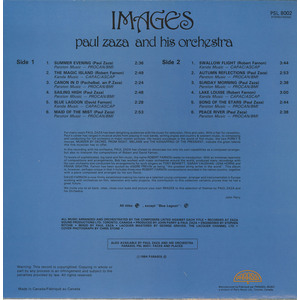
Paul Zaza - Images BACK
Images
Media
Videos
0 videos
No videos available for this title.
No Comments