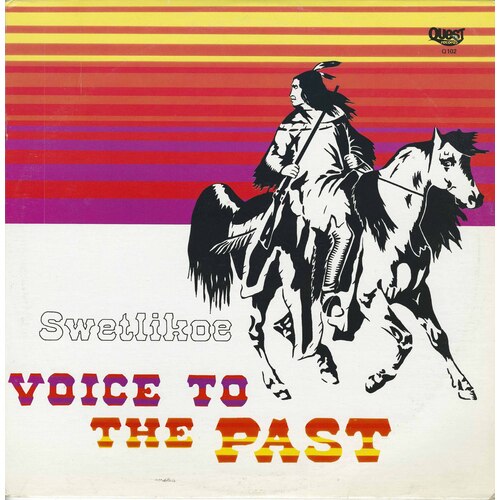
Insight
Artist notes
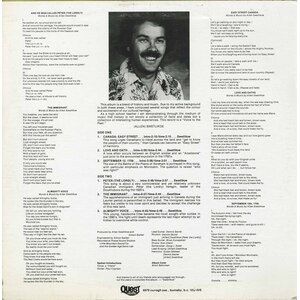
This album is a blend of history and music. Due to my active background in both these areas, I have composed several songs that reflect the colour and excitement of our cultural heritage.
As a high school teacher I am demonstrating through the medium of music that history is not simply a collection of facts and dates but a collection of interesting human experiences. This record is a “Voice to the Past.”
(ALLEN) SWETLIKOE
Track notes
‘Canada: Easy Street’
This song urges Canadians to travel across the land and “get to know the people of their country,” then Canada can become an “Easy Street” of harmony.
‘Love and Oath’
A love affair occurs between an English soldier and an “Acadienne” just prior to the announced expulsion in the 1750’s.
‘September 12, 1759’
The eve of the Battle of the Plains of Abraham is portrayed in this song, with particular emphasis on Montcalm. The question is raised “who was right?”
‘Peter (The Lordly)’
This song is about a very controversial and yet relatively unknown Canadian immigrant, Peter (the Lordly) Veregin, leader of the Doukhobors during the 1920’s.
‘The Immigrant’
The apprehensions of an immigrant just arriving in Canada during the Laurier period is personified in this ballad. The immigrant realizes his fears but yields to his inner spirit and decides to accept the challenge of this new land.
‘Almighty Voice’
This young, handsome Cree became the most sought after outlaw in the 1890’s. His fight until death represents the last major attempt by an Indian to overcome white control.
Liner notes
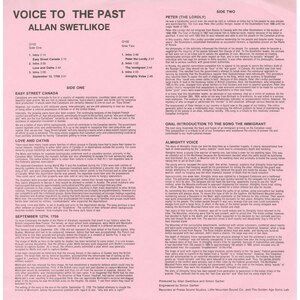
Easy Street Canada
Canadians are very fortunate to live in a country of majestic mountains, countless lakes and rivers and beautiful open prairie. We are rich in natural resources, hydro-electric power and fertile soil for extensive farm production. It would seem that Canadians are certainly blessed to live on such an “Easy Street”.
However, our country is still relatively young. Internationally, we are still attempting to lose our image of being either a colonial possession of Britain or of the United States.
Internally, the growing pains have also been evident. The continuing tensions of the English/French conflict are still with us. Age old arguments, periodically brought to the surface, such as “who won at Quebec” and “who are the true Canadians” certainly do not help to moderate the conflict as it may be seen in the existence of separatist movement in Quebec.
We are a nation of many ethnic backgrounds, which all contribute to the Canadian identity. The government cannot legislate unity and understanding. It is up to the people to recognize their own prejudices and realize, that, we are one. “Easy Street Canada” will only become a reality when a deep-seated respect among all ethnic groups is achieved. This song simply suggests that Canadian unity and understanding could be at least partially achieved by having “Canadians getting to know Canadians”.
Love and Oaths
There have been many cases where families of ethnic groups in Canada have had to leave their homes for varied reasons, migrating to either other parts of Canada or to destinations outside the country. For some minority groups hardships and heartaches were gallantly endured.
The Metis and Indians for example continuously undertook such a voluntary exodus, primarily in the Canadian West, following the nomadic buffalo and also attempting to escape the ever advancing white civilization. The native Indian’s desire to retain their culture is ironic in that their last migration was to the Federally planned reservation.
The Japanese-Canadians during World War II and the Acadians during the 1750’s were both victims of security systems during wartime. The Japanese-Canadians were considered a security risk in the coastal area of B.C. and were consequently deported to remote interior points in the Province and to other parts of Canada. When this deportation decree was passed, the Japanese could take only the possessions “they could carry” and their property was later sold at very low prices to hungry speculators.
The Acadians were provided with an alternative however, before their forced migration took place. If they swore allegiance to George II, they would be allowed to remain in Acadia. The proud Acadians who had occupied that area for approximately one hundred and fifty years, much longer than any other English colonists in that colony, refused this allegiance, resulting in their mass deportation to other British colonies. The question of fair policy for aliens during wartime can probably be argued endlessly, however one can sympathize with the victimized groups. Some historians have expressed yet stronger feelings regarding the Japanese and Acadian migrations by stating that both decrees were deplorable, cruel and unnecessary. More over, the countless little dramas that accompanied the breaking up of families and groups could have hardly been realized by military “commandants” who organized the deportations.
This song, Love and Oaths, is set in Acadia just prior to the deportation decree. The song portrays a love affair between an English soldier and an “Acadienne”. The conflict of their different ethnic backgrounds becomes evident, however, love triumphs over the many dark faces of war.
September 12th, 1759
To most Canadians the Battle of the Plains of Abraham represents that event in our history when the British conquered New France. The heroes, as most school texts emphasize, were Wolfe and Montcalm. These traditional concepts, however, can be modified, or at least placed in a different perspective.
This famous battle on September 12th, 1759, did not represent the total defeat of the French regime. After Quebec, Montreal still had to be conquered. However, before that feat was accomplished, the French had found time to lick their wounds and actually defeat the English in a rematch at Sainte Foy. It was not until the next fall that Montreal was finally captured by the English.
The image of Wolfe as hero in the battle for Quebec has been tarnished to some extent. It is now known, through various documents, that the officers under Wolfe became quite disgusted with Wolfe’s consistent failures to capture Quebec. As a result, the officers jointly submitted a plan which was generally accepted by Wolfe and used to capture Quebec.
It has been recognized by historians that the unsung heroes of the capture of Quebec were the British sailors. The large fleet, led by Admiral Saunders, accomplished the remarkable feat of sailing up the rugged St. Lawrence. Without the navy, the small British army would have had no supplies and also no military support.
Montcalm still has retained his hero image. He had established a masterful defence which could only be weakened by two possibilities. First, if the British navy could sail past Quebec to capture Montreal; then Montcalm would be completely surrounded and thus cut off from his sources of supplies. Second, the only other possibility. was insubordination within his own ranks. It so happened that Wolfe had his men climb a cliff which was not guarded. The Governor of New France, Vaudreil, had earlier countermanded Montcalm’s order resulting in this unguarded flank. One can appreciate Montcalm’s surprise and disgust when in the morning he saw the British army on the Heights. He stated, “I see them where they have no business to be.”
The setting of the song is the eve of the battle, September 12, 1759. The ballad attempts to invade the dreams of Montcalm. asking the perennial question with regard to war, “why and who is right?”
Peter (The Lordly)
He was a handsome, proud man. He could be cold or ruthless at times but to his people he was sincere and warm-hearted. The man was Peter (the Lordly) Verigin, leader of the Doukhobors from 1886 until his tragic death in 1924.
Peter (the Lordly) did not emigrate from Russia to Canada with the other Doukhobors in the exodus of 1898-1899. The Czar of Russia in 1887 had placed him in Siberian exile, mainly because of his belief in pacifism. It was not until 1902 that he was released and able to join his people on the Canadian prairies.
In this country, Peter (the Lordly) provided positive leadership for his people and despite some “hungry years”, the Doukhobors established themselves as successful farmers, a reputation proven on the Plains of Russia.
His philosophy of life definitely influenced the lifestyle of his people. For example, when he became a vegetarian the majority of his people followed this change of diet. To the Doukhobor leader, the animals of God were not to be killed just to satisfy the appetites of man. Moreover, he insisted on treating domesticated animals with the same respect as man, and in one instance he actually “whipped” an individual who had kept his animals in filthy quarters. It was other elements of his philosophy, however, that led to serious conflicts with government authorities.
In Russia, his pacifist convictions compelled him to appeal to his people to ignore the military draft of the Russian Czar; they should not be “toys” of the “war game”. In Canada, the conflict was over land ownership. This resulted from the government’s attempt to break down the communal approach to farming by insisting that the Doukhobors register their Saskatchewan land individually. This procedure also required them to swear the oath of allegiance to the King, which was contrary to Doukhobor doctrine; they “could only swear oaths to God”. Because of this dispute, Peter (the Lordly) purchased large tracts of land in the Kootenay Valley of British Columbia. Here, the Doukhobors, who emigrated in 1905 to this area, changed from wheat farmers to fruit farmers and even to sawmill operators. Peter (the Lordly) clearly recognized that adaptations to new economic environments had to be made for survival. Some “good” years were experienced by the Doukhobors in their new home.
It is ironic that this Doukhobor leader, an advocate of non-violence, died as a victim of violence. On the morning of October 29th, 1924, while on his way from Brilliant to Grandforks, he was killed in a serious train explosion. The evidence up to date overwhelmingly indicates an assassination motive. However, the mystery of who arranged or performed the “murder” is still unsolved, although various theories do exist.
The involvement of Peter Verigin in our country is found now in the pages of our history. The critics generally admit he was a remarkable man, recognizing the difficult problem he faced of maintaining the identity of his people in an alien, industrial society. This song is a tribute to this relatively unknown Canadian immigrant.
Oral introduction to ‘The Immigrant’
The next song illustrates the fears and hopes of an immigrant arriving on the Canadian coast. This composition is a tribute to all of our forefathers who weathered the storms of pioneer life and contributed to our multi-cultured mosaic.
Almighty Voice
The story of Almighty Voice can best be described as a Canadian tragedy. It clearly demonstrated how lack of understanding by the “policy makers” could lead to unnecessary death and hardship.
Almighty Voice, a young Cree warrior of twenty-one, had killed a steer for his wedding feast. This was an unlawful act in the Northwest because the Government decided when the cattle would be butchered and distributed. As a result, a Mountie rode to the wedding feast and promptly arrested the young Indian taking him to jail at Duck Lake.
The young warrior escaped the same night. One writer, however, explains that Almighty Voice had been told by the guard that hanging would be his punishment for killing the steer. Although the guard was simply attempting to scare him, Almighty Voice, believed the guard and made his escape. To the Indian warrior, death by hanging was the most shameful manner of death that he could conceive.
Approximately one week later, Almighty Voice was sighted by a Sergeant Colebrook and a halfbreed scout. The policeman approached the Indian but was quickly warned by the renegade not to move any closer or he’d be shot. The Sergeant did not heed the warning, apparently trying to use the “bluff” method; when the Mountie continued to approach displaying his revolver, Almighty Voice fired, killing the officer. Now Almighty Voice was not only wanted for a minor offense but also for murder.
By committing this crime, he was forced to follow the paths of an outlaw; going everywhere but leading to nowhere and always alone. To insure this type of life for the fugitive, the Northwest Mounted police, numbering around a thousand in the West, were constantly on the lookout for this criminal. Their search was quite unsuccessful however, and by evading his pursuers for two years, Almighty Voice became a martyr to his people. The Indian people thought it was very strange that one man could so consistently escape from such a large force. In short, in the eyes of the Indian people the young renegade was making the Northwest Mounted Police look very foolish and inept.
Two years of this lonely life, however, was all he could endure and so Almighty Voice returned to his tribe. The Mounties, receiving word that he was present, went to arrest him. The Indian outlaw, however, had decided to fight to the death, and was further supported in his decision by two comrade warriors, who had chosen to die with him. The warriors chose a bluff nearby and desperately dug a rifle pit for their doomed stand.
The Mounties of the surrounding detachments, reinforced with citizen volunteers, numbered about twenty and were quite unsuccessful in routing the renegades. Their ranks were bolstered, however, when a large detachment arrived from Regina. The three Indians without food and water, and facing one hundred militia equipped with two cannons, didn’t stand a chance. The siege was over in two days.
The death of Almighty Voice represented the last physical attempt to test the whiteman’s control in the west. This “challenge” was not entirely unexpected, if one considers how poor the living conditions for the Indians were at that time. In Almighty Voice’s tribe for example, because of malnutrition and disease, it had dwindled from 200 people in 1885 to approximately 100 people in 1895, which included only 20 able-bodied men, the supposed “breadwinners” of the tribe.
The finger of guilt with regard to this tragic situation, points clearly to the “far away” Federal government. Their policy was to transform the Indian from a “hunter” to a “mixed farmer”. However, this transition was not accompanied by an essential education program. To no one’s surprise, the Indians thus fared poorly as “mixed farmers” and they were reduced to a new starvation level. Thus, the parties directly involved in the conflict were actually cast in their roles by the Federal government. The Northwest Mounted Police were simply carrying out government policy. In the case of the Indians, being “wards” of the Government, they were the recipients of the poorly thought out policy.
The story of Almighty Voice has been passed from generation to generation in the Indian tribes of the prairies. They believed that he was the “last Cree warrior” and “died that his voice might live”.
Gallery
Images
3 images
Allan Swetlikoe - Voice to the Past
Allan Swetlikoe - Voice to the Past insert
Voice to the Past
Media
Videos
0 videos
No videos available for this title.
Credits
Musicians
Dennis Secret: lead guitar, rhythm guitar, harmony
Allen Swetlikoe: rhythm guitar on ‘Peter (The Lordly)’, lead singing, harmony
Brian Konopelski: bass guitar
Ken Infanti: drums
Doug J. Dodd: synthesizer
Susan Shewan: harmony
Songwriting
All songs written by Allen Swetlikoe
Spoken Introductions
A “friend”: voice
Paul Cypress: guitar
Production
Produced by Allan Swetlikoe and Simon Garber
Technical
Engineered by Simon Garber
Recorded at Praise Sound Studios, Little Mountain Sound Co. and the Golden Age Sonic Lab
Artwork
Album cover by Brent Bahnman
Special thanks
And thanks to all of my friends who encouraged me through-out the years to complete this album. — “Swetlikoe”
Release
Quest Records
6979 Curragh Ave., Burnaby, B.C. V5J 4V6
Canada
No Comments