Insight
Winston Wuttunee is one of Canada’s most enduring Indigenous entertainers, a Cree singer, songwriter, musician, storyteller, comedian, educator and inspirational speaker whose career has spanned more than five decades. Since beginning his professional civilian career in the early 1970s, he has carried Indigenous music, humour, history and cultural teachings to audiences throughout Canada and the United States, as well as Europe, Australia, New Zealand and other parts of the world. His work has crossed folk, country, children’s music, spoken word, comedy and traditional Indigenous forms, but its central purpose has remained remarkably consistent: to strengthen cultural pride, preserve memory and use music and storytelling as instruments of teaching and healing.
Wuttunee was born in 1940 at Notre Dame Hospital in North Battleford, Saskatchewan, and spent his early years in connection with Red Pheasant First Nation. Some of his earliest memories were of teepees, tents, wagons, workhorses and young riders moving around the Sundance lodge while relatives sang, laughed and visited. The sounds of drums, horses’ hooves and family voices formed his first musical environment. Long before he entered a classroom or learned an instrument formally, he experienced music as something inseparable from ceremony, family, movement, memory and the land.
He later recalled making his first appearance as a dancer when he was only two years old. His mother had made him a complete dancing outfit and encouraged him throughout his childhood. Music eventually won what he jokingly described as a struggle between the piano and the slingshot. These early experiences remained the foundation of his later life as an entertainer. Even as his repertoire expanded to encompass European classical music, country, blues, rock and roll, popular music and comedy, the emotional and spiritual centre of his work continued to come from the Cree cultural world in which he was raised.
After completing school, Wuttunee joined the Canadian Army in 1960. He became a clarinetist with the Canadian Guards Regimental Band and later served in Quebec with La Musique du Royal 22e Régiment. Military-band life broadened both his technical abilities and his musical vocabulary. He performed disciplined ensemble music while absorbing a wide variety of styles, an experience that later helped him move comfortably between traditional songs, folk ballads, children’s material, country music, humour and formal concert performance.
Wuttunee left the military in 1973 and studied music at the University of Saskatchewan. That same period marked the beginning of his recording career. His earliest long-playing record was started with a small operation in Rosetown and completed through Sunshine Records in Winnipeg. During the following decades he recorded albums, singles and cassettes for Sunshine Records, Turtle Island Music and other organizations, including educational and cultural recordings made in association with Indigenous institutions.
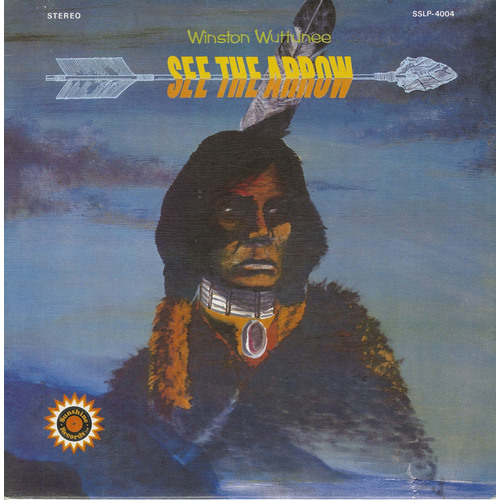
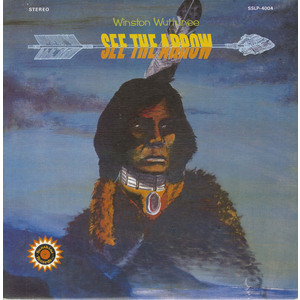
His recording catalogue reveals the unusual breadth of his work. See the Arrow combined original songs, Cree-language material, poetry, historical reflection and contemporary social commentary. Me and My Friends brought Indigenous themes, humour and family participation into children’s music. Songs of the Northwest explored Louis Riel, Gabriel Dumont, Batoche, Métis history and the North-West Resistance through original and historical songs. Other releases included humorous material, traditional songs, family recordings, educational pieces and compositions addressing identity, leadership, despair, resilience and cultural survival.
One of his signature compositions, “See the Arrow,” grew from his reflections on the treaty-making period. Wuttunee described the chiefs who signed the treaties as sending an arrow of hope and love through the generations so that Indigenous young people would remember who they were. The song encouraged listeners not simply to mourn the past, but to become educated, remain proud and help their children become strong. He regarded culture as a guiding force through life, once comparing it to a rudder that gives direction and responsibility.
Dreams also played an important role in his creative life. Wuttunee said that melodies and songs sometimes came to him in dreams after he had learned an important truth. He associated “See the Arrow” with the voices and unrealized talents of people who had gone before him. “Daddy Do” was likewise described as emerging from a dream in which young musicians performed a beautiful melody that returned to him while he was writing about the loneliness experienced by his family during his months of travelling.
His songs frequently addressed difficult social and emotional realities. “I Cried” was written after someone he knew attempted suicide. “My Son” encouraged young people to develop the courage and leadership associated with figures such as Crazy Horse and Louis Riel. “My Braids” affirmed the cultural and spiritual importance of long hair and braids; decades after recording it, Wuttunee offered the song to the family of a Calgary boy whose braid had been cut at school. He explained that Elders had blessed him to heal wounds and that he understood his music as spiritually healing.
Wuttunee also became widely known for performances aimed at children. He appeared in schools, universities, cultural centres, festivals and community organizations, combining songs, humour, stories, language and audience participation. Rather than performing at children, he invited them into the event. His recordings included children singing alongside adults, humorous characters, familiar traditional melodies, Cree-language learning material and songs dealing with friendship, family and self-respect.
That participatory approach remained central to his work well into his eighties. Interviewed at Festival du Voyageur shortly after his eighty-fifth birthday, Wuttunee explained that he continued because performing and storytelling were simply what he did and because he loved working with children. He described calling a teacher forward to demonstrate a two-step and then encouraging the children to dance. He took particular pleasure in seeing young participants become confident and visibly excited by the experience.
For Wuttunee, storytelling has never been entertainment alone. He believes that an old story has a reason for being told: it shows what people were like, how they lived and what earlier generations understood. A story can reveal both the way things were and the way things might become, leaving listeners to decide what they can do with the lesson. He has described storytelling as one of the traditional means by which a teaching is carried from one generation to another.
He has also drawn attention to the absence of Indigenous memory from many public landscapes. Speaking about the Prairies, he recalled the immense buffalo herds and the long presence of Indigenous peoples, yet observed that these histories are often missing from roadside signs and official markers. His stories therefore do more than recall the past: they restore people, events and meanings to places from which they have frequently been erased.
Language has been another important part of his work. Wuttunee speaks Cree, English and French and has used some German, while also drawing upon his familiarity with other Indigenous languages and speech patterns. Moving between languages, accents and voices allows him to embody different characters and make stories vivid for varied audiences. He has also emphasized the relationships among Cree, Saulteaux, Blackfoot and other Indigenous languages, although the exact extent of his fluency in each has been described differently in various biographies.
Underlying his storytelling is a strong ethical principle. Stories must be told well or people will not listen, but they must also carry truth. Wuttunee has said that storytellers should spread what is good rather than lies, hatred or harmful ideas. When a person carries the truth, he explained, there is no reason to live in fear.
Throughout his career, Wuttunee has appeared on radio, television and film and has performed alongside prominent Canadian children’s entertainers, folk musicians and country artists. Accounts of his career state that he opened for Johnny Cash and Willie Nelson, appeared on Canadian children’s television and performed his composition “Museecho” at Carnegie Hall, where he received a standing ovation.
His screen work has included productions associated with filmmaker and poet Duke Redbird, with whom he also collaborated musically. Redbird’s poetry appeared on See the Arrow, including “Old Woman” and “The Beaver.” Wuttunee’s acting and television credits have been variously listed as He Who Sees Upside Down, The New Ghostdancers and Flat Mountain Tax Tales. A later documentary, Winston Wuttunee: Kitochikew, The One Who Makes Music, examined his life and work for television.
Recognition of Wuttunee’s contribution grew steadily during the later decades of his career. His recordings received nominations and honours at the Canadian Aboriginal Music Awards, and in 2002 he received the organization’s Lifetime Achievement Award. In 2013 he was presented with an Indspire Award for Culture, Heritage and Spirituality. In 2019 the University of Manitoba awarded him the honorary degree of Doctor of Letters, honoris causa, recognizing a lifetime devoted to music, Indigenous culture, education and community service.
Awards, however, tell only part of his story. Wuttunee’s lasting achievement lies in the way he brought together roles that are often treated separately. He has been at once a concert musician and a community educator, a comedian and a cultural historian, a children’s performer and an Elder, a songwriter and a keeper of stories. His songs move between laughter and grief, family and nationhood, personal memory and collective history.
Wuttunee’s commitment to education has extended beyond performance. During the early 2000s, he developed a series of music-course publications designed to bring his knowledge and experience into educational settings. These materials reflected his longstanding belief that music, storytelling and cultural understanding can help younger generations connect with history, identity and one another.
More recently, he collaborated with the music teacher and students of a Winnipeg elementary school whose population includes many South Asian and Southeast Asian children, as well as Indigenous students, to create and present an original school musical. The project brought together students from varied cultural backgrounds through music and performance. The Manitoba Department of Education has encouraged Wuttunee and the school’s music teacher to pursue the musical’s inclusion on the province’s Teacher’s Resource list.
At an age when many performers have long since retired, Winston Wuttunee has continued singing, dancing, teaching and telling stories. His longevity reflects more than professional discipline. It reflects his understanding that music and story remain living responsibilities. From the drums and horses of his childhood memories to classrooms, festivals, recordings and international stages, he has carried those responsibilities with warmth, humour and an enduring belief in the ability of culture to guide, strengthen and heal.
-Robert Williston
Gallery
Images
4 images
Winston Wuttunee - See the Arrow BACK
Wuttunee, Winston - See the Arrow
Wuttunee, Winston - See the Arrow
See the Arrow
Media
Videos
0 videos
No videos available for this title.
Credits
Musicians
Winston Wuttunee: vocals, guitar
Happy Music: female vocals on ‘Canada My Home’, ‘La Ronge’ and ‘Old Woman’
Janet Deiter: female vocals on ‘Wunisca’, ‘Ninestosin’ and ‘Kayas Nehiyaw’
Alvin Musqua: bass guitar on ‘Kayas Nehiyaw’
Duke Redbird: poetry on ‘Old Woman’ and ‘The Beaver’
Songwriting
‘Canada My Home’ written by Winston Wuttunee
‘Bucksaw Jig’ written by Winston Wuttunee
‘La Ronge’ written by Winston Wuttunee
‘Wunisca’ written by Winston Wuttunee
‘Ninestosin’ words by the Cree Language Instructors of the Saskatchewan Cultural Indian College; music by Winston Wuttunee
‘See the Arrow’ written by Winston Wuttunee
‘Old Woman’ poem by Duke Redbird; words and music by Winston Wuttunee
‘Kayas Nehiyaw’ words by the Cree Language Instructors of the Saskatchewan Indian Cultural College; music adapted from the traditional Huron song ‘Ani Cooni’
‘The Beaver’ poem by Duke Redbird
‘Pretty Girl’ written by Winston Wuttunee
‘Song of the Arctic’ words by Gene Rheaume and Davey S. O’Brien; traditional Irish music
‘Daddy Do’ written by Winston Wuttunee
Production
Produced by Ness Michaels
Recorded at Century 21 Studios, Winnipeg, Manitoba
Engineered by Jack Clements
Cover photograph by Denny Morrison
Manufacturing and distribution
Distributed by Native Country for Sunshine Records
Printed in Canada
Technical
Artist and production are Canadian
Liner notes
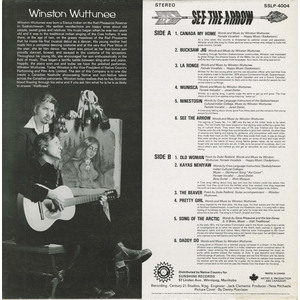
Winston Wuttunee was born a Status Indian on the Red Pheasants Reserve in Saskatchewan. His earliest recollections are happy ones about old people, sweet grass and relatives. His music began when he was two years old and it was in the traditional Indian singing of the Cree Indians. It was there, at the age of two, on the grassy meadows of the Red Pheasants that he made his first musical debut as a dancer. His young mother had made him a complete dancing costume and at the very first Pow Wow of the year, she let him dance. Her heart was proud as her first-borne son proudly danced, bowed, and swayed in the customs of his ancestors. Throughout his young life, she encouraged her son enthusiastically in the field of music. Thus began a terrific battle between sling-shot and piano. Happily, the piano won out and today we have the polished performer, Winston Wuttunee. Today Winston is the Vice-President of Native Country Performing and Film Arts Limited. The aim of this Company is to one day create a Canadian Nashville showcasing Native and non-Native talent across the Canadian panorama. Winston today realizes that he has Scottish blood flowing through his veins and if you ask him what he is he is as likely to answer “Halfbreed”.
Words and Music by Winston Wuttunee.
Female Vocalists — Happy Music (Saskatoon).
At a time when this country is threatened by policital unrest and separation, Winston wrote this song for those glorious unsung heroes who helped to build this great country, Canada.
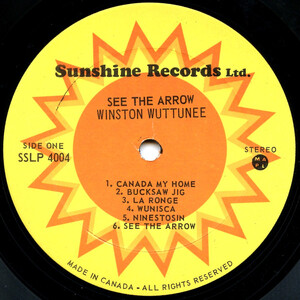
2. BUCKSAW JIGWords and Music by Winston Wuttunee.
Travelling through Northern Saskatchewan communities, Winston was impressed by three things: the physical beauty of the Métis; the joie de vivre in their culture; and the fact that many spoke three languages. As a result, this song was borne.
3. LA RONGEWords and Music by Winston Wuttunee.
Female Vocalists — Happy Music (Saskatoon).
Written for the two young pilots and the one education officer who lost their lives in an airplane crash in November, 1974 around Cumberland House, Saskatchewan. One pilot was an Indian, one an English Canadian and one a French Canadian. This song is in commemoration to them and to the many wonderful people he met on his visits to La Ronge.
4. WUNISCAWords and Music by Winston Wuttunee.
Female Volcalist — Janet Deiter.
Written as a spring song, it gently urges the earth to get up and grow. The Cree chant at the end is an ageless song meaning "wake-up".
5. NINESTOSINWords by Cree Language Instructors of the Saskatchewan Cultural Indian College, Music by Winston Wuttunee.
Female Vocalist — Janet Deiter.
A Cree song talking about the by-gone Pow Wow days and the romance that young people found there.
6. SEE THE ARROWWords and Music by Winston Wuttunee.
The signing of Treaty No. 7 in 1887 was the last of the Indian lands to be taken away. The old Chiefs that were present at that signing were suffering a great feeling of cultural shock. They knew their way of life was finished and that these Treaties were the only things they would be able to give their children. So after days of praying and fasting and asking for guidance, and consultation with each other, they made their mark on the Treaty. When they made their mark, it was as though they were sending an arrow through the years, an arrow of love and hope which would land in the hearts of every young Native person today, so we would not forget who we were and who we are. It tells us to be proud of ourselves, don't cry about what's past, but instead go and get an education so your children will be strong.
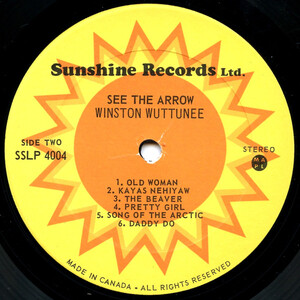
Side B 1. OLD WOMANPoem by Duke Redbird, Words and Music by Winston Wuttunee.
Female Vocalists — Happy Music (Saskatoon).
Words by Cree Language Instructors (Saskatchewan Indian Cultural College).
Music — Old Huron Song "Ani Cooni".
Female Vocalist — Janet Deiter.
Bass Guitar — Alvin Musqua.
A Cree song talking about long ago and how the Indians could live where they wanted, how they could hunt the buffalo when they wanted, how they respected the earth and each other and their Indian God. They were happy to be Indians.
3. THE BEAVERPoem by Duke Redbird, Guitar accompaniment — Winston Wuttunee.
4. PRETTY GIRLWords and Music by Winston Wuttunee.
A song inspired by the blue skies, the blue eyes, the blue waters and the tall trees of Northern Saskatchewan, in particular the Waskesieu area. It is sung with a deep feeling of loneliness he felt for a pretty girl who he loved and that time would not allow him to be with. The song is in French, English and Cree.
5. SONG OF THE ARCTICWords by Gene Rheaume and the late Davey S. O'Brien, Music — Irish Traditional.
In the early '60's, the Carruthers Commission was in the North conducting a series of investigations as to what the people of the North really wanted in regards to Aboriginal rights and land claims. Many Eskimos were interrogated in the Court House and what inspired this song was a red-haired, blue-eyed, fair-skinned trapper who claimed to be half Eskimo and half RCMP.
6. DADDY DOWords and Music by Winston Wuttunee.
A song given to Winston by a talented young composer in a dream. In the dream, Winston was a visiting guest artist in a music classroom which contained about 15 students. Upon entering the classroom one young man presented his music on guitar while another played the melody on flute. It was beautiful and Winston suffered pangs of jealousy. The story changes and we find Winston and his family reunited after three months of road travelling. It is there he realizes how lonesome his children and his wife are when he is gone. As he starts to write the song, his dream comes back to him and he uses the melody from the dream for the song.
No Comments