Insight
The Super Friendz emerged from Halifax’s mid-1990s creative surge as one of the city’s most inventive and quietly influential indie rock bands. Formed in 1994 by King’s College students Matt Murphy, Charles Austin, and Drew Yamada, the group quickly established itself within the same tight-knit ecosystem that produced Sloan, Thrush Hermit, and Jale—but carved out a sound that was more elastic, playful, and structurally curious than most of their peers.
Murphy had previously played guitar in Black Pool, while Austin had a brief stint with Al Tuck and No Action. Yamada rounded out the core with a guitar style that leaned as much toward texture and rhythm as melody. In their earliest phase, The Super Friendz operated without a permanent drummer, instead drawing from the Halifax community: Chris Murphy of Sloan, Cliff Gibb of Thrush Hermit, and Dave Marsh all sat behind the kit at different points, reinforcing the band’s fluid, collaborative nature.
Their first releases appeared on Sloan’s Murderecords, a label that functioned less as an industry pipeline than as a document of a scene in motion. Early singles and cassette material captured a band already resistant to settling into a fixed formula—mixing power pop instincts with abrupt shifts, lo-fi experimentation, and lyrics that often felt deliberately off-center. Touring with Sloan in 1994 helped bring wider attention, but the band’s identity was never dependent on proximity to their more commercially successful contemporaries.
The debut album Mock Up, Scale Down (1995) was recorded in producer Brenndan McGuire’s house and featured Dave Marsh on drums. The record balanced concise pop songwriting with an undercurrent of structural risk, earning strong critical response while remaining resolutely independent in spirit. Rather than polish away rough edges, the album leaned into them, reflecting the band’s interest in tension, contrast, and momentum over radio readiness.
In 1996, the band released Play the Game, Not Games, a 10-inch EP that marked a decisive shift. Contributions from Austin and Yamada pushed further into experimental territory, blurring lines between song fragments, textures, and ideas. In hindsight, the record reads as both a bridge and a warning sign—pointing toward new creative ground while exposing internal differences about direction.
That same period saw the American reissue of Mock Up, Scale Down under the title Sticktoitiveness on March Records in 1997, incorporating selections from the earlier cassette and EP material. While the U.S. release broadened the band’s reach, it also coincided with a moment of transition rather than consolidation.
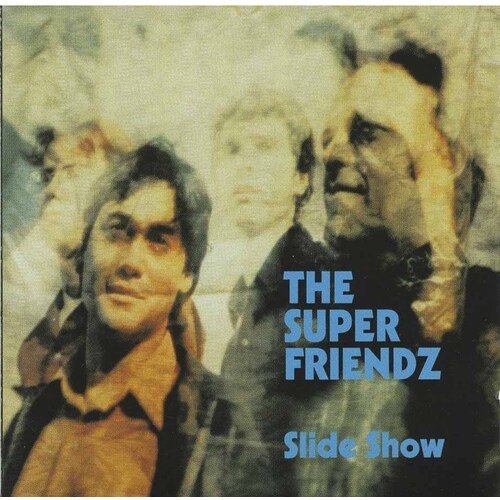
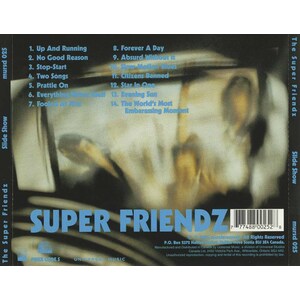
The Super Friendz’ final studio album, Slide Show (1997), is widely regarded as their most fully realized work. With Lonnie James now on drums, the band achieved a new level of cohesion without sacrificing unpredictability. Recorded at Chemical Sound in Toronto and co-produced with Eric Masunaga, the album sharpened their arrangements while retaining the restless, idea-driven quality that defined the group from the start. Tracks like ‘Citizens Banned’ and ‘Slow-Motion Blues’ reflected a band confident enough to let songs unfold on their own terms.
Shortly after Slide Show, The Super Friendz dissolved, choosing not to force continuation as creative priorities diverged. The breakup was quiet, unaccompanied by narrative or spectacle—consistent with a band that had always favored process over profile.
In the years that followed, Matt Murphy resurfaced with The Flashing Lights and later City Field, and also appeared in The Life and Hard Times of Guy Terrifico. Charles Austin remained deeply embedded in Halifax’s music infrastructure as a recording engineer and producer. Drew Yamada toured with Mike O’Neill before stepping away from the music industry to pursue post-secondary education. Dave Marsh continued his own creative and professional path beyond the band.
The Super Friendz briefly reconvened in 2003 for new recordings, underscoring the enduring chemistry among the original members.
-Robert Williston
Musicians
Charles Austin: bass, vocals, guitar
Matt Murphy: guitar, vocals
Drew Yamada: guitar, vocals, bass
Lonnie James: drums, percussion
Jim Maciukenas: saw on ‘Citizens Banned’
Production
Produced by Eric Masunaga and The Super Friendz
Recorded in late May and early June 1996 at Chemical Sound, Toronto, Ontario
Additional recording by Daryl Smith
Mastered by Peter J. Moore at the E Room
Artwork
Layout by Murphy Design
Photography by Jannie McInnes
Photos of projections by Catherine Stockhausen
Notes
Released 25 February 1997
Thanks to Colin MacKenzie, Chip Sutherland, Clive McNutt, Andrew Scott, Fiona Highet, Jenn Adcock, Tina Cooper, Kelly Dodge, Family Yamada, Gordy Coleman, Jannie McInnes, Anne-Marie Smith, Bev McKee, Mitchell Wiebe, Adam H, Chris Mueller, Andrew Glencross, JALE, Mike & Judy Weil, Dave Bookman, Tyson, Fayze, Rob Lightfoot, The Local Rabbits, Zumpano, The Inbreds, Scott Gubbles, Dave Marsh, Brenndan McGuire, Chris Murphy (TC), Jay Ferguson, Patrick Pentland, Marc Brown, Catherine Stockhausen, Tim Brennan, Daryl Smith, Eric Masunaga, Alyson MacLeod, Greg Tymoshenko, The Gunnings, Mark Watts and FACTOR, Michal Friedman, and the murderecords volunteers: Vincent, Hope, and Stephanie. Thanks to our parents.
Gallery
Images
2 images
Super Friendz - Slide Show
Slide Show
Media
Videos
0 videos
No videos available for this title.
Credits
In Transit
No Comments