Insight
Orval Prophet was one of the first Canadian country singers to build a career with real international reach. Born Orval William Prophet in Edwards, Ontario, on August 31, 1922, he became known across Canada as The Canadian Ploughboy, a nickname rooted in both his farm upbringing and the image that followed him throughout his career. Long before he became a recording artist, Prophet was a farm boy with a strong, direct country voice, singing while working the land and performing locally around the Ottawa Valley.
His first public performances came early. As a teenager, he sang at community events, church functions, and local gatherings, and by the late 1940s he was appearing on Ottawa radio. His career took a decisive turn in 1949 when he joined Wilf Carter on a coast-to-coast Canadian tour. Carter was impressed enough by Prophet’s voice to bring a tape to Decca Records in New York, leading to Prophet’s first major recording contract.
Prophet’s early Decca sides placed him among the first Canadian country artists to record in Nashville. His first Decca sessions in 1952 produced material such as ‘I’m Going Back to Birmingham’, ‘Don’t Trade Your Love for Gold’, ‘The Judgement Day Express’, ‘Crown of Thorns’, ‘Molly Darling’, and ‘Tears on Her Bridal Bouquet’. These recordings established the foundation of his early reputation: plainspoken country songs delivered with a warm, instantly recognizable voice, backed by Nashville session musicians at a time when very few Canadian artists had that opportunity.
During the 1950s, Prophet recorded under several variations of his name, including Orval Rex Prophet and Rex Prophet, and later adopted the alias Johnny Six. Under that name he recorded ‘Mademoiselle’, a major part of his catalogue and one of the songs most closely associated with him. The Johnny Six period showed Prophet’s ability to adapt to the changing late-1950s market while still retaining the vocal character that made him recognizable to country audiences.
By the early 1960s, Prophet’s earlier Decca material was gathered on The Travellin’ Kind, issued in Canada on Point Records. The album preserved many of his key early recordings, including ‘The Travellin’ Kind’, ‘Molly Darling’, ‘I’m Gonna Sink Your Boat’, ‘Tears on Her Bridal Bouquet’, ‘The Judgement Day Express’, ‘I’m Going Back to Birmingham’, ‘Don’t Trade Your Love for Gold’, ‘Another Day’, ‘Forget Me Not’, and ‘Crown of Thorns’. These songs formed the backbone of his early catalogue and later reappeared on several reissues and compilations.
Prophet remained active through the 1960s, recording for Sparton, Starday, and Caledon. His Caledon period produced Propheteering, an album that gathered songs such as ‘South Bound Number Nine’, ‘Human Nature’, ‘You’re Not My Sweetheart Anymore’, ‘Blue Side of the Street’, ‘Lois and Me’, ‘Run Run Run’, and ‘Big River Joe’. The back-cover notes for that album framed him as a veteran performer whose career stretched from early local appearances in Edwards and Ottawa to Nashville, the Grand Ole Opry, WWVA in Wheeling, West Virginia, and tours with major country figures.
In the 1970s, Prophet entered another productive phase through his work with Gary Buck and the Harmony, Broadland, Birchmount, and Acclaim labels. Mile After Mile, issued in 1971, included the title song that became one of his signature recordings. The follow-up Judgement Day Express continued his return to earlier themes while adding newer material such as ‘Headin’ Down the Line’, ‘It’s Good to Be Home Again’, ‘Champlain and St. Lawrence Line’, and ‘Singing Wires’. These records connected his early country identity with the Canadian country industry of the 1970s.
The Broadland years brought Prophet into a circle of Canadian country writers and producers that included Dallas Harms, Gary Buck, Artie MacLaren, Porter Wagoner, Leonard Kohls, and others. His 1975 album My Kind of Woman and the 1978 album Ol’ Amos placed him firmly in the contemporary Canadian country market. Ol’ Amos included several Dallas Harms compositions, among them ‘Ol’ Amos’, ‘I’ve Seen Some Things’, ‘Lisa Mae’, ‘Paper Rosie’, ‘Just a Simple Love Song’, and ‘Leroy Can’t Go Home’, alongside ‘Where Have All the Cowboy Songs Gone?’, ‘Tennessee Sunshine’, ‘Four Little Faces’, and a later version of ‘The Travelling Kind’.
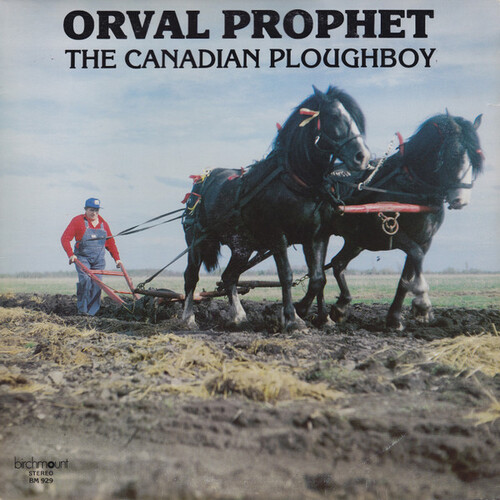
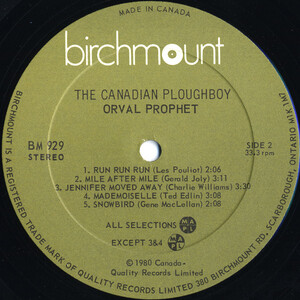
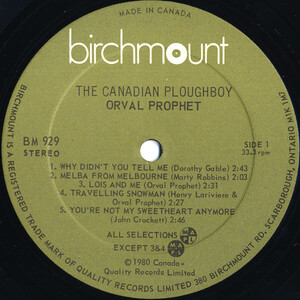
Prophet’s 1980 Birchmount album The Canadian Ploughboy served as both a reintroduction and a tribute. Its selections reached back across his catalogue, including ‘Why Didn’t You Tell Me’, ‘Melba from Melbourne’, ‘Lois and Me’, ‘Travelling Snowman’, ‘You’re Not My Sweetheart Anymore’, ‘Run Run Run’, ‘Mile After Mile’, ‘Jennifer Moved Away’, ‘Mademoiselle’, and ‘Snowbird’. The liner notes by Dallas Harms placed Prophet in the lineage of Canadian country pioneers, crediting him as an influence on later artists and recalling that Waylon Jennings admired his voice and knew his records from his own early years.
Prophet’s later recordings continued into the early 1980s with the Acclaim album True Blue and singles such as ‘A Little League in Heaven’, ‘I’m Going Back to Birmingham’, ‘I’ll Lay My Head in Carleton County’, ‘Secret Love’, ‘Please Accept My Apology’, ‘Time’, ‘Born to Booze’, and ‘So Round, So Firm, So Fully Packed’. Even after decades in the business, he remained closely tied to the older country tradition, drawing on train songs, farm songs, road songs, religious material, heartbreak ballads, and Canadian place-name songs.
Prophet’s career was interrupted repeatedly by serious heart trouble. He suffered heart attacks in 1970 and underwent open-heart surgery later that year, but he continued to perform and record. He died in Ottawa on January 4, 1984, at the age of 61. Contemporary obituaries remembered him as a Canadian country music star whose biggest hits included ‘Mile After Mile’ and ‘Mademoiselle’, and noted that he had been among the first Canadians to record in Nashville.
Orval Prophet’s legacy rests on more than one hit or one stage name. He was a bridge between the old Ottawa Valley country circuit, Nashville recording culture, Canadian radio and television, and the independent country labels that documented Canadian artists through the 1960s, 1970s, and early 1980s. As The Canadian Ploughboy, Orval Rex Prophet, Rex Prophet, and Johnny Six, he left behind one of the foundational catalogues in Canadian country music.
-Robert Williston
Gallery
Images
3 images
Orval Prophet (Rex) The Canadian Ploughboy (6)
Orval Prophet (Rex) The Canadian Ploughboy (7)
The Canadian Ploughboy
Media
Videos
0 videos
No videos available for this title.
Credits
Musicians
Orval Prophet: vocals
Songwriting
‘Why Didn’t You Tell Me’ written by Dorothy Gable
‘Melba from Melbourne’ written by Marty Robbins
‘Lois and Me’ written by Orval Prophet
‘Travelling Snowman’ written by Henry Lariviere and Orval Prophet
‘You’re Not My Sweetheart Anymore’ written by John Crockett
‘Run Run Run’ written by Les Pouliot
‘Mile After Mile’ written by Gerald Joly
‘Jennifer Moved Away’ written by Charlie Williams
‘Mademoiselle’ written by Ted Edlin
‘Snowbird’ written by Gene MacLellan
Artwork
Horses compliments of Dave Mackey, Edwards, Ontario
Photography by Joe Rowan, Winchester Press
Manufacturing and Distribution
Manufactured and distributed in Canada by Fabrique et Distribue au Canada par Quality Records Limited, 380 Birchmount Road, Scarborough, Ontario
Liner notes
This album contains some of Orval Prophet’s earlier releases. If your hobby or listening pleasure is collecting Canadian Country Artists who have pioneered Country Music in Canada, this album is a credit to your collection.
Orval has paved the way for many Canadian Artists, including myself, and to know him is to love him. I guess I’d have to say ‘There’s a little bit of Orval in a lot of us.’ And it’s not unusual to hear Country Singers in Night Clubs doing impersonations of Orval Prophet singing ‘Mile After Mile’ with their left hand shaking a finger at someone while the right leg is bobbing up and down like a pump handle. To me that’s a mark of success, and Orval Prophet is certainly one of a kind.
A few years ago, Orval and myself were in Nashville at Jack Clements Recording Studio, and Gary Buck was doing the final mix on Orval’s newest album. I had heard that Waylon Jennings would be in Studio “B” doing some overdubs on his wife’s latest album, so I had a friend who worked at RCA invite him over.
As I was introducing Waylon to Gary Buck, I noticed Waylon lending an ear to the playback of Orval’s finished album. He said, “that sounds like Orval Prophet. I’d know that voice anywhere. When I was starting out I used to buy his records and try to imitate him.” I asked Waylon if he would like to meet Orval, and he replied “I’d love to.” As they were shaking hands Gary Buck and I felt pretty damned proud to know that Waylon Jennings is an admirer of Orval Prophet, The Canadian Ploughboy and his music.
— Dallas Harms
Notes
Made in Canada
All selections MAPL except tracks 3 and 4.
℗ 1980 Canada - Quality Records Limited
Also issued on 16th Avenue Records AVE-5703 in 1983.
16th Avenue Records edition:
℗ 1983 Acclaim Records Inc.
Manufactured and distributed in Canada by Acclaim Records Inc., c/o 1343 Matheson Blvd. E., Mississauga, Ontario L4W 1R1
No Comments