Insight
The Poppy Family emerged from Vancouver's rapidly evolving music scene in the mid 1960s, a period when West Coast folk clubs, teen television shows, and garage bands were shaping a new Canadian pop identity. The group began not as a formal band but as a creative alliance between two young performers moving through the same circuit. Susan Pesklevits was a gifted teenage singer from Saskatchewan who settled in British Columbia and quickly found steady work on CBC’s Music Hop. Terry Jacks, a guitarist and songwriter active in several local groups including The Chessmen, appeared on the same program. Their chemistry, both musical and personal, was immediate.
The first configuration of what would become The Poppy Family formed when Susan invited Terry to accompany her at live shows. By 1966 they were performing as a trio with guitarist Craig McCaw, a player whose mixture of folk technique and emerging psychedelic influences added a distinctive colour to their arrangements. The group passed through several names, among them The Powerline and Winkin’, Blinkin’ and Nob. When the time came to establish something more permanent, they settled on The Poppy Family, a name discovered in a dictionary and chosen for its combination of gentleness and possibility. Susan and Terry married in 1967, anchoring the project with a shared commitment to songwriting and studio experimentation.
The Poppy Family’s definitive sound took shape with the addition of Satwant Singh, a classically trained Indian percussionist who played tabla and other hand drums. Singh’s arrival in 1968 expanded the trio’s palette into territory few North American pop groups were exploring. The group’s early singles were recorded in Vancouver and reflected the hybrid that would define them: folk inspired melodies, lush string arrangements, West Coast psychedelia, and the rhythmic grounding of South Asian percussion. Their debut single, Beyond the Clouds, introduced Susan’s clear, unaffected vocal style and Terry’s preference for understated but emotionally direct lyrics. Its flip side, Free From the City, hinted at their growing interest in blending pop structure with non Western textures.
Their national breakthrough came with Which Way You Goin’, Billy?, recorded in 1969 and released the following year. The song, inspired by the emotional toll of the Vietnam War on those left behind, was shaped through an intense recording session in which Susan delivered one of her most vulnerable performances. The single reached number 1 in Canada and climbed to number 2 on the Billboard Hot 100 in the United States, held back only by The Beatles’ The Long and Winding Road. It sold more than two and a half million copies worldwide and cemented the group’s international reputation.
The success of Which Way You Goin’, Billy? propelled the release of their debut album of the same name in 1970. Recorded partly in Vancouver and partly in London with members of the London Philharmonic Orchestra, the album showcased the full extent of their stylistic reach. Songs such as You Took My Moonlight Away and That’s Where I Went Wrong demonstrated Terry’s evolving production approach, Craig McCaw’s sitar and guitar textures, and Singh’s tabla patterns that gave the group a character unlike any other pop act in North America. The record produced several Canadian hits and reinforced Susan as one of the most compelling vocalists of the period.
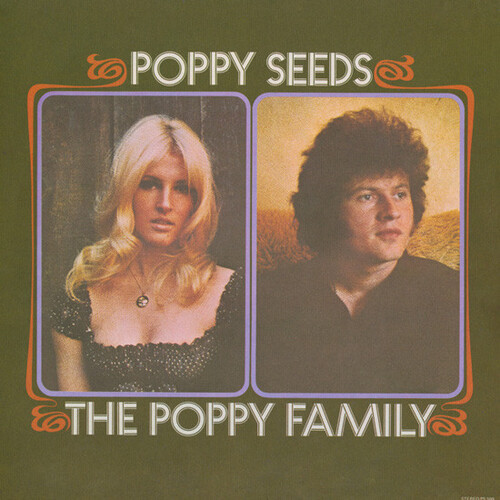
By the time of their second album, Poppy Seeds (1971), the internal dynamics of the group had shifted. Terry released Craig and Satwant from the project and completed the record using studio musicians, tightening the arrangements and leaning further into pop structure. Though less eclectic than the first album, Poppy Seeds generated a run of popular singles including Where Evil Grows, Good Friends?, I Was Wondering, and Tryin’. Where Evil Grows in particular became a cult favourite, remembered for its unusual lyrical darkness and tightly wound rhythmic feel. Despite their continued chart presence, the marriage between Susan and Terry was deteriorating, and by 1972 the Poppy Family name was phased out.
Both continued recording, often still working on each other's projects. Terry had begun issuing solo singles as early as 1970, while Susan prepared her own material even as the group was unravelling. The two assisted one another on their first solo albums, with Terry developing Seasons in the Sun and Susan recording what would become I Thought of You Again. By 1973 they had separated, bringing an abrupt end to a band that had, within a short span, bridged folk, light psychedelia, baroque pop, and Indo Canadian musical influences in ways that prefigured later explorations by artists seeking to merge Western and non Western forms.
Onstage and in the studio The Poppy Family were never a conventional pop combo. They were a Vancouver band shaped by the Coast’s hybrid sensibilities, comfortable working between genres and among diverse musical traditions. Susan’s voice carried a clarity and emotional steadiness that anchored even the most experimental arrangements. Terry’s songwriting drew from personal experience, environmental concerns, and an interest in understated storytelling. McCaw’s sitar and guitar lines, paired with Singh’s tablas, placed them in a lineage that touched on raga rock and modal folk without ever losing the grounding of North American pop.
The group’s recordings, long unavailable after their initial release, have since been reissued and reappraised, drawing attention to their role in defining a uniquely Canadian form of late 60s and early 70s pop music. Their blend of acoustic and electric textures, orchestral elements, and non Western instrumentation remains striking for its era. For a few years The Poppy Family created a sound that was both intimate and expansive, optimistic and melancholic, rooted in the Pacific Northwest yet open to the wider world, a reflection of the possibilities and tensions that defined the period in which they worked.
-Robert Williston
Musicians
Susan Jacks: vocals
Terry Jacks: vocals
Songwriting
‘No Good to Cry’ written by Al Anderson
‘Tryin’’ written by Terry Jacks
‘Good Friends?’ written by Terry Jacks
‘I Started Loving You Again’ written by Merle Haggard
‘I’ll See You There’ written by Terry Jacks
‘I Was Wondering’ written by Terry Jacks
‘Where Evil Grows’ written by Terry Jacks
‘Living Too Close to the Ground’ written by Terry Slater
‘Someone Must Have Jumped’ written by Terry Jacks
‘So Used to Loving You’ written by Sonny Curtis
‘Remember the Rain’ written by Bob Lind
‘Winter Milk’ written by Joe Fahrni
Producer and arranged by Terry Jacks
Engineered by Rolly Newton and Si Garber
Mixed by Michel Lachance
Manufactured by London Records, Inc.
Pressed by Audio Manufacturing Record Co., Lakewood (Audio Lakewood pressing variation)
Published by Gone Fishin’ Music Ltd.
Gallery
Images
4 images
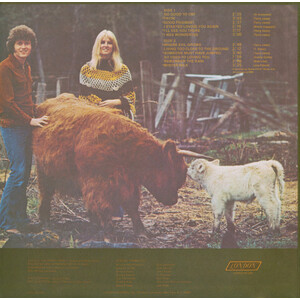
Poppy Family - Poppy Seeds
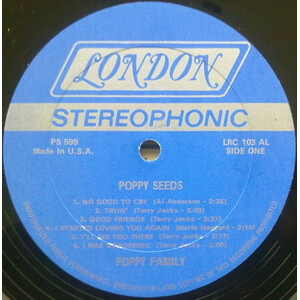
Poppy Family - Poppy Seeds
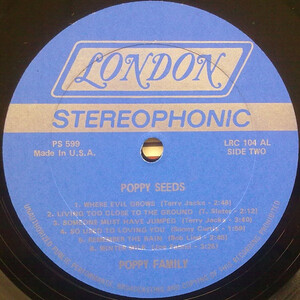
Poppy Family - Poppy Seeds
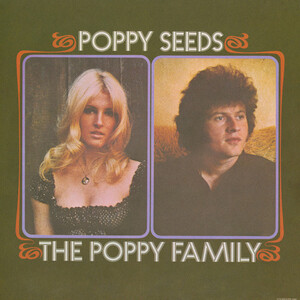
Poppy Seeds
Media
Videos
0 videos
No videos available for this title.
Credits
In Transit
No Comments