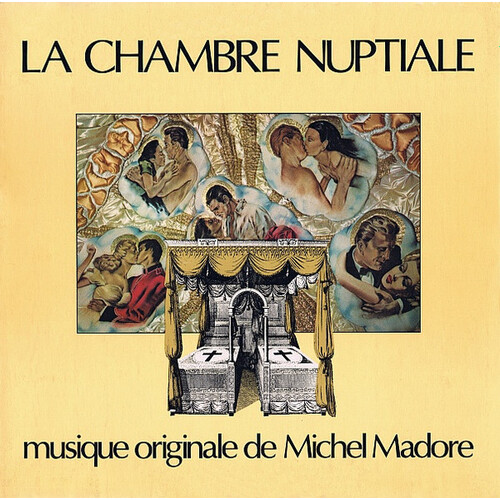
Insight
Michel Madore emerged in the late 1960s and early 1970s as a singular figure within Quebec’s creative underground, equally drawn to music, visual art, and experimental forms that resisted easy categorization. Born in Montreal in 1949, Madore studied visual arts in Quebec at a moment when boundaries between disciplines were dissolving. From the outset, his work reflected a broader philosophical outlook: creation as an act of free will, intuition, and inward exploration rather than stylistic conformity.
In the mid-1970s, Madore began to translate these ideas into music. Working in Montreal between 1975 and 1976, he conceived two parallel projects. One was a full-band instrumental exploration rooted in progressive rock, jazz, and emerging electronic textures, resulting in Le Komuso à Cordes, released on Barclay in 1976. The other was a more conceptual and experimental work that would later evolve into La Chambre nuptiale. These projects were not conceived as commercial exercises but as extensions of Madore’s wider artistic practice, emphasizing space, tone, and gradual transformation over traditional song structures.
Le Komuso à Cordes placed Madore at the quieter, more introspective end of Quebec’s progressive spectrum. Surrounded by musicians drawn from the province’s jazz and avant-rock circles, he created music that balanced acoustic instruments with synthesizers and tape-era electronics, allowing textures to breathe and unfold at their own pace. The album’s calm, meditative quality reflected Madore’s interest in atmosphere and inner motion rather than surface virtuosity, distinguishing him from many of his contemporaries while firmly situating him within the fertile Montreal scene of the period.
In 1977, Madore relocated to Paris, a move that marked a gradual shift away from public musical activity and toward a deeper immersion in visual art. Although he completed and presented La Chambre nuptiale after returning temporarily to Canada—where it was premiered as part of a special exhibition—music increasingly became one element within a much wider creative universe rather than a primary focus. By the early 1980s, Madore had largely withdrawn from recording, dedicating himself fully to painting, drawing, and sculpture.
Over the ensuing decades, Madore established an international reputation as a visual artist, particularly in France and Asia. His work came to be defined by spare, flowing lines, restrained use of colour, and an emphasis on silence, gesture, and negative space. A pivotal moment occurred in 2001, when a visit to Xi’an, China’s ancient capital, and the Han Yang Ling Mausoleum provoked a profound emotional response. The encounter with history, time, and elemental form left a lasting imprint on his artistic language.
Drawing from both Western abstraction and Eastern calligraphic traditions, Madore developed a highly personal visual vocabulary. His ink drawings and large-scale works—often executed with charcoal pencil and Chinese ink—are marked by meandering, interlacing lines and carefully controlled empty space. These elements intertwine and overlap in ways that suggest movement, breath, and internal rhythm, echoing the same sensibility that once guided his music. Nature and humanity, restraint and expression, coexist in quiet tension.
This convergence of philosophies was particularly evident in major exhibitions, including his 2011 solo presentation in Shenzhen during the Sino-French Cultural Spring, where large ink paintings and monumental sculptures were unveiled. Created in near-isolation at his Paris studio, these works were informed by long periods of contemplation on what it means to remain spiritually “alive” in the modern world. A sense of purified vitality runs through them, shaped by meditation, simplicity, and resolve.
Though his recorded output is small, Michel Madore’s legacy within Canadian music remains significant. Le Komuso à Cordes and La Chambre nuptiale stand as audio counterparts to a lifelong artistic journey—documents of a creator for whom sound, line, and silence are simply different expressions of the same inner pursuit.
-Robert Williston
Musicians
Michel Madore: synthesizers (ARP Pro-Soloist, Roland SH-1000, ARP Solina, Elka Rhapsody, Mini-Moog, EMS Putney), piano, Casavant grand organ, vibraphone, ocarina, voice, Japanese blocks, lyre (corde lyreuse), cimbalom, flute, percussion, chimes, twelve-string guitar
Songwriting
All compositions by Michel Madore
Published by Éditions Komdor Enrg.
Production
Produced by GRASAM and Michel Madore
Engineered by Denis Houle, Jean Besse, Jean Sauvageau, and Peter Burns
Mixed by Jean Sauvageau and Michel Madore
Recorded at Studio Jean Sauvageau, Montréal, Quebec; Marc Studio, Ottawa, Ontario; and the Office national du film du Canada
Recorded between July 1975 and March 1978
Lacquer cut at Disques SNB Ltée
Artwork
Graphic conception by Jacques Lafond
Liner notes by Francine Larivée
Notes
Studio credits appear on jacket as: Studio Jean Sauvageau Inc. (Montréal), Studio Marc Inc. (Ottawa), and Studio Jean Besse (Office national du film du Canada)
Gallery
Images
4 images
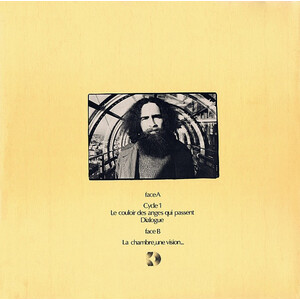
Michel Madore – La Chambre Nuptiale (3)
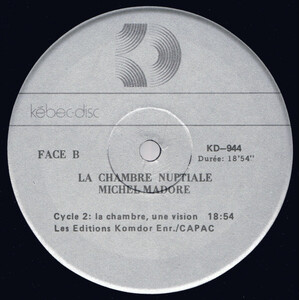
Michel Madore – La Chambre Nuptiale (1)
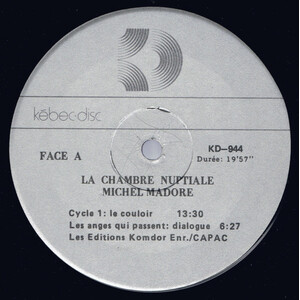
Michel Madore – La Chambre Nuptiale (2)
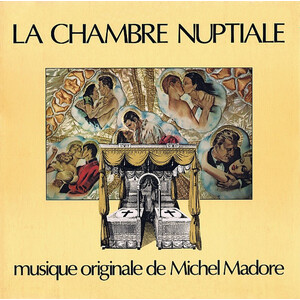
La Chambre Nuptiale
Media
Videos
0 videos
No videos available for this title.
Credits
In Transit
No Comments