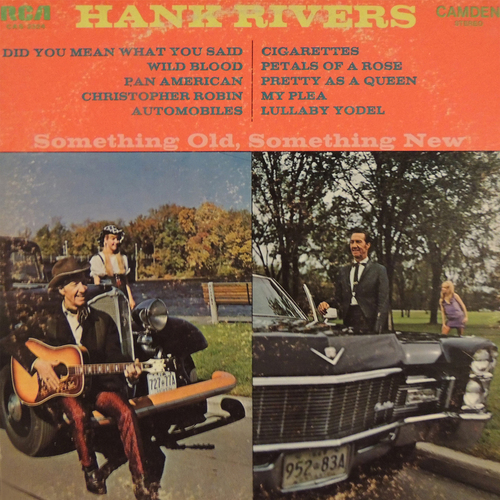
Album / Title
Something Old, Something New
By: Hank LaRiviere (Hank Rivers)
Origin: Hawkesbury, Ontario
Insight
Hank La Riviere, also known professionally as Hank Rivers, was a Canadian country singer, songwriter, guitarist, wartime entertainer, and recording artist whose career linked the Ottawa Valley, the Canadian Armed Forces, early national radio, postwar country touring, and the Centennial-era celebration of Canada in song. Born Henry La Riviere in Hawkesbury, Ontario to French and Irish parents, he moved with his family to Ottawa when he was three years old and later considered the capital his hometown. His music grew out of the country, western, military, and old-time traditions that circulated through eastern Ontario, western Quebec, radio stations, army camps, touring shows, and dance halls.
La Riviere began singing at a young age, later recalling that he started performing when he was about twelve. By seventeen he had made his first radio appearance over CFLC in Prescott, Ontario. His early career developed in the Ottawa Valley, where he sang on local radio stations and performed in night clubs and community venues. That regional base became central to his identity. He was part of the Ottawa Valley country network that produced, supported, and connected singers, fiddlers, radio hosts, touring bands, and wartime entertainers.
During the Second World War, La Riviere joined the Armed Forces. According to the liner notes to Songs by Hank La Riviere, he was on his way overseas when he was taken off the ship and returned to hospital for an operation. He was later discharged, travelled west, and entertained at stops along the route, including the Calgary Stampede and exhibitions in Toronto and Ottawa. Determined to serve, he re-enlisted as an entertainer and sang in troop shows across Canada. His wartime and military-themed repertoire became one of the defining parts of his public identity, and he became known as “The Singing Soldier.”
That nickname followed him into his recording career. La Riviere recorded for RCA Victor under the “Singing Soldier” identity, and his army-themed songs remained associated with him long after the war. The Banff LP A Salute to Gallant Men gathered that side of his career into a dedicated tribute album, presenting songs such as ‘I’m A Convict With Old Glory In My Heart’, ‘The Soldier’s Ballad’, ‘Our Sergeant Major’, ‘The Longest Day’, ‘Hurrah! For Camp Borden’, ‘Gallant Men’, ‘I’m Sending You Red Roses’, ‘Your Mother Is Praying For You’, ‘The Big Battle’, and ‘The Wild Colonial Boy’. The album was framed as a salute to his army buddies, their mothers, and sweethearts, and its notes emphasized the affection audiences still had for the old army songs he had carried through his career.
La Riviere’s radio work extended well beyond early regional appearances. He was featured with The Western Five on CBC network broadcasts, performing two radio programs a week for more than two years. He later described that period as part of the time when he became widely known as the Singing Soldier. After his army discharge, he returned to Ottawa and again became vocalist for The Western Five on the CBC network, an experience that placed him within the broader national radio circuit during a period when Canadian country music was still shaped by live broadcast, station bands, barn-dance programming, and travelling entertainers.
Touring was central to his life. He worked with Wilf Carter, Joe Brown, and the Hill-Billy Jewels, including a fourteen-week tour that took him to the outports of Newfoundland. He also spent time in Vancouver, British Columbia with Bill Rea of CKMO, singing on radio and performing in night clubs, and later recalled meeting Pat Morgan and playing engagements on the West Coast. His notes for Hank’s Centennial Travels read almost like a personal road diary of Canada: Newfoundland with Wilf Carter and Joe Brown; Nova Scotia during the war; Prince Edward Island’s red soil and warm audiences; New Brunswick’s army memories and musical friendships; Quebec’s country audiences and RCA Victor studios in Montreal; Ottawa and the St. Lawrence as his Ontario home ground; Winnipeg and the Red River Valley; Saskatchewan’s Moose Jaw radio connections and Wood Mountain Stampede; Alberta’s Calgary Stampede and mountain scenery; and British Columbia’s Vancouver, Victoria, North Vancouver, Prince Rupert, and the Fraser River.
One of La Riviere’s most important contributions to Canadian country music was his lyric to ‘Maple Sugar Sweetheart’. The melody came from Ward Allen’s fiddle classic ‘Maple Sugar’, one of the best-known Canadian fiddle tunes of the postwar era. La Riviere wrote words to the tune and turned it into ‘Maple Sugar Sweetheart’, a song that became strongly identified with him and was recorded by multiple artists. In his own notes, he recalled meeting Ward Allen in Ottawa and explained that Allen wrote the music for ‘Maple Sugar’ while he wrote the words and gave it its vocal title. The connection placed La Riviere directly alongside one of the most significant figures in Canadian old-time fiddle music and helped bridge fiddle repertoire and country song.
La Riviere’s early Banff and Rodeo period documented both his country-song catalogue and his place among Canada’s postwar country entertainers. Hank LaRiviere and The Country Kings, issued by Banff as RBS 1056, included ‘The Ranger Speaks’, ‘Little Johnnie’s Last Ride’, ‘Maple Sugar Sweetheart’, ‘Hank’s Travelling Blues’, ‘How My Yodeling Days Began’, ‘The Ballad Of Rodger Young’, ‘Goodbye Mary Dear’, ‘Big Chief Buffalo Nickel’, ‘The Trains Late Tonight’, and ‘The Gangsters Warning’. The album placed him within the same Banff/Rodeo catalogue world as Joe Murphy, Ron McMunn, Jimmy MacLellan, Ed Gyurki, Ken Davidson, Byron MacPhee, Bernie Ley, Joe MacDougall, and other Canadian country, fiddle, and old-time performers.
Songs by Hank La Riviere, released on Banff as RBS 1117, presented him as a songwriter and storyteller. Its selections included ‘Banjo Sam’, ‘Talk About Hawaii’, ‘Rose From The Garden Of Prayer’, ‘Patrick Murphy’, ‘Uncle Sammy’, ‘Barnyard Twist’, ‘Harbour Of Regret’, ‘Hobo Bill’, ‘When The Good Lord Moves In’, and ‘Big Semi Trailer’. The back-cover biography stressed the breadth of his entertainment life, noting his long travel schedule, wartime service, CBC work, association with Wilf Carter, radio and nightclub performances, and friendships across the Canadian country field. Ken Reynolds’ notes also included a tribute from Hank Snow, who praised La Riviere as one of Canada’s notable country artists and as a respected friend.
A Salute to Gallant Men, released by Banff as RBS 1143, returned directly to La Riviere’s military identity. Its back-cover “Army Biography of Henry (Hank) La Riviere” traced his Hawkesbury birth, Ottawa upbringing, wartime service, troop entertainment, connection to Captain George Hamilton of the original Tin Hats Revue, RCA Victor recordings, and long audience memory for his army songs. The album also named several fellow artists he admired or counted as friends, including Bob King, Ward Allen, Ken Davidson, Vince LeBeau, Joe Brown, Mac Beattie and his Melodiers, and Ted Daigle and his Music Men. That network is important: La Riviere’s career was never isolated from the broader Canadian country scene. It moved through a web of bands, radio people, fiddlers, military entertainers, touring packages, and regional stars.
By 1967, performing as Hank Rivers, he released Hank’s Centennial Travels, one of the clearest examples of his country-patriotic writing. Issued on Excellent Records as ESP-110 and also associated with RCA Camden CAL 2179, the album was built around Canada’s Centennial year and turned his cross-country memories into a province-by-province song cycle. Produced by Alan Sherman, associate produced by Ted Daigle, and recorded at RCA Victor Studios in Montreal, it featured Ted Daigle and His Music Men with Ted Daigle and Gilbert Glazier on guitars, Joe Pino on bass, and Byron Stever on drums. The album included ‘Hank’s Travels’, ‘Come Where We’re At’, ‘My Nova Scotia Home’, ‘Red River Valley’, ‘My Home By The Fraser’, ‘Where The St. Lawrence River Flows’, ‘Prince Edward Island Is Heaven To Me’, ‘Blue Canadian Rockies’, ‘Girl From Saskatoon’, ‘French Song’, ‘Take Me Back To Old New Brunswick’, and ‘Something To Sing About’.
Hank’s Centennial Travels was more than a souvenir of 1967. It functioned as a musical map of Canada through the eyes of a working country entertainer. In the notes, La Riviere described crossing provincial borders, remembering audiences, radio contacts, stampedes, military camps, ships, railway travel, and friends made through music. The record captured a particular mid-century Canadian sensibility: patriotic but personal, regional but national, rooted in travel rather than abstraction. The songs were not only about provinces; they were about the lived circuit of a singer who had moved through them.
La Riviere’s career shows how Canadian country music developed outside a single commercial centre. He recorded in Montreal, worked from Ottawa, toured Newfoundland, appeared in Western Canada, spent time in Vancouver, and built repertory from military songs, old-time fiddle material, country ballads, comic pieces, road songs, and patriotic numbers. He belonged to the generation of performers who carried Canadian country through radio barns, military shows, local stations, early television, small labels, and national tours before the later infrastructure of Canadian country music was fully formalized.
As Hank La Riviere, he was The Singing Soldier, the Ottawa Valley country vocalist, and the songwriter connected to ‘Maple Sugar Sweetheart’. As Hank Rivers, he became the travelling Centennial troubadour, turning his life on the road into a Canadian songbook. His recordings preserve a career built on movement: from Hawkesbury to Ottawa, from army camps to CBC broadcasts, from RCA Victor to Banff, Rodeo, Excellent, and RCA Camden, from the Calgary Stampede to Newfoundland outports, from Montreal studios to Vancouver radio rooms, and across the country he spent decades singing about.
-Robert Williston
Gallery
Images
3 images
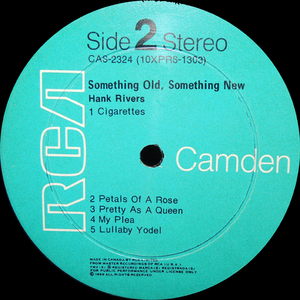
Hank LaRiviere (Hank Rivers) - Something Old, Something New Side 2
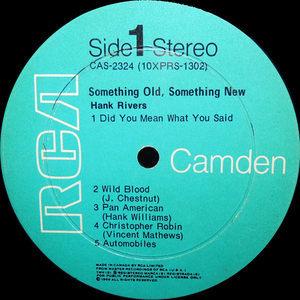
Hank LaRiviere (Hank Rivers) - Something Old, Something New Side 1
Something Old, Something New
Media
Videos
0 videos
No videos available for this title.
Credits
In Transit
No Comments