Insight
Tommy Hunter was one of the great national figures in Canadian popular music: a country singer, guitarist, broadcaster, television host, cultural ambassador, and builder of Canadian country music whose career stretched from postwar church halls and local radio to national television, American syndication, and farewell concerts before four generations of fans. Known across the country as “Canada’s Country Gentleman,” Hunter brought country music into Canadian living rooms with dignity, warmth, professionalism, and an instinctive respect for audience loyalty. For nearly three decades, The Tommy Hunter Show was not simply a music program; it was a Canadian household ritual, a weekly meeting place where rural and urban audiences, Canadian performers, Nashville legends, gospel singers, fiddlers, dancers, families, and emerging stars could all belong.
Thomas James Hunter was born in London, Ontario, on March 20, 1937. He was the son of a railway worker and came of age in the years just after the Second World War, when radio, records, travelling stage shows, church socials, veterans’ halls, movie-theatre variety bills, and live community performance were still essential parts of everyday entertainment. His musical awakening came early. Around the age of nine, after seeing Roy Acuff and His Smoky Mountain Boys perform, Hunter became determined to learn guitar. His father, unable to buy him one outright, arranged the next best thing: lessons and a rented guitar. That modest beginning became the start of one of the longest public careers in Canadian country music.
Roy Acuff remained one of Hunter’s defining models. What impressed him was not only Acuff’s music, but the way he treated an audience: as important people in an important community. Hunter absorbed that lesson completely. He did not see performance as display alone. He saw it as service, communication, and trust. As a boy, he began performing wherever he could: churches, veterans’ hospitals, garden parties, strawberry socials, legion dinners, local theatres, and community events. He learned to read a room before he ever had a band behind him. With only a guitar, a few songs, and an expanding bag of stage instincts, he discovered how to get strangers clapping, singing, and feeling included.
Those early years shaped the artist more deeply than any formal training could have. Hunter haunted local record shops, listening in booths to Eddy Arnold, Hank Snow, and other country singers, often writing out lyrics by hand because he could not afford to buy the records. He learned repertory the hard way: by ear, by memory, and by necessity. He also learned how easily country music could be misunderstood or mocked. An early theatre audition, in which he was asked to sing as a “hillbilly” character, left him angry when the production team laughed; but the experience helped form the polished public manner he later used to neutralize condescension toward country music. Hunter would spend much of his career proving that the music did not need to be dressed down to be authentic.
His first major radio opportunity came while still a teenager. After appearing in a theatre production, he was invited by London disc jockey Norm Pringle to perform on the air. Expecting perhaps a brief appearance, Hunter found himself required to fill a live, spontaneous thirty-minute program. It was a trial by fire, and it revealed another side of him: not only singer and guitarist, but host, talker, storyteller, and master of the easy transition. That ability to make live performance feel relaxed would become one of the foundations of his later television success.
Hunter’s national break came in 1956, when he joined CBC Television’s Country Hoedown as rhythm guitarist with King Ganam’s Sons of the West. He was still a teenager, but the timing was perfect. Canadian television was young, CBC was building a national culture through broadcasting, and country music still had a large audience that was often underestimated by urban programmers. Country Hoedown gave Hunter a place inside the new medium, first as a supporting musician and then as an increasingly familiar performer. The program became his apprenticeship in national television, and by the mid-1960s he was ready to carry his own name into the title.
While still associated with Country Hoedown, Hunter also moved into radio with his own CBC program, The Tommy Hunter Show, which began in 1960. The schedule was demanding: television commitments, radio performance, writing, arranging, rehearsing, and personal appearances. When his radio producer-writer moved on, Hunter had to learn quickly how to shape his own daily program. Radio’s appetite for fresh material pushed him beyond a narrow country repertoire into pop and other accessible songs, helping him broaden his musical reach without losing his country identity. That broad-but-rooted approach would later become central to his television success.
In 1965, at only twenty-eight, Hunter was given his own CBC television series. The Tommy Hunter Show debuted as a half-hour black-and-white program and grew into one of the most durable music-variety programs in North American broadcasting. It aired weekly on CBC from September 17, 1965, to April 11, 1992, a twenty-seven-year run that made it one of the longest-running programs of its kind in television history.
From the beginning, Hunter knew what he did not want. He did not want barns, hay bales, corn stalks, or the exaggerated “hayseed” image that had so often framed country entertainment. He believed country music deserved better. His ambition was not to make country music slick beyond recognition, but to present it with class, respect, and production values equal to other major television entertainment. His model was closer to Perry Como than caricature: relaxed, musical, respectful, and intimate. He understood that if country music was to last on national television, it had to be presented not as novelty, but as culture.
That philosophy made The Tommy Hunter Show distinct. It was a variety program within CBC’s structure, but it resisted the usual variety-show clutter. It was, in practice, a show about the music, built around serious musicianship rather than sketches or spectacle. Its regulars over the years included major Canadian country and roots figures such as The Rhythm Pals, Al Cherney, Donna Ramsay, Jim Pirie, Debbie Lori Kaye, Red Shea, the Allan Sisters, Gordie Tapp, and the Andy Body Dancers.
Hunter’s great strength was that he understood television without surrendering to television fashion. He knew the camera made the performance personal. Everything he did on the show was being done in people’s living rooms. That sense of intimacy mattered. His audience did not feel marketed to; they felt visited. His manner was formal enough to be respectful, but never cold. He was tall, composed, courteous, and controlled, but the warmth was real. The “Country Gentleman” image endured because it was not merely a slogan. It reflected a code: respect the song, respect the guest, respect the viewer.
The show became one of the most important platforms Canadian country music ever had. Hunter welcomed major international stars, including Hank Snow, Roy Acuff, Kitty Wells, Johnny Cash, Loretta Lynn, Roy Rogers, Dale Evans, Reba McEntire, Alan Jackson, Garth Brooks, Trisha Yearwood, Clint Black, Martina McBride, The Judds, and many others. But he also made room for Canadian performers and younger artists who needed national exposure. The program introduced or amplified performers who later became household names, including Carroll Baker, Rita MacNeil, Michelle Wright, Bruce Cockburn, Alison Krauss and Union Station, Ricky Skaggs, and a young Eileen Twain, later Shania Twain, who appeared on the show as a teenager.
For Canadian country musicians, that platform mattered enormously. Hunter offered something that was still rare: a national stage on which Canadian country performers could appear beside American stars without seeming secondary. His show helped create continuity between the older world of Canadian radio barn dances, regional country circuits, and travelling live entertainment, and the newer world of national television. He made country music visible across class, region, and generation, and he did it without making the music apologize for itself.
Hunter’s own recording career was sometimes overshadowed by his television fame, but it was substantial and deeply connected to his public identity. His signature song, “Travellin’ Man,” became inseparable from the travelling spirit of his show and later from his touring band, The Travellin’ Men. Other important recordings included “Cup of Disgrace,” “The Battle of the Little Big Horn,” “Mary in the Morning,” “Half a World Away,” “Walk With Your Neighbour,” “Wait for Sunday,” “Bill Jones General Store,” “Born to Be a Gypsy,” “Dance With Me Molly,” and “The Man of ’87.” His records placed him on Canadian country charts through the 1960s, 1970s, and beyond, while his later specialty albums, inspirational recordings, Christmas releases, readings, and concert-oriented releases served the loyal audience that followed him after weekly television ended.
What separated Hunter from many television singers was that he remained fundamentally a live performer. Throughout the television years he continued making personal appearances and used the road as a testing ground. If a song, joke, pacing idea, or audience-participation moment worked in a theatre, it might find its way back to television. The circuit also kept him connected to the people who mattered most to him: the fans outside the boardrooms, outside the ratings reports, outside the demographic assumptions of network executives.
Hunter also took Canadian country performance beyond the usual routes. His career included northern road-show ventures into the Arctic, appearances at major military bases in Canada, and performances for United Nations forces abroad. These were not incidental side trips. They reinforced the central idea of his career: that country music could travel anywhere if it was presented with sincerity, discipline, and respect. Hunter believed in bringing the show to the people, wherever they were.
That bond with the audience became especially important after CBC cancelled The Tommy Hunter Show in 1992. Hunter was deeply wounded by the decision. For him, cancellation was not merely a business change; it felt like a personal rejection after decades of loyalty to the network and to the audience. Yet the end of the show did not end his career. Instead, he returned to what had formed him in the first place: the stage. Touring with The Travellin’ Men, he continued to perform across Canada and the United States, often to capacity crowds. Many fans who had watched him on television for decades came to see him in person with children and grandchildren in tow.
In 2003, Hunter returned to CBC television with the special Talk About the Good Times, proving that the appetite for his kind of family entertainment had not disappeared. His later live shows and specialty recordings were sustained by the same principle that had guided him since childhood: respect the people who came to listen. After concerts he was known to spend long periods signing autographs and greeting fans. It was not an add-on to the show; it was part of the compact.
Hunter used his public profile for charitable work throughout much of his career. He supported organizations including the Cancer Society, the Heart Fund, the Cystic Fibrosis Foundation, children’s hospitals, humane societies, and animal-rescue causes. In the death notice released after his passing, his family asked that donations be made to the London Humane Society or to an animal rescue organization of the donor’s choice, a fitting reflection of his long affection for animals.
His honours reflected both musical and broadcasting achievement. Hunter won the Juno Award for Best Male Country Singer three consecutive years, from 1967 to 1969, and was inducted into the Canadian Country Music Hall of Fame in 1984. He became a Member of the Order of Canada in 1986 and was invested in 1987. He was also appointed to the Order of Ontario in 1996, received a Gemini Award, a Broadcasting Industry Achievement Award, recognition as an Honorary Citizen of the State of Tennessee and a Kentucky Colonel, a place on the Country Music Hall of Fame Walkway of Stars in Nashville in 1990, and a Lifetime Achievement Award from the Ontario Country Music Association in 1999. In 2014, Canada Post honoured him as one of five Canadian country artists featured on commemorative stamps, alongside k.d. lang, Renée Martel, Hank Snow, and Shania Twain.
He also documented his own story. His autobiography, My Story, written with Liane Heller and published in 1985, traced the path from childhood and early struggle to Country Hoedown and the long CBC television years. The book remains an important source for understanding Hunter not as a distant television personality, but as a working performer who built his career step by step, audience by audience, song by song.
Hunter retired from professional touring in 2012, closing his career with a farewell tour that ended in his hometown of London, Ontario, on his seventy-fifth birthday. It was a fitting final bow: the boy with the rented guitar returning home after a national career that had taken him from local halls to CBC studios, Arctic road shows, military bases, American television, Nashville recognition, and stages across Canada.
Tommy Hunter died of natural causes on July 2, 2026, at the age of eighty-nine. His longtime business manager, Brian Edwards, remembered him as a man who lived and worked with grace, humility, and deep respect for the audiences who had welcomed him into their homes for decades. Hunter is survived by three children, four grandchildren, and one great-grandchild.
His legacy is larger than nostalgia. Tommy Hunter helped define how Canadian country music could look and sound on national television. He gave rural and small-town audiences a place on the national screen without caricature. He gave Canadian performers a platform beside American stars. He treated country music as something worthy of care, craft, and presentation. He made television feel local, even when it was national. He proved that sincerity, professionalism, and respect could sustain a career for more than half a century.
For generations of Canadians, Tommy Hunter was the man who came into the living room each week with a guitar, a smile, a song, and a promise that the music would be clean, warm, tuneful, and true. He was a broadcaster, but never only a broadcaster; a country singer, but never only a country singer. He was one of the great custodians of Canadian musical memory. Canada called him its Country Gentleman because no better phrase quite captured the combination of grace, discipline, loyalty, and heart that he brought to the stage.
-Robert Williston
Gallery
Images
4 images
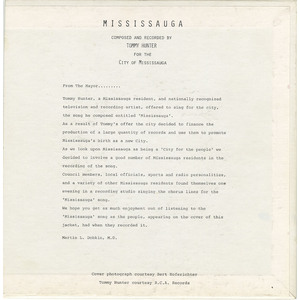
45-Tommy Hunter - Mississauga BACK
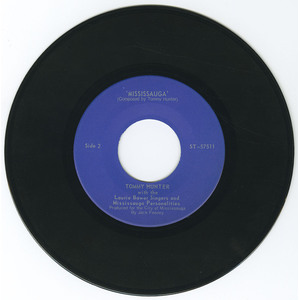
45-Tommy Hunter - Mississauga VINYL 02
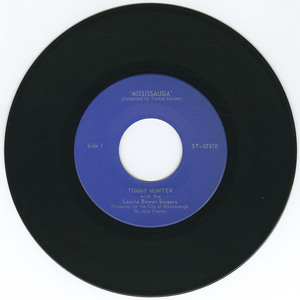
45-Tommy Hunter - Mississauga VINYL 01
Mississauga
Media
Videos
0 videos
No videos available for this title.
Credits
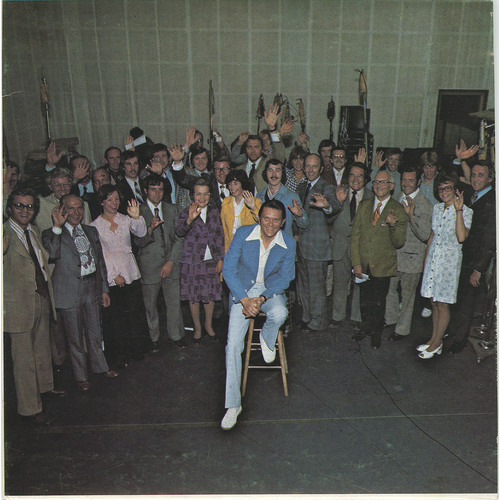
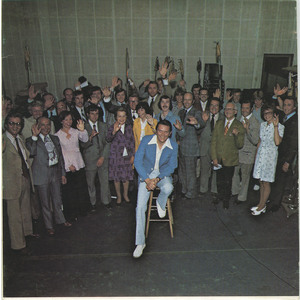
Composed and recorded by Tommy Hunter for the City of Mississauga Produced by Jack Feeney for the City of Mississauga With The Laurie Bower Singers and Mississauga personalities Cover photography by Bert Hoferichter
No Comments