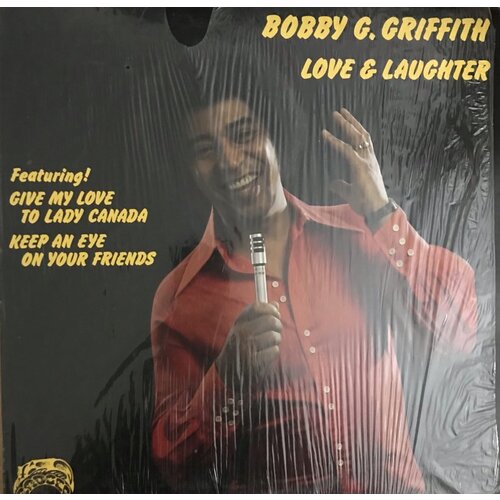
Album / Title
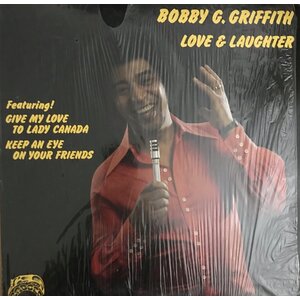
Love & Laughter
Origin: St. Boniface → Winnipeg, Manitoba → Dryden → Toronto, Ontario, 🇨🇦
Insight
Bobby G. Griffith was a Canadian singer, songwriter, producer, and entrepreneur whose career bridged early television, nightclub performance, broadcast recording, and the independent music economy of the 1960s and 1970s. His trajectory — marked by early promise, repeated industry setbacks, and sustained professionalism — reflects the experience of many Canadian performers working outside the emerging rock mainstream.
Born in 1936 in St. Boniface, Manitoba, Griffith first appeared on stage at the age of six. By his mid-teens he was already working professionally, holding a regular nightclub residency in Winnipeg between the ages of fifteen and eighteen. At twenty-one, he hosted his own television variety program in Winnipeg, establishing himself early as a confident vocalist and entertainer within Canada’s pre-rock cabaret and broadcast tradition. He toured extensively throughout Canada and the United States, developing a polished, adaptable stage presence that would define his later career.
After relocating with his family to Dryden, Ontario, Griffith eventually settled in Toronto, where he entered the city’s club circuit in the mid-1960s. During this period he fronted The New Movement and made his first commercial recordings. Two singles document this early phase: “You’re Married Now Jack” b/w “Cheater, Cheater” (1966, Amcan AMCAN 128) and “Tough Guy” b/w “Yes, It’s Me” (1967, Stone SX 720). Both releases are credited to Griffith as songwriter and place him in a straightforward mid-1960s rock context, years before his later adult contemporary and broadcast-oriented work. Neither record received sustained promotion, as both labels were short-lived, and the project did not continue beyond these two releases.
Regrouping as a solo artist, Griffith shifted toward a more adult contemporary and vocal-pop direction. A 1970 single, “Living on a Wishbone” b/w “Simplicity” (MTCC), again suffered from label instability, briefly resurfacing later through licensing but failing to establish momentum. These early false starts would become a recurring theme in his recording career.
A significant turning point came with his association with the Canadian Talent Library in the early 1970s. His self-titled CTL album presented Griffith as a versatile singer-songwriter, blending original compositions with contemporary material by Jim Croce, Ray Price, Lloyd Price, and Stevie Wonder. While none of its tracks were issued commercially as singles, the album circulated widely through broadcast channels and firmly positioned Griffith within Canada’s institutional music infrastructure.
This phase was reinforced by his appearance on the CBC Radio Canada LM Series. The 1973 single Toronto Vocalist/Composer (LM 189) featured four Griffith originals — “My Love, My Love,” “Donna Is a Woman,” “Song of Peace,” and “Ain’t No Chicken” — backed by the Jerry Toth Orchestra, formally establishing him as both composer and vocalist within the jazz-pop and broadcast music tradition.
In 1972, Griffith’s career reached its widest exposure through an introduction to Dean Kay, Vice President of Lawrence Welk’s music publishing operations, facilitated by record executive Percy Curtis. Kay brought Griffith’s song “In Her Loving Way” directly to Lawrence Welk, resulting in a publishing agreement, appearances on The Lawrence Welk Show, and a recording contract with Ranwood Records. Ranwood subsequently reissued material from the CTL album as singles — notably “The Badger’s Song” and “The Sound of Peace” — pairing them with unreleased recordings. Both singles achieved modest success on adult contemporary charts, aided by Griffith’s television exposure.
Determined to gain greater control over his recordings and career, Griffith established his own label, Badger Records, in the mid-1970s. The label was named after “The Badger’s Song,” his first significant international success. Gerry Beadle, who had written the liner notes for Griffith’s CTL album, initially served as National Promotion Director and later became president of the label, giving Badger an unusually professional structure for a small, artist-run Canadian imprint. In July 1975, Badger Records secured a Canadian distribution deal with Quality Records Limited, followed by a United Kingdom distribution agreement with Music World Scotland in November 1976.
Under the Badger imprint, Griffith released the album Love and Laughter (1975), recorded with producers Paul Zaza and Jerry Toth. The album yielded his most successful single, “Give My Love to Lady Canada,” which reached number four nationally, along with follow-up singles including “No Money Blues” and “Keep an Eye on Your Friends.” Despite renewed television appearances and professional promotion, sustained momentum again proved elusive.
Griffith continued recording and performing through the late 1970s and early 1980s. His final album, Still Together (1982, Quality Records), was released with little promotional support and passed largely unnoticed. By this stage, his career centered increasingly on the show-club and lounge circuit, particularly in western Canada. His touring bands were fluid, featuring musicians such as Valentine Bent, Jimmy Carver, Keith Retson-Spalding, Lou Fortin, George Dearling, and Sheldon Miller, several of whom later went on to notable careers of their own.
In his final years, Griffith worked predominantly in smaller venues, often fronting bands that performed contemporary Top 40 material before stepping forward for later sets. He passed away in the mid-1980s, following complications related to liver and kidney disease.
Though many of his later recordings added little to his commercial legacy, Bobby G. Griffith remains an important figure in Canadian music history — a professional vocalist, songwriter, and independent label owner whose career documents both the opportunities and the structural limitations faced by Canadian artists navigating television exposure, institutional support, and self-production during a transitional era.
-Robert Williston
Musicians
Bobby G. Griffith: vocals
Songwriting
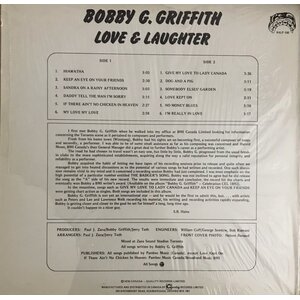
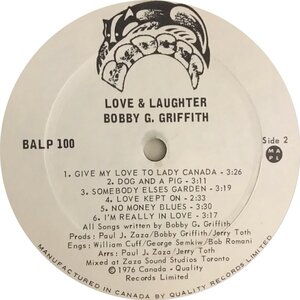
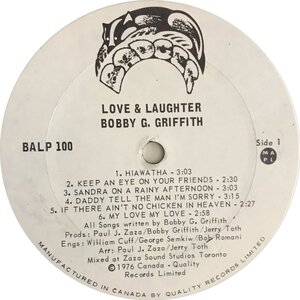
All songs written by Bobby G. Griffith
Production
Arranged by Paul Zaza and Jerry Toth
Produced by Bobby G. Griffith and Paul Zaza (Side A)
Produced by Bobby G. Griffith and Jerry Toth (Side B)
Engineered by William Cuff, George Semkiw, and Bob Romani
Recorded and mixed at Zaza Sound Productions, Toronto, Ontario
Artwork
Front cover photo by Nelson Renaud
Publishing
All songs published by Pambec Music (Canada), except 'Love Kept On' and 'If There Ain't No Chicken in Heaven', published by Pembec Music (Canada) and Broadland Music
Manufacturing
Manufactured and distributed by Quality Records Limited
Notes
Released on Bobby G. Griffith’s Badger Records imprint
“Give My Love To Lady Canada” reached number four on Canadian charts in 1975
Liner notes
I first met Bobby G. Griffith when he walked into my office at BMI Canada Limited looking for information concerning the Toronto scene as it pertained to composers and performers.
Fresh from his home town (Winnipeg), Bobby had his sights set on becoming first, a successful composer of songs and secondly, a performer. I was able to be of some small assistance as far as his composing was concerned and Harold Moon, BMI Canada's then General Manager did a great deal further. Bobby as a performing artist.
The road he had chosen to travel wasn't an easy one, but little by little, Bobby G. progressed from the usual break-in clubs to the more sophisticated establishments, acquiring along the way a valid reputation for personal integrity and reliability as a performer.
Bobby acquired the habit of letting me have tapes of his recording sessions prior to release and quite often we managed to get into heated discussions as to the potential of various songs he had written and recorded. One such discussion remains vivid in my mind and concerned a recording session Bobby had completed. I was most emphatic in advising the high potential of a particular number entitled THE BADGERS SONG. Bobby was not inclined to agree but did release the song as the "A" side of his new record. The results were immediate and conclusive; the record hit the charts and eventually won Bobby a BMI writer's award. Available on the album "Bobby G. Griffith" - Celebration CEL 1892).
In the meantime, songs such as GIVE MY LOVE TO LADY CANADA and KEEP AN EYE ON YOUR FRIENDS were getting chart action as singles. Both songs are included in this album.
Bobby G. Griffith is not yet an international star — and he would be the first to admit this, but... with artists such as Peters and Lee and Lawrence Welk recording his material, his writing and recording activities rapidly expanding, Bobby is getting closer and closer to the goal he set for himself a long, long time ago.
I couldn't happen to a nicer guy.
-S.B. Hains
Gallery
Images
4 images
Griffith, Bobby G. - Love & Laughter (4)
Griffith, Bobby G. - Love & Laughter (2)
Griffith, Bobby G. - Love & Laughter (3)
Love & Laughter
Media
Videos
0 videos
No videos available for this title.
Credits
In Transit
No Comments