Information/Write-up
Toronto-born Michael Dee Graham built a career on movement, reinvention, and a natural ease with audiences that carried him from rockabilly stages to country charts, from Montreal radio booths to national CBC television. He arrived in the early 1960s with a strong voice, a quick sense of humour, and a performer’s instinct that allowed him to slip from one musical identity to another without ever losing his grounding. When he moved from Toronto to Montreal in the early part of the decade, it was not as a band member but as a young entertainer and radio personality, soon becoming a familiar voice on CHOM and developing the high-energy persona that earned him the nickname “Canada’s Rockabilly King.” The Montreal period was where he found his confidence as both a singer and a communicator, sharpening the charisma he would later bring fully into the country market.
By the mid-1960s he shifted toward country music, a transition that broadened his emotional range and set him up for the decade of national visibility that followed. He eventually made London, Ontario his home base and, under the name Michael Dee, became one of the most recognizable voices on BX-93. His warm delivery, wit, and easy rapport gave him a deep connection to listeners across Southwestern Ontario, and his local popularity expanded further through a weekly program on CFPL-TV. That combination of radio and television exposure positioned him perfectly for the next phase of his career, when CBC hired him to co-host the final season of Countrytime with Myrna Lorrie in 1973 and 1974. It was his largest national platform to date and showed how naturally he could hold a camera’s attention.
His recording career grew steadily alongside his broadcasting work. Between 1970 and 1980 he placed nineteen singles on the RPM country charts, an impressive run that included three Top Ten hits. His revival of Johnny Horton’s “Battle of New Orleans” gave him one of his earliest national successes, while in 1979 his tender version of Elvis Presley’s “Loving You” reached number six and became the single most associated with him during the later peak of his career. His albums appeared on an array of Canadian labels including Banff, Rodeo, United Artists, GRT, Amber, Boot, ATI, and later his own Northern Gold imprint, which he used to record, publish, and promote both his material and the work of other artists. He could slip easily between identities as circumstances required, releasing material as Mike Graham, Michael Dee Graham, Michael Dee, and, for certain projects, Kyle Cody. Much of the material on his albums came from his own pen, earning him a reputation as a sturdy songwriter with an instinct for direct, melodic phrasing. Songs like “Lonely Cabdriver,” “Shadow of a Man,” “Then Came You,” “Till the Minute You Go,” and “Would You Still Love Me” all charted during this period and helped solidify his national profile.
In the midst of his Amber Records period, Graham also stretched into studio-band productions, writing and producing the 1976 single Got Nothin’ On But the Stereo for the Blind River Band, a Toronto studio outfit he led behind the scenes.
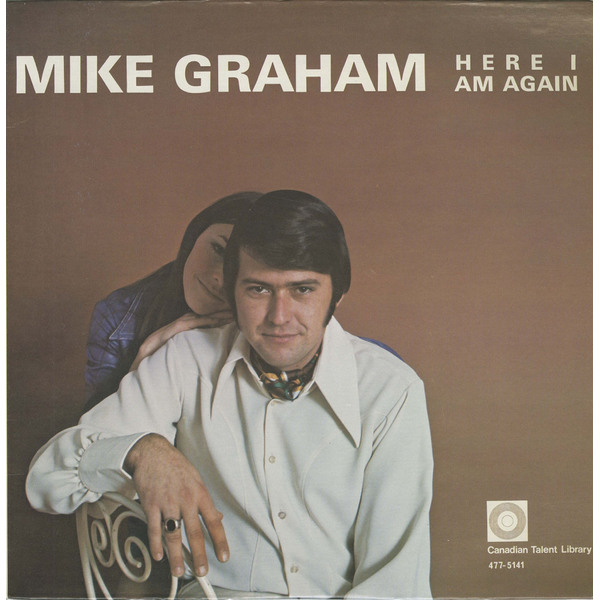
His most enduring achievement as a writer arrived in 1991 when American singer Billy Joe Royal recorded his composition “If the Jukebox Took Teardrops,” turning it into a Top Thirty Billboard country hit. The Canadian release climbed into the national Top Twenty and gave Graham a rare and satisfying moment of international recognition. Long before that success, however, he had already shown that he could deliver compelling material outside the standard country framework. His CTL album Here I Am Again, produced by Gary Buck, showcased a versatile vocalist supported by the elegant piano and arrangements of John Arpin, while his Banff album Momento of Manitoulin captured the warmth he brought to the songs of Arthur Schaller, turning regional stories into something broader and emotionally lasting.
What audiences seemed to love most, though, was the showman. On stage he mixed his own material with established country hits and comic impersonations that delighted audiences across Ontario and the Prairie provinces. His humour was never cruel, always affectionate, and carried the same warmth he brought to his radio work. That generosity extended into the community as well. He was a steady presence at fundraising events for Easter Seals, the Sunshine Foundation, the Kidney Foundation of Canada, the Canadian Cancer Society, and numerous smaller charities, where he treated his role less as a duty and more as a privilege.
Mike Graham’s life was rich in motion and expression, anchored by the desire to reach people in whatever medium he touched. He moved fluidly between performer, broadcaster, songwriter, and promoter, and at every point brought sincerity, craft, and charm to the work. He died in London, Ontario on August 18, 1993 at only forty-eight, leaving behind a catalogue of recordings, a generation of radio listeners who felt they knew him personally, and a legacy defined by versatility, dedication, and an unmistakable warmth that still registers in the grooves of the records he made.
-Robert Williston
Mike Graham: vocals
Laurie Bower Singers: backing vocals
Assumed Laurie Bower Singers:
Kathy Collier: vocals
Leith Harris: vocals
Colina Phillips: vocals
Laurie Bower: vocals
Cal Dodd: vocals
Bill Misener: vocals
Brian Russell: vocals
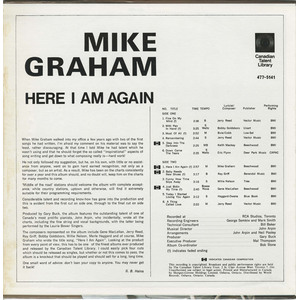
Produced by Gary Buck
Engineered by George Semkiw and Mark Smith
Recorded at RCA Studios, Toronto, Ontario
Musical Director: John Arpin
Arrangements by John Arpin and Neil Pooley
Album coordinator: Bob Stone
Executive Producer: Mal Thompson
Liner notes:
When Mike Graham walked into my office a few years ago with two of the first songs he had written, I'm afraid my comment on his material was to say the least, rather discouraging. At that time I told Mike “he had talent which he wasn't using and that he should forget the so called "inspirational" aspects of song writing and get down to what composing really is—hard work!"
He not only followed my suggestion, but he, on his own, with little or no assistance from anyone, went on to gain hard earned recognition, not only as a composer, but as an artist. As a result, Mike has been on the charts consistently for over a year and this album should, and no doubt will, keep him on the charts for many months to come.
“Middle of the road" stations should welcome the album with complete acceptance, while country stations, uptown and otherwise, will find it extremely suitable for their programming requirements.
Considerable talent and recording know-how has gone into the production and this is evident from the first cut on side one, through to the final cut on side two.
Produced by Gary Buck, the album features the outstanding talent of one of Canada's most prolific pianists, John Arpin, who incidentally, wrote all the charts, including the fine string and vocal backgrounds.
Members of the top line of brass, strings and background singers are used in the production.
The compositions presented on the album include Gene MacLellan, Jerry Reed, Ray Griff, Bobby Goldsboro, Willie Nelson, as well as three original Mike Graham pieces. Two of the songs "Slip Away" and "Here I Am Again," were produced for release only by the Canadian Talent Library. "Here I Am Again" by Mike Graham will be the vital, this has to be one of the proudest productions ever presented for your listening pleasure. The blend of a fine mixture of songs, long as the album is a knockout that should be played and should sit for a long last.
One small word of advice: don't loan your copy to anyone. You may never get it back!
-S. B. Hains

No Comments