Insight
Doug & the Slugs emerged from Vancouver in the late 1970s as a band that quietly rewrote the rules for Canadian pop-rock success. At a time when much of the national industry was oriented toward major-label pipelines and regional radio silos, the group demonstrated that a smartly run independent operation—grounded in strong songwriting, disciplined musicianship, and relentless live work—could reach a mass audience without sacrificing personality. Central to that achievement was Doug Bennett, a guitarist, vocalist, and songwriter whose work combined melodic immediacy with wit, emotional self-awareness, and a distinctly Canadian sense of understatement.
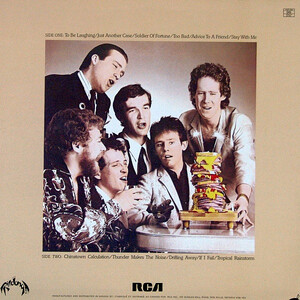
Bennett formed Doug & the Slugs in 1977, drawing on Vancouver’s club scene and his own interest in blending rhythm and blues structures with concise pop songwriting. The band’s earliest incarnations were fluid, reflecting both the realities of a working group and Bennett’s evolving vision. Initial members included guitarist John Burton, bassist Dennis Henderson, keyboardist Drew Neville, and drummers John “Wally” Watson and Ted Laturnus. Though short-lived, this first lineup established the ensemble-driven approach that would define the band’s sound.
By 1978, Doug & the Slugs had solidified into a lineup that would carry them through their most productive and influential years: Bennett, Burton, and Watson were joined by guitarist Richard Baker, bassist Steve Bosley, and keyboardist Richard Kendall. This configuration balanced tight rhythmic feel with layered vocals and crisp arrangements, allowing Bennett’s songs to land with both clarity and warmth. Rather than chasing trends, the band focused on refinement—honing a sound that was danceable, radio-friendly, and flexible enough to work in clubs, theatres, and festival settings alike.
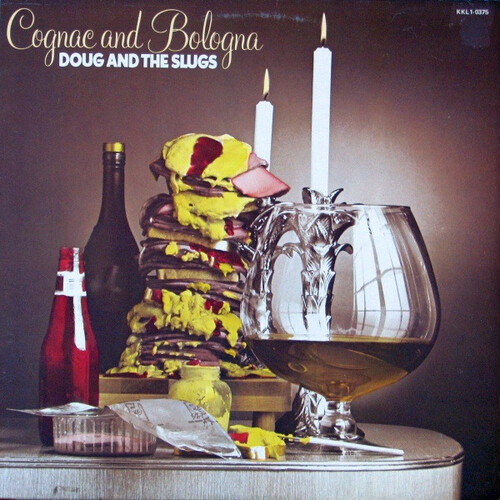
The group’s breakthrough came through self-determination rather than industry patronage. In 1980, Doug & the Slugs released the independently produced single “Too Bad,” pressing and promoting it themselves. The record’s success forced the industry to take notice, leading to a deal with RCA Records later that year. Their debut album, Cognac and Bologna (1980), captured the band at a creative peak and became one of the most successful independent-to-major transitions in Canadian rock history, selling more than 100,000 copies nationally.
Throughout the early 1980s, Doug & the Slugs built a catalogue that balanced commercial appeal with consistent craft. Wrap It! (1981) expanded the group’s sonic range, notably incorporating vocal arrangements by Toronto’s the Nylons, while Music for the Hard of Thinking (1983) delivered the band’s most enduring hit, “Making It Work.” Bennett’s songwriting during this period resonated because it addressed adult uncertainty, work, relationships, and ambition without irony or posturing—subjects rarely handled so plainly in mainstream pop.
The band reached its institutional peak with Popaganda (1985), which earned the Juno Award for Album of the Year and secured Doug & the Slugs the Group of the Year honour. By then, they were fixtures on Canadian radio, MuchMusic, and touring circuits across North America. Their songs also found extended life through film and television placements, appearing in productions such as Iron Eagle II, Meatballs II, Tough Love, and Neon Rider, reinforcing their reputation as reliable, adaptable songwriters.
Even as Doug & the Slugs remained active, Bennett pursued parallel creative paths that reflected his broader interests in performance and production. He released the solo album Animato in 1986, appeared on stage in John Gray’s musical Rock and Roll, and later co-produced an English-language adaptation of the Quebec comedy Brew. He also became a respected music-video director and producer, working with artists including Trooper, Headpins, Zappacosta, Images in Vogue, and several Canadian country acts, expanding his influence well beyond his own band.
By the early 1990s, the original lineup had largely turned over, but Doug & the Slugs continued as an active touring entity under Bennett’s leadership. By 1998, the band featured Marc Gladstone (keyboards, vocals), Chris Murray Driver (drums, vocals), Elio Martelli (guitar, vocals), and Jay Wittur (bass, vocals), a configuration that emphasized ensemble vocals and live flexibility. Rather than functioning as a nostalgia act, the band remained focused on performance and connection, sustaining a loyal audience well into their third decade.
In 2003, Doug & the Slugs marked their 25th anniversary with reunion performances in Vancouver that reunited past members and reaffirmed the band’s standing within Canadian music culture. The following year, Doug Bennett died from complications related to cirrhosis of the liver, ending a career defined as much by persistence and intelligence as by commercial success.
Since Bennett’s passing, members of Doug & the Slugs have continued to perform the band’s material, including live appearances beginning in 2009 with new frontman Ted Okos, ensuring that the group’s catalogue remains a living part of Canada’s rock tradition—rooted in melody, professionalism, and a quietly influential independent spirit.
-Robert Williston
Musicians
Doug Bennett: lead vocals, guitar
John Burton: guitar
Richard Baker: guitar
Steve Bosley: bass
John "Wally" Watson: drums
Simon Kendall: keyboards
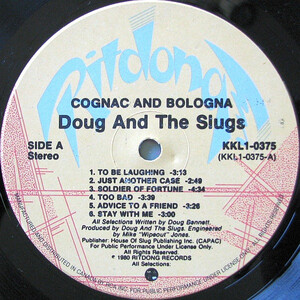
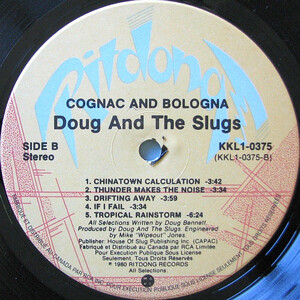
Produced by Doug And The Slugs
Engineered by Mike “Wipeout” Jones*
Recorded at Metalworks Studios
Cover photo by Hans Sipma
Gallery
Images
4 images
Doug & The Slugs - Cognac and Bologna (1)
Doug & The Slugs - Cognac and Bologna (4)
Doug & The Slugs - Cognac and Bologna (3)
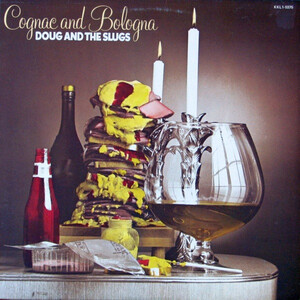
Cognac and Bologna
Media
Videos
0 videos
No videos available for this title.
Credits
In Transit
No Comments