Insight
The Courriers were an Ottawa-based folk trio whose brief recording career in the early-to-mid 1960s captured a very specific moment: when the North American folk boom was peaking, coffee houses were gateways to national exposure, and a young Canadian act could plausibly find itself moving between synagogue halls, university concerts, CBC studios, and rooms in Greenwich Village—sometimes all within the same year.
The group formed in 1958 around boyhood friends Mark Max and Russell Kronick, initially singing together in camp and community settings before formalizing as a performing act. Their earliest lineup included teenage singer Cayla Mirsky, and the group briefly performed under the name the Folklores before adopting the Courriers, a name that better fit their widening repertoire and ambitions. Both Max and Kronick came to folk music through the powerful example of Pete Seeger and the Weavers—not as imitators, but as young musicians who understood that folk could be dramatic, funny, fast, and intensely audience-facing.
By 1961–62, management and bookings began pulling them beyond Ottawa into Montréal club work, U.S. college dates, and industry auditions in New York. When Mirsky left, the Courriers found a remarkable replacement in Jean Price, whose presence added a true ballad voice and expanded the group’s range. With Price, the Courriers cut their debut album for Mercury, The Courriers Carry On (recorded in 1962; issued 1963), a high-energy set that moved confidently through traditional material, gospel, and international folk themes. It was the record that introduced many listeners to the group—particularly via “Sing Hallelujah”—and it remains their most celebrated and sought-after release, prized for its speed, clarity of diction, and “build to the climax” vocal arranging that made the trio sound larger than it was.
The Courriers’ live history was equally telling. They played the American circuit in the places that mattered: the Bitter End in Greenwich Village, the Gate of Horn in Chicago, and university stages where folk groups could deliver full-concert bills. Their repertoire also allowed them to connect across cultural lines—whether singing Hebrew material, French-Canadian songs, or spirituals like “Oh Freedom”—and they earned a reputation for being entertainers as much as “folkies,” a stance that sometimes put them at odds with purists but won them broad audiences.
After Jean Price left, the group continued with Pam Fernie, shifting toward a slightly more produced and commercially contemporary sound as the folk marketplace itself evolved. Their Canadian recordings for RCA Camden—most notably From Sea to Sea (1964)—reflected that maturation: more measured pacing, richer harmony thinking, and originals that helped define their identity, including Kronick’s title song “From Sea to Sea” and “Cherry Bough Tree.” Around the same time, the Courriers were recognized at home as a leading Canadian folk act, including being named top folk group by RPM in 1964 (an award stream that would later align with the early Juno era), and they undertook major touring and broadcast work, including their own CBC television series.
By 1966, the practical realities that shadowed many folk-era groups—career decisions, health, and the changing musical landscape—began to close the first chapter. Kronick pursued law; Max built a distinguished professional life in arts promotion and communications; and the original momentum of the early 1960s folk circuit faded as popular taste moved rapidly toward rock and electrified singer-songwriters. Yet the Courriers never truly disappeared: the music remained deeply local in Ottawa memory, and decades later Max and Kronick returned to the stage for reunion performances and benefit concerts, proving that the spark that powered their early records was rooted less in fashion than in genuine musical chemistry.
Today, the Courriers are remembered as a rare Canadian example of a folk group that briefly touched the U.S. circuit while still sounding unmistakably like what they were: sharp, ambitious young performers from Ottawa who believed folk music could be both disciplined and fun—delivered at full speed, with every word meant to land.
-Robert Williston
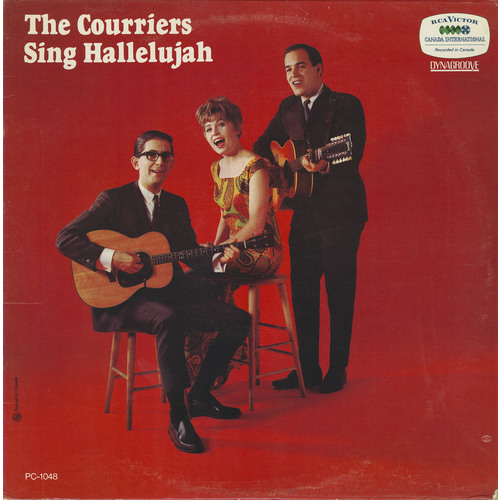
Pam Fernie: vocals
Russell Kronick: vocals, banjo, guitar
Mark Max: vocals, banjo, guitar
Peter Fleming: bass
Howie Rea: drums
Jim Pirie: guitar (I'm on the Run)
Produced and engineered by Ed Benou
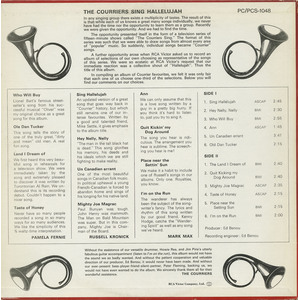
Liner notes
THE COURRIERS SING HALLELUJAH
PC/PCS-1048
In any singing group there exists a multiplicity of tastes. The result of this is that while each of us knows a great many songs individually, we never have had the time nor the opportunity to learn them as a group. Recently we were given the opportunity. And we had to find the time.
The opportunity presented itself in the form of a television series of fifteen-minute shows called “The Courriers Sing.” The format of this series was such that we were able to draw songs from almost every area of “popular” music. So suddenly, individual songs became “Courrier” songs.
A further opportunity arose when RCA Victor asked us to record an album of selections of our own choosing as representative of the songs of this series. We were so ecstatic at RCA Victor’s request that our immediate reaction was a collective shout of “Hallelujah.” Thus the title of this album.
In compiling an album of Courrier favourites, we felt it was only fair that each one of us choose one-third of the selections. Below you will find our comments on our choices.
Who Will Buy
Lionel Bart’s famous street-seller’s song from his successful musical “Oliver” was my original choice as a great song for this album.
Ole Dan Tucker
This song tells the story of the truly great, “dirty and mean” old men. A real fun song.
Land I Dream of
We first heard this very beautiful song in rehearsals for a television show. We were immediately taken by the song and extremely pleased to discover it was written by Torontonian Al Rain. We understand this is its recording debut. Couldn’t happen to a nicer song.
Taste of Honey
Never have so many people recorded a song in so many ways for so many audiences. We like the simplicity of this 3/4 waltz-time interpretation.
PAMELA FERNIE
Sing Hallelujah
An updated version of a great song that goes way back in Courrier history, but which still remains one of our intense favourites. Written by a good and talented friend, Mike Settle, it gives emphasis to the album title.
Hey Nelly, Nelly
“The man in the tall black hat is dead.” This song glorifies his memory, his deeds and his ideals which we are still fighting to make reality.
Un Canadien errant
One of the most beautiful songs in Canadian folk music. In political upheaval a young French-Canadian is forced to abandon home and sings of his longing for his native land.
Mighty Joe Magrac
Paul Bunyan was tough. John Henry was mammoth. The Man on Bald Mountain was super. But in this company, Mighty Joe is Chairman of the Board.
RUSSELL KRONICK
Ann
We can only assume that this is a love song written by a guy in a pretty big hurry. If you think it’s hard to listen to, just you try to sing it.
Quit Kickin’ my Dog Around
The song you hear is ridiculous. The arrangement you hear is sublime. The screeching you hear is me!
Place near the Settin’ Sun
We make it a habit to include one of Russell’s songs in our albums. Only one. Royalties, you know.
I’m on the Run
The wanderer has always been the subject of the songwriter’s fancy. The lyrics and rhythm of this song written by our good friend, Kenny Hodge, catch the “Wandering Spirit” as well as any song we’ve heard.
MARK MAX
Without the assistance of our versatile drummer, Howie Rea, and Jim Pirie’s utterly fabulous guitar accompaniment (listen to I’m on the run), this album would not have the sound we so badly wanted. And without the patient cooperation and valuable direction of our producer, Ed Benou, it would never have been made. And without our ever-present bass-player-friend-silent-partner, Peter Fleming, backing us, we would not have even wanted to do the album. We sincerely thank them all for their wonderful assistance.
Gallery
Images
4 images
Courriers - Sing Hallelujah BACK
Courriers - Sing Hallelujah LABEL 01
Courriers - Sing Hallelujah LABEL 02
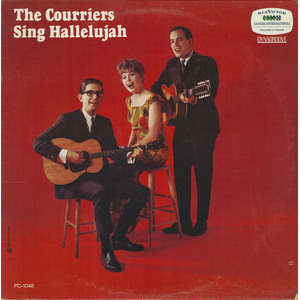
Sing Hallelujah
Media
Videos
0 videos
No videos available for this title.
Credits
In Transit
No Comments