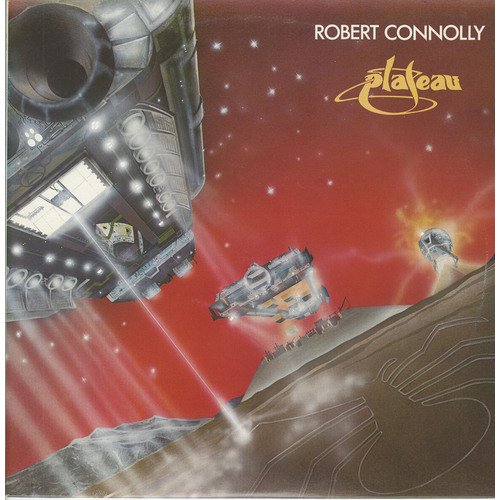
Insight
Plateau is not a record that thinks small. It begins centuries before the birth of Christ, sends alien spacecraft toward the Plateau of Nasca, passes through Giza, Sodom and Gomorrah, transfers knowledge to a chosen human being and eventually sends its travellers back through a black hole toward other worlds. And that is before you even open the comic book.
Behind all of it was Robert Connolly, a Hamilton-born, self-taught multi-instrumentalist who had spent several years travelling Canada as a professional musician before settling in Toronto in 1974. Rather than use the money his father had saved for university, Connolly invested it in building a professional eight-track recording studio and began teaching himself the other side of the music business: recording, engineering and production.
Before Plateau became an album, it had been a band. Connolly later remembered the group as a deliberately theatrical showband that pretended to be aliens who had landed on Earth to study the inhabitants of local bars, using multi-image projections to help sell the idea. The inspiration was very much of its time: Erich von Däniken's Chariots of the Gods?, the growing fascination with ancient astronauts, and eventually Close Encounters of the Third Kind. What could easily have remained a piece of bar-band theatre instead became the foundation for something considerably more ambitious.
Plateau first recorded the independent single ‘My Life’ b/w ‘Under the Big House’, hoping that a more commercial recording might attract management or a record company. Connolly then moved his eight-track Scully studio and the band into a partnership with Cottingham Sound in Toronto. They continued playing the bar circuit and recorded ‘Journey’, but after roughly two years of struggling without a record deal the group finally broke apart. Connolly did not want the music simply to disappear. With the other musicians' agreement, he kept what they had recorded and began building an album of his own around it.
That history explains why Plateau feels less like the work of one fixed band than a project assembled from different stages of Connolly's musical life. Side one features Connolly with drummer Greg McIlveen and vocalists Sheila and Sandra Willick, while the long ‘Journey’ brings in Dave Beatty, Peter Crolly, Frank Russell and Howie Strutt. Connolly himself is everywhere — guitar, bass, Mellotron, Mini Moog, organ, piano, string ensemble, synthesizer bass and vocals — making the record unmistakably his creation even as the musicians around him change.
The opening ‘Plateau of Naska’ establishes the premise immediately. Somewhere in the distant past, visitors from another world arrive on Earth in search of what the comic calls the “seed of knowledge.” The music and narration are inseparable from the science-fiction story; this is not an album on which the concept has been loosely attached after the songs were written. Connolly is building a world and asking the listener to enter it.
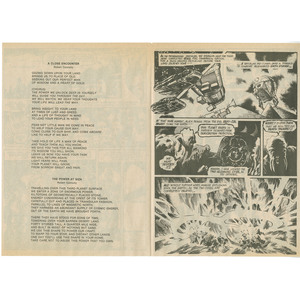
‘A Close Encounter’ moves from spectacle toward something more human. The visiting beings are not simply monsters or invaders but teachers, offering knowledge to humanity while warning against greed and misuse. The accompanying lyrics talk about wisdom, responsibility and the possibility that humanity might eventually grow beyond sorrow and pain. That idea — knowledge as something powerful but potentially dangerous — becomes one of the threads running through the entire project.
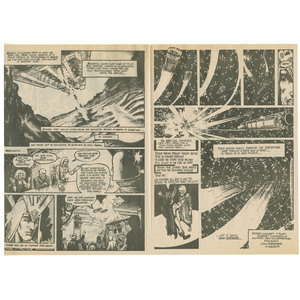
With ‘Power of Giza’, Connolly's fascination with ancient civilizations moves to the foreground. The pyramids are imagined not merely as tombs or monuments but as enormous machines capable of harnessing cosmic energy. It is pure ancient-astronaut speculation, but Connolly commits to it completely. In the comic, alien technology descends onto the Giza complex to refuel before continuing its journey, turning one of history's great architectural mysteries into part of a much larger interstellar system.
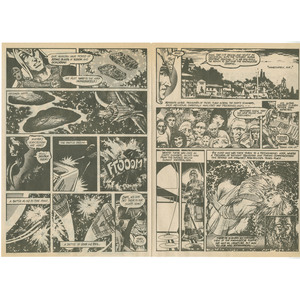
Then ‘Battle of Gomorrah’ gives the story its conflict. Two opposing alien forces arrive, and the Biblical destruction of Sodom and Gomorrah is recast as collateral damage from a battle fought with technology far beyond human understanding. It is a wonderfully extravagant piece of late-1970s imagination: scripture, science fiction, ancient history and progressive rock all occupying the same few minutes without any apparent concern for whether they are supposed to belong together.
That willingness to go all the way is central to Plateau. Connolly draws on the full late-1970s progressive palette — Mellotron, Mini Moog, organ, piano, synthesizer, guitars and layered voices — but the instrumentation is really serving the story. Side one consists of four relatively compact chapters; side two opens outward into the fourteen-minute ‘Journey’, where the album finally has room to stretch.
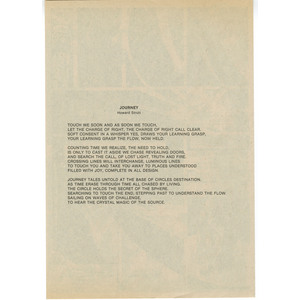
‘Journey’ is also an important surviving connection with Plateau the band. Howie Strutt supplied the words, while the original jacket describes the piece as a group composition. Its concerns move beyond spaceships and ancient monuments toward perception, consciousness and the search for understanding. The science-fiction imagery remains, but the journey has become inward as well as outward. It is here that the album's fascination with unexplained knowledge begins to sound less like a plot device and more like something Connolly genuinely wanted to explore.
The brief ‘The Oracle’ closes the record after that long excursion, but the story does not really end with the vinyl. The original LP came with an eight-page illustrated comic book, with Connolly credited for the story concept and plot, Poliwko as author and illustrator and T. Nesbitt as calligrapher. The comic follows the entire extraterrestrial narrative through ancient Earth, Giza, the destruction of Gomorrah and the eventual departure of the visitors into space.
What makes that insert especially important is that it was never intended merely as an elaborate piece of packaging. Connolly later explained that the comic was a storyboard for an animated feature film he hoped to make, something in the spirit of Yellow Submarine but built around his own ancient-alien story. The album itself was conceived as the demonstration record he could carry to Hollywood along with it. He had 1,000 copies pressed for that purpose. Canadian comic historians have since identified Plateau as one of the relatively few Canadian records of its period to be issued with an original comic-book adaptation, making the complete package interesting well beyond record collecting alone.
Before Hollywood, however, something unexpected happened in Toronto. Connolly gave a copy to CHUM-FM's Larry Wilson, who invited him onto the station. On August 29, 1978, Wilson devoted his Night At Eleven program to Plateau and played the album in its entirety, discussing Connolly's concept with him on air. Contemporary RPM reported the broadcast the following month, giving independent confirmation to a story Connolly still remembered vividly decades later.
Connolly recalls that the exposure quickly brought a call from J.C. Enterprises, the distributor named on the album, which wanted copies for a display at Sam the Record Man. The 1,000 records that had begun as an elaborate calling card for America suddenly had a Canadian life of their own. For an independently produced concept album about ancient extraterrestrials, complete with Mellotron and comic book, that was no small achievement.
Connolly nevertheless remained focused on the larger idea. He sold most of his recording equipment, kept his guitar and headed for Hollywood carrying Plateau as his pitch for a feature project. His later recollections differ somewhat in the details of the people he dealt with there, but the central story remains consistent: the record and comic were created as a combined demonstration for an animated science-fiction film. Connolly remembered genuine industry interest before becoming disillusioned with Hollywood and returning to Canada.
In retrospect, that may be the most interesting thing about Plateau. It is easy to hear the album purely as an artefact of late-1970s progressive rock — synthesizers, Mellotron, extended compositions, narration, aliens, pyramids and a concept large enough to require its own comic book. But for Connolly, those subjects did not disappear when progressive rock moved out of fashion.
He eventually shifted from being a recording artist toward production, film, television and emerging digital media. Years later, his programs Passport to Adventure and Timeless Places would take him around the world exploring lost civilizations, pyramids, unexplained architecture, ancient technologies and other mysteries remarkably close to the ideas he had imagined on Plateau.
That gives the album a dimension its early critics could not have known. What may have looked in 1978 like an outrageously ambitious piece of progressive-rock science fiction turned out to contain many of the questions Robert Connolly would spend much of his life pursuing.
The spaceships were imaginary. The journey wasn't.
-Robert Williston
In short, here is my storyAfter recording and releasing that single as a demo - I moved my 8 Track Scully studio and the whole band to become partners with Cottingham Sound in Toronto. We played the bar circuit, recorded the song “Journey” in a professional 24 track studio and then after 2 years of starvation - sort of just gave up when no record companies were interested in signing us. I disbanded Plateau, recorded enough songs at Cottingham to produce one LP as a solo artist. The band Plateau agreed to allow me to use the music we had recorded because they did not want to see it go to waste. We all wanted to have a memory of the fun times performing live.
I made 1000 copies as a demo to take to the USA, and gave the first one to Larry Wilson who was a DJ at Chum FM. The next day I was interviewed live on the air and he played every song and asked me what I was thinking about when I wrote the story line that was Ancient Alien oriented. That was like dropping an Ancient Aliens bomb on Toronto and Larry almost lost his job for doing that.
The next day I got a call from JC Enterprises, a rack jobber and they wanted those 1000 copies for a store window display at Sam the Record Man. The next day after that I was making the window display - and was getting a full page write-up in the Hamilton newspaper. Hamilton boy makes good.
I sold all of my equipment to get money to survive in America - except my guitar, and moved to Hollywood soon after that. One week after I arrived, I handed the record to the A&R department head Harvey Kubernick at MCA Universal and said ’"This is a concept album for my feature musical film about Aliens that visited earth. The comic book was the story board - the pitch.” Instead of the animated movie Heavy Metal - It was the music for a progressive animated feature rock film about Ancient Aliens.”
After a week they got back to me and said OK…….
But that fame would come with a price which everyone is starting to learn about with what happens in Hollywood and I said NO THANK YOU.
I will leave that to your imagination…….
So - Instead of being a musician - I became a record producer, moved back to Canada and discoverd and produced acts like Lee Aaron hoping to move towards music video production. I made my first music video - Metal Queen and that started her career.
I then started to produce feature music movies for Thor - Rock and Roll nightmare for $50 grand - which was impossible to do at that time - but I have a talent for system integration with computers. That first comedy feature film played in a movie theatre in film without using work prints. It was all edited on video tape and the music was from a machintosh Plus computer. I changed the methods of post production….Hollywood payed attention to how I did it - and that started the ball rolling in Toronto for film production for Hollywood production companies…..
I met my X wife making that Thor film - married her and we travelled for 24 years to make a TV series about the mysteries of the world. Just me and her. I learned a lot - visiting all of the places that I had wanted to go to as a kid when I made that first record.
-Robert Connolly email to Robert Williston, April 25, 2024
Gallery
Images
9 images
View All
Robert Connolly-Plateau BACK
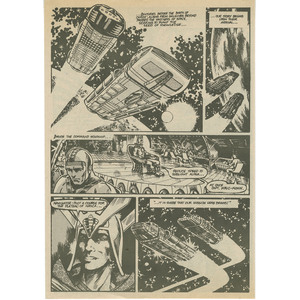
Robert Connolly-Plateau INSERT COMIC PAGE 1
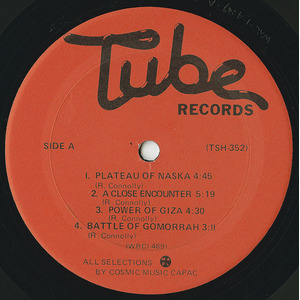
Robert Connolly-Plateau LABEL 01
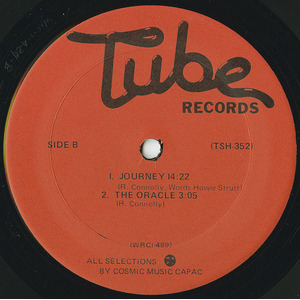
Robert Connolly-Plateau LABEL 02
Robert Connolly-Plateau INSERT COMIC PAGES 2 AND 7
Robert Connolly-Plateau INSERT COMIC PAGES 3 AND 6
Robert Connolly-Plateau INSERT COMIC PAGES 4 AND 5
Robert Connolly-Plateau INSERT COMIC PAGE 8
Media
Videos
0 videos
No videos available for this title.
Credits
Musicians
Robert Connolly: guitars, bass, Mellotron, Mini Moog, organ, piano, string ensemble, synthesizer bass, vocals
Greg McIlveen: drums on ‘Plateau of Naska’, ‘A Close Encounter’, ‘Power of Giza’ and ‘Battle of Gomorrah’
Sheila Willick: vocals on ‘Plateau of Naska’, ‘A Close Encounter’, ‘Power of Giza’ and ‘Battle of Gomorrah’
Sandra Willick: vocals on ‘Plateau of Naska’, ‘A Close Encounter’, ‘Power of Giza’ and ‘Battle of Gomorrah’
Dave Beatty: guitar on ‘Journey’
Peter Crolly: bass, flute, vocals on ‘Journey’
Frank Russell: drums, bells on ‘Journey’
Howie Strutt: vocals on ‘Journey’
Songwriting
‘Plateau of Naska’ written by Robert Connolly
‘A Close Encounter’ written by Robert Connolly
‘Power of Giza’ written by Robert Connolly
‘Battle of Gomorrah’ written by Robert Connolly
‘Journey’ music by Robert Connolly; words by Howie Strutt
‘The Oracle’ written by Robert Connolly
Additional Composition Credit
The back cover additionally describes ‘Journey’ as a group composition.
Production
Produced by Robert Connolly
Recording
‘Plateau of Naska’, ‘A Close Encounter’, ‘Power of Giza’ and ‘Battle of Gomorrah’ recorded at Cottingham Sound, Toronto
‘Journey’ recorded at Springfield Sound, London
‘The Oracle’ recorded at Sound Stage, Toronto
Engineering
Dave Beare: engineer for the Cottingham Sound recordings
Rocky Farr: engineer on ‘Journey’
Jim Frank: engineer on ‘The Oracle’
Mixing
‘Plateau of Naska’, ‘A Close Encounter’, ‘Power of Giza’ and ‘Battle of Gomorrah’ mixed at Audios Amego, Toronto
‘Journey’ and ‘The Oracle’ mixed at Springfield Sound, London
Publishing
All songs published by Cosmic Music (CAPAC)
Artwork
Dean Motter: cover artwork
Betsy Ross Designs: layout and typography
The Picture Taker: photography
Comic Book
Robert Connolly: story concept and plot
Poliwko: author and illustrator
T. Nesbitt: calligrapher
Acknowledgements
Special thanks to Herb Connolly, Mike White and Susan Carrier
Additional Information
The original LP includes an eight-page illustrated science-fiction comic book accompanying the album.
No Comments