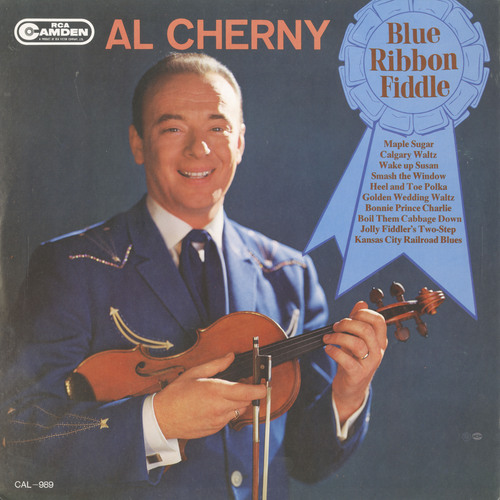
Album / Title
Blue Ribbon Fiddle
By: Al Cherney (Alexander Peter Chernywech)
Origin: Medicine Hat, Alberta → Mississauga, Ontario, 🇨🇦
Insight
Al Cherny was one of Canada’s most recognized country fiddlers, a spirited old-time player whose speed, showmanship, and bright melodic attack made him a familiar presence on Canadian radio, television, records, and concert stages for more than three decades. Born Alexander Peter Chernywech in Medicine Hat, Alberta, on November 1, 1932, he was the son of Ukrainian parents and grew up within a western Canadian musical culture where fiddle music, country dance tunes, and ethnic folk traditions often overlapped.
Cherny began playing at an early age, learning Ukrainian tunes as a child in Medicine Hat. He later described the Ukraine as the birthplace of his parents and the home of his relatives, including uncles, aunts, and his grandmother, or “Babushka.” Weddings and dances were central to the social life of the Ukrainian community around him, and that early exposure helped shape the rhythmic drive, warmth, and dance-hall energy that became part of his playing.
His early career took shape through radio. After moving east, Cherny auditioned for CKNX Wingham’s Barn Dance Show in Ontario, where he became a regular performer through the 1950s. Tommy Hunter later recalled first meeting him there in 1955, during a guest appearance on the station’s popular barn dance program. That circuit placed Cherny among many of the artists who would define postwar Canadian country entertainment, including Tommy Hunter, Gordie Tapp, Myrna Lorrie, Wilf Carter, and The Mercey Brothers. The exposure also helped lead him into television, where he became associated with CBC’s Country Hoedown before moving into the national orbit of The Tommy Hunter Show.
Cherny’s reputation grew rapidly through competition. In 1959, he won the novelty-class prize at Shelburne, Ontario, home of one of North America’s leading old-time fiddle contests. In 1960 and 1961, he returned and won both the novelty and old-time classes in consecutive years, becoming the only Canadian in the contest’s fourteen-year history to achieve that distinction at the time. His teacher in Medicine Hat, Frank Novak, was later credited in album notes as an important early influence.
His first long-play album for Arc Records, Old Time Fiddle Champion, presented Cherny as a North American open and novelty champion and framed him as one of the leading old-time fiddlers of his generation. The album paired him with professional studio accompaniment, including Mike Crosty on drums, Bill Gibbs on bass, Hap Swatridge on piano, and Maurice Bolyer on banjo and guitar, with recording and A&R direction by Dan Bass.
By the mid-1960s, Cherny was recording for labels including Arc and RCA Camden, issuing a steady run of fiddle albums aimed at country, old-time, and family audiences. Al Cherny plays Old Tyme Fiddle, Blue Ribbon Fiddle, and On Stage With Al Cherny documented different sides of his repertoire: old-time contest pieces, Ukrainian dance material, French-Canadian fiddle numbers, waltzes, reels, polkas, and showpieces such as ‘Orange Blossom Special’. His 1966 RCA Camden album Blue Ribbon Fiddle presented him in the clean, danceable old-time style that suited his television image, while On Stage With Al Cherny placed stronger emphasis on his Ukrainian heritage and his regular CBC television presence.
Cherny’s most important national platform was The Tommy Hunter Show, where he became a regular featured musician from the 1960s until his death. On the program he was valued not only as a polished instrumentalist but also as a calming presence for younger or nervous performers. Tommy Hunter later remembered him as a musician who could help “scared kids” break the ice under the pressure of national television. Cherny’s fiddle became part of the show’s musical identity, bridging rural Canadian fiddle tradition with the polished production style of network television.
Outside his own albums, Cherny was also an active session player. During the 1970s he recorded with a range of Canadian country and folk artists, including Gary Buck, Dick Damron, Tommy Hunter, Jesse Winchester, and Sylvia Tyson. His own 1972 RCA Camden album Fiddle Magic, produced by Gary Buck, showed his repertoire extending from traditional and old-time fiddle material to contemporary song adaptations, including ‘Mr. Bojangles’, alongside pieces by Andy De Jarlis, A. P. Carter, Jerry Jeff Walker, Roy Warhurst, and Cherny himself.
Cherny also performed widely beyond Canada. His travels included appearances for troops stationed in France, England, Germany, and the United Arab Republic, and one notable appearance in Montreal, Quebec, where he performed for Prince Philip and the Commonwealth Conference with accompaniment from the Montreal Symphony Orchestra. He remained closely connected to Ukrainian Canadian cultural events as well, including Canada’s National Ukrainian Festival in Dauphin, Manitoba, where he became a recurring and well-remembered attraction.
In 1978, Cherny received RPM’s Big Country Award for Top Country Instrumentalist, confirming his standing within the Canadian country industry. By that point he had released more than ten albums and had become one of the country’s most visible fiddle specialists, known for standards such as ‘Orange Blossom Special’, ‘Back Up and Push’, ‘Road to Boston’, and ‘The Black Velvet Waltz’.
Al Cherny died in Mississauga, Ontario, in August 1989 after a battle with cancer. That same year, he was inducted into the Canadian Country Music Hall of Fame. His legacy rests on a rare combination of old-time fiddle championship, national television exposure, studio versatility, and cultural memory within both Canadian country music and Ukrainian Canadian musical life.
-Robert Williston
Gallery
Images
4 images
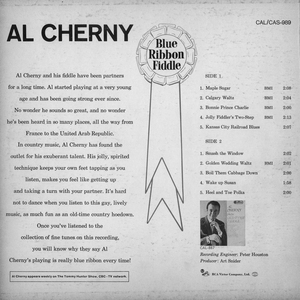
Al Cherney - Blue Ribbon Fiddle BACK
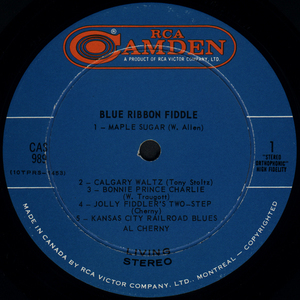
Al Cherney (Alexander Peter Chernywech) Blue Ribbon Fiddle LABEL 01
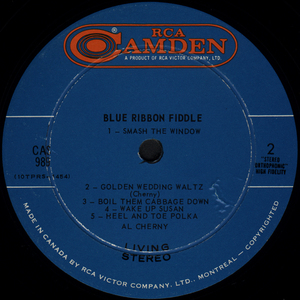
Al Cherney (Alexander Peter Chernywech) Blue Ribbon Fiddle LABEL 02
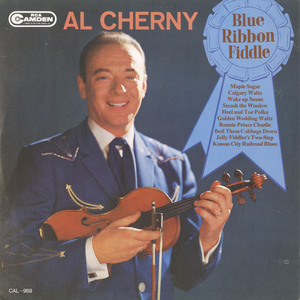
Blue Ribbon Fiddle
Media
Videos
0 videos
No videos available for this title.
Credits
Musicians
Al Cherny: fiddle
Production
Produced by Art Snider
Engineered by Peter Houston
Lacquer cut at RCA Studios, Toronto, Ontario
Artwork
Printed by Ever Reddy
Notes
Made by RCA Victor Company, Ltd.
Al Cherny appears weekly on The Tommy Hunter Show, CBC-TV network.
Liner notes
Al Cherny and his fiddle have been partners for a long time. Al started playing at a very young age and has been going strong ever since. No wonder he sounds so great, and no wonder he’s been heard in so many places, all the way from France to the United Arab Republic.
In country music, Al Cherny has found the outlet for his exuberant talent. His jolly, spirited technique keeps your own feet tapping as you listen, makes you feel like getting up and taking a turn with your partner. It’s hard not to dance when you listen to this gay, lively music, as much fun as an old-time country hoedown.
Once you’ve listened to the collection of fine tunes on this recording, you will know why they say Al Cherny’s playing is really blue ribbon every time!
Al Cherny appears weekly on The Tommy Hunter Show, CBC-TV network.
No Comments