Information/Write-up
Guido Basso was one of the most important and distinctive brass voices in Canadian music, whose career spanned jazz, television, studio recording, big band leadership, and popular orchestral work. Born in Montréal, Québec, he began playing trumpet at the age of nine and studied at the Conservatoire de musique du Québec à Montréal. By his early teens he was already working professionally, performing under the nickname “Stubby” Basso in dance bands and show orchestras led by figures such as Al Nichols and Maury Kaye.
While appearing with Kaye at El Morocco in Montréal, Basso was heard by American singer Vic Damone, who hired the young trumpeter and took him on tour in 1957–58. This marked the beginning of several years of steady work in the United States. From 1958 to 1960, Basso toured extensively across North America with Pearl Bailey and the orchestra led by her husband, drummer Louis Bellson, gaining first-hand experience in major concert halls, theatres, and television productions while still in his teens.
In 1960, Basso relocated to Toronto, where he quickly became one of the city’s most in-demand studio trumpeters. He was a first-call musician for recording sessions, radio broadcasts, film and television work, and commercial jingles, and his playing soon became embedded across a wide cross-section of Canadian popular recording beyond strictly jazz contexts. He was also noted for his versatility, occasionally taking on harmonica assignments alongside his brass work. Toronto would remain his professional base for the remainder of his career.
Basso became a familiar national presence through his long association with the CBC. From 1963 to 1967 he served as musical director for the CBC-TV program Nightcap, followed by similar duties for Barris and Company from 1968 to 1969. He co-starred with vibraphonist Peter Appleyard on the CBC-TV series Mallets and Brass in 1969, was musical director for CBC Radio’s After Noon from 1969 to 1971, and later led orchestras for two major CBC-TV series devoted to big band music, In the Mood (1971–72) and Bandwagon (1972–73). In 1975, he organized and led large ensembles for high-profile concerts at the Canadian National Exhibition featuring Dizzy Gillespie and Benny Goodman.
Alongside his broadcasting work, Basso remained active as a performer in Toronto nightclubs and hotel lounges, leading small groups that often blended jazz and Latin rhythms. He was also a central soloist with many of Canada’s leading jazz ensembles, including the Boss Brass, the Rob McConnell Tentet, Nimmons ’N’ Nine Plus Six, and the big bands of Ron Collier and others. His flugelhorn playing, in particular, became widely admired for its warmth, lyricism, and expressive control, qualities that were heard to great effect on numerous Boss Brass recordings.
At the same time, Basso’s studio career extended deeply into Canadian pop, rock, soul, reggae, and television recording. His trumpet appears on a remarkably broad range of sessions, including recordings by artists as stylistically distant as Jackie Mittoo and Teenage Head, illustrating his role as a trusted first-call professional whose sound moved effortlessly between jazz ensembles, pop productions, reggae sessions, and punk-era rock recordings. That same adaptability placed his playing firmly within the wider soundscape of Canadian broadcast culture, including appearances on hockey-related recordings such as Lafleur! and the Hockey Night in Canada theme.
Despite his stature within Canadian jazz, Basso was often reluctant to present himself strictly as a jazz artist, preferring to work across stylistic boundaries. He was nonetheless capable of incisive bebop trumpet work when required and became well known for his oft-quoted observation that “you attack a trumpet, and you make love to a flugelhorn,” a phrase that neatly summarized his approach to tone and phrasing.
As studio work declined in the late 1970s, Basso shifted much of his professional focus toward leading what became one of Toronto’s most successful society orchestras, maintaining a high level of performance activity well into later decades. His contributions to Canadian music were formally recognized in 1994, when he was appointed a Member of the Order of Canada. Guido Basso passed away on February 13, 2023, at the age of 85.
-Robert Williston
Musicians
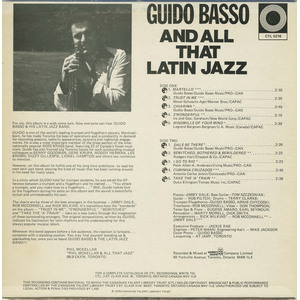
Jimmy Dale: piano
Tom Szczesniak: bass guitar
Rob Piltch: guitar
Terry Clarke: drums
Guido Basso: trumpet, flugelhorn
Arnie Chypski: trumpet, flugelhorn
Rob McConnell: trombone
Don Thompson: vibes
Eugene Amaro: tenor saxophone, flute
Earl Seymour: tenor saxophone, flute
Marty Morell: percussion
Dick Smith: percussion
Arrangements
Arrangements by Rick Wilkins, Rob McConnell, and Jimmy Dale
Production
Engineered by Peter Mann, assisted by Mike Jackson
Recorded and mixed at eastern sound Company Limited
48 Yorkville Avenue, Toronto, Ontario M4W 1L4
Executive producer: Jackie Rae
Lacquering at JAMF, Toronto
Artwork
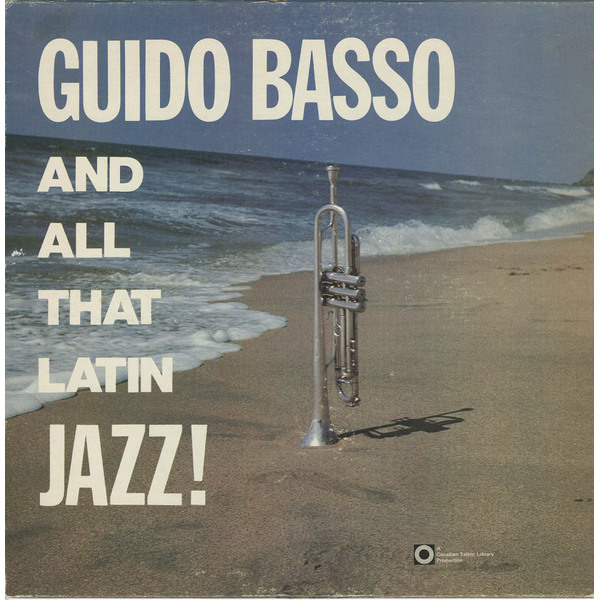
Cover photo by Guido Basso
Songwriting
‘Martello’ written by Guido Basso (Guido Basso Music / PRO–CAN)
‘Trust In Me’ written by Wever–Schwartz–Ager (Warner Bros. / CAPAC)
‘Chiarina’ written by Guido Basso (Guido Basso Music / PRO–CAN)
‘S’Wonderful’ written by Ira and Geo. Gershwin (New World Corp. / CAPAC)
‘Windmills Of Your Mind’ written by Legrand–Bergman–Bergman (U.A. Music (Canada) / CAPAC)
‘Dale Be There’ written by Guido Basso (Guido Basso Music / PRO–CAN)
‘Bewitched, Bothered & Bewildered’ written by Rodgers–Hart (Chapel & Co. / CAPAC)
‘I Go To Rio’ written by Peter Allen–Anderson (Irving Music / PRO–CAN)
‘Cumunha Cruzados’ written by Antonia Carlos Jobim–Corcovado (PRO–CAN)
‘Take The ‘A’ Train’ written by Duke Ellington (Tempo Music Inc. / CAPAC)
Notes
CTL
2 St. Clair Ave. West
Toronto, Ontario Canada M4V 1L6
Liner notes
For me, this album is a wish come true. Now everyone can hear GUIDO BASSO & HIS LATIN JAZZ BAND.
GUIDO is one of the world’s leading trumpet and flugelhorn players. Montreal-born, he has made Toronto his base of operations and is constantly in demand for recording sessions, radio/tv appearances, concerts and nightclub engagements. He is also a most important member of the brass section of the internationally popular BOSS BRASS band, featuring 22 of Canada’s finest musicians. Guido has also fronted Toronto bands for such outstanding musical colleagues as BENNY GOODMAN, GENE KRUPA, WOODY HERMAN, LES BROWN, DIZZY GILLESPIE, LIONEL HAMPTON and others too numerous to mention.
However, on this album he fulfils one of his long-time ambitions—to lead his own latin jazz band, playing the kind of music that has been running around in his head for many years.
In a clinic which GUIDO held for trumpet students, he was asked the difference between a trumpet and a flugelhorn and he replied . . . “You attack a trumpet, and you make love to a flugelhorn.” . . . Well, Guido makes love to the flugelhorn during his solos on this album and the sound is beautifully lyrical and unmistakeably his own.
The charts are by three of the best arrangers in the business — JIMMY DALE, ROB MCCONNELL and RICK WILKINS. It’s marvellous how the “standards” on the album — “TRUST IN ME”, “SWONDERFUL”, “BEWITCHED” and “TAKE THE ‘A’ TRAIN” — take on a new lustre through the imagination of these outstanding arrangers. The original compositions, written by GUIDO, indicate his fascination for latin rhythms and his understanding for this always popular musical idiom.
Whenever this band appears before a live audience, the reaction is fantastic . . . complete with a standing ovation. You may find yourself standing up & applauding too, once you’ve heard GUIDO BASSO & THE LATIN JAZZ BAND!!!
Phil McKellar
“Phil McKellar & All That Jazz”
99.9 CKFM, Toronto
No Comments