Artist / Band
Art Morrow Orchestra

Biography
Arthur Cecil Forrest Morrow was born in Westmount, Quebec, on December 11, 1919. He studied piano with Rose Blackwell from 1930 to 1935 and taught himself most of what followed. By 1958 CBC was describing him as a self-taught musician who could play more than a dozen instruments.
By the early 1940s Morrow was working in Montreal as a saxophonist and arranger with the Johnny Holmes Orchestra, one of the city’s leading dance and jazz bands. Over the years the Holmes band included Al Baculis, Nick Ayoub, and Percy and Maynard Ferguson. Morrow also had military band duties during the Second World War, and in September 1942 Down Beat reported him spending his leave sitting in with Montreal bands.
In 1942, when Holmes needed a pianist, Morrow brought a nervous 17-year-old Oscar Peterson to rehearsal. Peterson had never played in a professional big band and at first crowded his playing with everything he knew. Holmes had his doubts, but Morrow urged him to keep listening. Holmes worked with Peterson through the rehearsal and hired him at the end of the night, starting the job that took Peterson from Montreal prodigy to working professional.
Morrow joined CBC Radio in 1946. His first conducting assignment was Sunshine Society, followed by a long run of Montreal productions. In the early 1950s the Art Morrow Orchestra backed the vocal group built around Bob and Joyce Hahn on Sunshine Society, A Trip To The Moon, Cue For Fun and A Date With Fred Hill. The 1953 Fred Hill program combined the tenor with the Bob Hahn Quartet and the Art Morrow sextet, with Morrow as musical director and Ken Withers producing. When Joyce Hahn began recording for Sparton in 1956, her early singles, including ‘You’ve Got The Love’ and ‘(The Kind Of) Girl For Joe’, were backed by the Art Morrow Orchestra.
Morrow is credited with the music, alongside Paul Colbert, for Séraphin, the French-language feature drawn from Claude-Henri Grignon’s Un homme et son péché. Jean Deslauriers conducted the orchestra, and the film opened at Montreal’s Théâtre Saint-Denis on February 17, 1950. From 1952 to 1955 the Art Morrow Singers appeared with Alan Mills and Hélène Baillargeon on Songs de Chez Nous, which brought French-Canadian traditional songs to a national radio audience.
The arranging never stopped. His October 1954 orchestral piece ‘Patrol (A Novelty)’, his 1955 and 1956 theme music for Music-Hall and a 1958 arrangement of ‘I Could Have Danced All Night’ for strings, woodwinds, French horns, trumpets, percussion, harp and piano all survive in full score at Library and Archives Canada.
Morrow made his French-language television debut as a musical director in 1955, and in 1956 he became conductor-arranger of Radio-Canada’s Music-Hall. By 1960 the Montreal variety show was regularly beating The Ed Sullivan Show in the local ratings. He also arranged and conducted G.M. Vous Invite, carried in some markets as Radio-Canada Vous Invite, while continuing to work for the English network.
In 1958 he assembled a 21-piece orchestra for his own national Trans-Canada network series, Meet Mr. Morrow, and CBC promoted it as the largest jazz band in Canada. The same players became the pool for his other broadcasts. Morrow told CBC that a jazz bandleader had to give musicians room for individual expression, and that he picked players for personality as well as technical ability.
A March 25, 1958 Montreal session issued through CBC’s Jazz From Canada series names trumpeters John DiStaulo, Arthur Phillips, Jack Shtyka and Guido Basso; trombonists Ted Elfstrom, Joe Bell, Gérard Vaillancourt and Joseph Zuskin; saxophonists Gerry Danovitch, Douglas Michaud, Nick Ayoub, Mark Harwood and Frederick Nichols; pianist Armas Maiste, guitarist Clare Bolton, bassist Wilbert Brown and drummer Donat Perrier. Joyce Hahn sang, with Morrow leading and arranging.
In the spring of 1959 the orchestra played the Montreal Forum during the campaign for the concert hall that became Place des Arts. It was the only jazz act on a largely classical bill, and reviewers singled out its precision and enthusiasm. That June, Radiomonde et télémonde introduced it on the television program Rythmes as one of the best jazz orchestras in Montreal.
By 1960 Morrow had written the ballet Postscript for the Montreal Theatre Ballet, and his orchestra was heard on the English network’s Variety Hour, where full-band numbers alternated with smaller groups and vocalists drawn from its ranks. That year CBC’s International Service produced Jazz From Canada, a series of short transcription programs sent to Canadian embassies and consulates around the world. Alongside Oscar Peterson, Phil Nimmons and Ron Collier, the series gave three programs to the Art Morrow Orchestra, with Joyce Hahn singing.
Meet Mr. Morrow ran until 1960, followed by Variety Showcase from 1960 to 1962, Sheila Sings with Sheila Graham in 1962 and Music Scene from 1964 to 1966. In January 1966 Music Scene was still presenting “the music of Art Morrow and his orchestra.” On the French network he led broadcasts on Music-Hall du samedi soir.
From 1967 to 1971 Morrow played piano in Montreal hotels. In 1968 Billboard reported on an album produced by Bob Hahn in which all twelve songs were arranged by Morrow and performed by Canadian musicians and singers, part of Hahn’s push to show that polished commercial music could be written, arranged, performed and largely recorded in Canada. By 1969 Morrow was general manager of Laurentian Music, the Montreal BMI publisher headed by Hahn, with Summerlea Music and Winterlea Music among its affiliates. Laurentian Music would publish Morrow’s compositions and adaptations on his CBC records of the 1970s.
In 1971 Morrow produced two singles for The Gentlemen on the Montreal label Astra: ‘Latin Afternoon’ b/w ‘Slavic Afternoon’, and ‘Running Up North’ b/w ‘Let Me Live Again’. RPM called ‘Latin Afternoon’ a middle-of-the-road instrumental with a distinctive whistled passage and noted that both singles were all-Canadian productions. The tune was written by Billy Andrusco of The Gentlemen, who recorded it again for his 1983 solo album Billy.
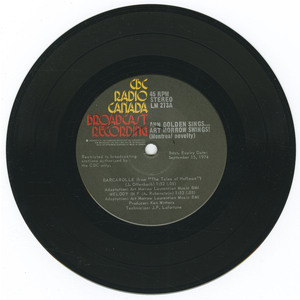
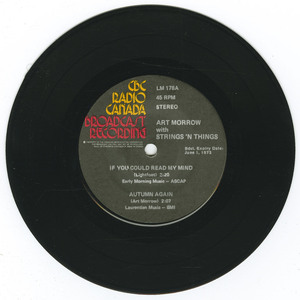
Morrow came back to ‘Latin Afternoon’ in 1973 on the CBC transcription disc LM 178, billed as Art Morrow with Strings ’N Things. He paired it with two of his own compositions, ‘Autumn Again’ and ‘Do It Today’, and an orchestral version of Gordon Lightfoot’s ‘If You Could Read My Mind’. In 1974 CBC issued LM 273, Ann Golden Sings... Art Morrow Swings!, labelled a “Montreal novelty.” Golden sang Morrow’s adaptations of Offenbach’s ‘Barcarolle’, Rubinstein’s ‘Melody In F’, Dvořák and William Arms Fisher’s ‘Goin’ Home’ and Bizet’s ‘Seguidilla’. The producer was Ken Withers, who had been producing Morrow at CBC since the Fred Hill broadcasts more than twenty years earlier.
Most of Morrow’s working life went into music made for broadcast, and it survives in CBC schedules, transcription discs, singles, film credits and hundreds of pages of orchestral scores.
Morrow later settled on Vancouver Island, where he kept playing with the Nanaimo Concert Band, the Parksville Concert Band, the Just Us Band and a group in Port Alberni. He died in Nanaimo on November 13, 2001, a month short of his 82nd birthday.
-Robert Williston
Art Morrow Orchestra, March 25, 1958
John DiStaulo: trumpet
Arthur Phillips: trumpet
Jack Shtyka: trumpet
Guido Basso: trumpet
Ted Elfstrom: trombone
Joe Bell: trombone
Gérard Vaillancourt: trombone
Joseph Zuskin: trombone
Gerry Danovitch: saxophone
Douglas Michaud: saxophone
Nick Ayoub: saxophone
Mark Harwood: saxophone
Frederick Nichols: saxophone
Armas Maiste: piano
Clare Bolton: guitar
Wilbert Brown: bass
Donat Perrier: drums
Art Morrow: leader, arranger
Joyce Hahn: vocals
Tracks
8 tracks
-
If You Could Read My Mind
-
Autumn Again
-
Do it Today
-
Latin Afternoon
-
Barcarolle
-
Melody in F
-
Goin' Home
-
Seguidilla
Discography
Featured Titles
Albums
Singles
Gallery
Images
0 images
No photos available for this artist.
Media
Videos
0 videos
No videos available for this artist.