Artist / Band
Tycons
Biography
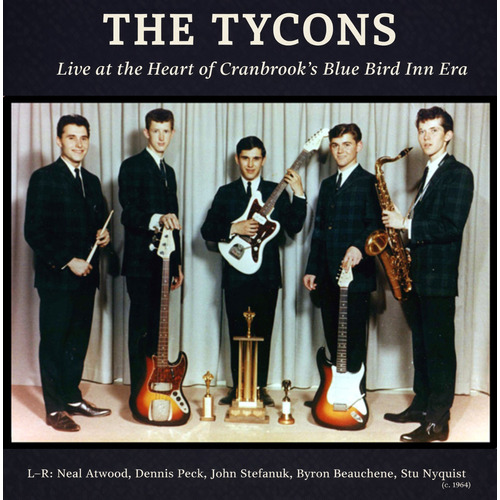
The Tycons were a Cranbrook, British Columbia rock and roll group active during the early to mid-1960s, part of the vibrant interior British Columbia and southern Alberta circuit that supported touring American and Canadian acts. Based in Cranbrook, the band became closely associated with the Blue Bird Inn, one of the region’s premier live music venues, renowned for its excellent acoustics and steady flow of major touring performers.
According to founding member and lead vocalist Byron Beauchene, The Tycons regularly appeared at the Blue Bird Inn alongside high-profile acts including The Fireballs, Bill Black’s Combo, The Champs, Bobby Curtola, The Checkers, The Crickets, and Buddy Knox. The venue was a key stop on the Western Canadian touring route, and its reputation made it a focal point for live rock and pop in the East Kootenays.
The group’s core lineup during its most active period included John Stefanuk (lead guitar), Byron Beauchene (rhythm guitar, lead vocals), Dennis Peck (bass, vocals), Stuart Nyquist (saxophone), and Neal Atwood (drums, vocals). Bruce Frost was the group’s original bass player and a founding member, later replaced by Dennis Peck as the band evolved. Atwood was a founding member of the Tycons and served as drummer and vocalist during the band’s formative early-1960s period, helping establish the group on the regional circuit.
In addition to their club and ballroom work, the Tycons also made regional television appearances, including performances on KXLY-TV in Spokane. Studio and live recordings of the band were made at Cranbrook’s Armond Theatre by Randy Archibald, though these tapes are now believed to be lost. These appearances reflect the group’s standing as one of the better-known interior British Columbian acts of their era.
As the Cranbrook scene evolved, members of the Tycons became part of a broader network of Western Canadian and Pacific Northwest bands. After the Tycons, John Stefanuk and Byron Beauchene were involved with The Thin Red Line, before later forming Western Union. Jim Lecluse was the drummer for The Thin Red Line, and he and Dennis Peck have continued to perform with later incarnations of that group in Vancouver, with Peck later transitioning from bass to lead guitar.
After his time with the Tycons, Bruce Frost moved into the Calgary scene, going on to play bass with Happy Feeling, who scored a regional hit in 1968–69 with the single ‘Happy Feeling.’ Through these connections, the Tycons became part of a wider musical pipeline linking the East Kootenays with Calgary, the Lower Mainland, and the U.S. Pacific Northwest touring circuit.
Saxophonist Stuart Nyquist joined the Tycons during the band’s later lineup. At the 1964 Creston Blossom Festival Battle of the Bands, The Tycons won Best Band. Dennis Peck won Best Bass for his solo in “Woodchoppers Ball,” and John Stefanuk won Best Lead Guitar for his Chet Atkins–style fingerpicking. Nyquist’s performance of “Danny Boy” was a standout moment that brought the house down, according to Byron Beauchene. He later resided in Lethbridge, Alberta, and returned to perform with the band at their 1999 Kimberley Rock Revival reunion. Neal Atwood also appeared at the Kimberley event, and live video documentation exists from this period showing both Atwood and Nyquist performing with the band. Nyquist passed away in 2013, and Atwood later settled in Fort Macleod, Alberta, where he passed away in recent years.
Following the Tycons, Byron Beauchene remained a central figure in the Cranbrook and Pacific Northwest music scene, performing with The Thin Red Line, Western Union, and later Canadian Crossfire. Music from Canadian Crossfire’s album The Lottery is available here at citizenfreak.com.
A major chapter in Cranbrook music history came on March 19, 1981, when the Blue Bird Inn was destroyed by fire. Beauchene, who witnessed the blaze, documented the venue’s destruction — marking the end of one of the region’s most important live music rooms and a significant loss to the local music community.
While the Tycons did not leave behind known commercial recordings, their documented television appearances, lost Armond Theatre recordings, and surviving live video from the 1999 Kimberley Rock Revival place them firmly within the fabric of Western Canada’s 1960s live music economy, supporting touring headliners and helping sustain a thriving interior club circuit.
-Robert Williston, with input from Byron Beauchene, Jan 25, 2026
Related acts:
Happy Feeling: https://www.citizenfreak.com/artists/96267-happy-feeling
Western Union: https://citizenfreak.com/artists/105183-western-union
Canadian Crossfire: https://citizenfreak.com/titles/330261-canadian-crossfire-the-lottery
Tracks
0 tracks
No tracks available for this artist.
Discography
Gallery
Images
3 images
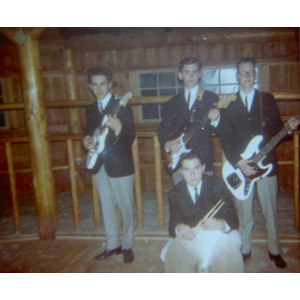
L-R: John Stefanuk - Bruce Frost - Neal Atwood
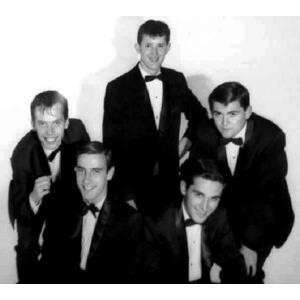
The Thin Red Line: L-R: Jim Lecluse - Dennis Peck - Byron Beauchene - David Hoole - John Stefanuk
Tycons
Media
Videos
1 video