Album / Title
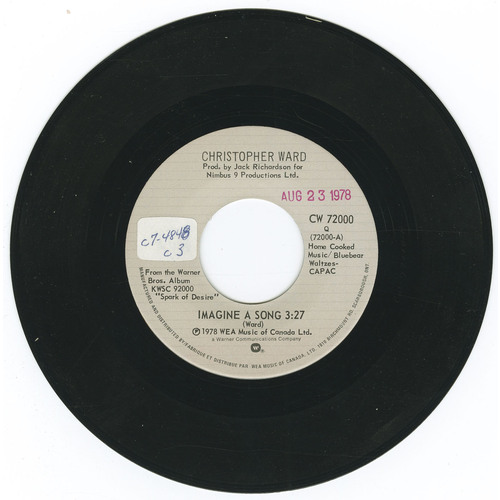
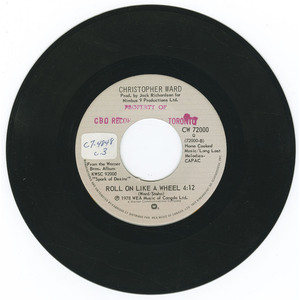
Imagine a Song b/w Roll On Like a Wheel
By: Christopher Ward
Origin: Toronto, Ontario, 🇨🇦 → Los Angeles, California, 🇺🇸
Insight
Christopher Ward spent almost twenty years writing songs before ‘Black Velvet’ made him one of the most sought-after songwriters in Canada. In that time he played dinner music at the Playboy Club in Ankara, Turkey, put a string of Warner Bros. singles on Canadian radio, led the band on a CBC Television children’s series and became one of the first VJs hired by MuchMusic.
He was born in Toronto on July 28, 1949. Each summer his family drove to Lyndhurst, Ohio, to visit an aunt, uncle and cousins, and his father arranged through a business contact for him to work on a ranch near Beechy, Saskatchewan, beside the South Saskatchewan River. There he learned to drive a tractor, milk a cow, ride a horse and swear, and he has called those summers one of the formative experiences of his life. The British Invasion put a guitar in his hands. The Rolling Stones, the Beatles and the Kinks came first, followed by the Motown songwriting of Marvin Gaye, Smokey Robinson and Holland-Dozier-Holland. The songs that made him want to write his own included Ray Charles’ ‘You Don’t Know Me’, the Beatles’ ‘You’ve Got to Hide Your Love Away’, Bob Dylan’s ‘Like a Rolling Stone’, Laura Nyro’s ‘Emmie’ and Gordon Lightfoot’s ‘Early Morning Rain’.
In the fall of 1967, the year of Sgt. Pepper, Ward arrived at Champlain College at Trent University in Peterborough. There he met Stephen Stohn, a year ahead of him and already a veteran of high school bands called The What 4, The Uncalled 4 and Rain Against the Sun. The two stayed up all night in Ward’s dorm room playing records and writing their first songs. Their first gig together, a medley of Everly Brothers songs, managed to offend the Trent Folk Club. With Stohn and Peter Northrop, Ward also helped found the campus radio station that became CFFF-FM.
After Stohn graduated in 1969 the pair loaded a battered Volkswagen van and worked the nightclubs of Europe as Cookies and Milk. Stohn taught Ward about song structure and the bridge, which the Beatles called the middle eight, and the songs slowly got better. The trip included a two-month engagement playing dinner music at the Playboy Club in Ankara. In all, Ward spent about five years travelling through Europe, Asia and California. Back in Canada, Stohn went to law school while Ward worked the bars and found work as a producer and announcer in private radio. Stohn never stopped writing melodies. On visits to his grandmother’s cottage on Georgian Bay he composed sweeping, Brian Wilson-inspired tunes on an old Heintzman upright piano, and Ward set words to them.
Ward’s earliest released recordings came through CBC Radio. Four of his songs, ‘Highway Song’, ‘Just to Say Hello’, ‘She Dance Like a Pony’ and ‘California Morning Glory’, filled side two of the 1975 CBC Radio Canada compilation LM 414. They were originally produced for Touch the Earth, the network’s folk program hosted by Sylvia Tyson, with Paul Mills producing in Toronto and Larry Morey engineering. The sleeve notes credited Ward with an easy familiarity with music ranging from Hank Williams to Bartók and singled out the Ankara engagement as one of his most memorable gigs.
The Stohn and Ward songs won him a contract with WEA Music of Canada, which Stohn negotiated while still in law school. ‘Lost in a Love Song’, one of the first songs the two had written together, appeared on Warner Bros. in 1976 backed with ‘Play One for Your Mother’. It reached No. 9 on RPM’s adult contemporary chart and No. 10 on its country chart. ‘Once in a Longtime’ followed in 1977 and climbed to No. 19 adult contemporary and No. 38 on the pop chart. The signal of CHYR in Leamington, Ontario, carried it across Lake Erie, and that summer two teenagers from Euclid, Ohio, took the ferry over to visit the station and buy the single. ‘Maybe Your Heart’, backed with ‘Dreamboat’, peaked at No. 17 on CHUM in Toronto in June 1978. That May, WEA sent Ward on a promotional trip through Winnipeg, Regina, Edmonton, Calgary and Vancouver to meet radio programmers and the press.
His debut album, Spark of Desire, was released in 1978 on Warner Bros. (KWSC 92000), produced in Toronto by Jack Richardson. Its title came from a line in ‘Sweet Rose’. Richardson surrounded Ward with an exceptional cast. Danny McBride, Brian Russell, David Wipper and Sandy Torano played guitar, Jack Waldman keyboards, Mark Egan and Tom Szczesniak bass, and Cedrick Wright and Steve Ferrone, then of the Average White Band, drums. Moe Koffman played alto saxophone and flute, Michael Brecker tenor saxophone, Randy Brecker trumpet, Gary Morgan baritone saxophone and Russ Little trombone, while Paul Hoffert contributed vibraphone and arrangements and Dick Armin strings. The backing vocalists were Bill Misener, Colina Phillips, Laurie Bower, Sharon Lee Williams, Tracy Richardson and James "Soupy" Campbell. Ward and Stohn wrote most of the album together, with Ward writing ‘Danceaway’ and ‘Imagine a Song’ on his own. ‘Imagine a Song’, backed with ‘Roll On Like a Wheel’ (CW 72000), reached No. 16 adult contemporary, and ‘No Time to Cry’ became the album’s fifth single.
Ward also joined the CBC children’s series Catch Up as leader of the show’s band, and by WEA’s account he returned in the fall of 1978 as its host. The label’s press material from that year also noted that he was a gourmet cook. A second album, Time Stands Still, followed in 1981 on House of Lords Records (HLR 10004), with ‘So Long Baby Jane’ released as a single. He then joined the Second City Touring Company in Toronto, where he became friends with a young Mike Myers.
Ward then hosted City Limits, an overnight music video program that ran from midnight to 6 a.m. on Friday and Saturday nights from CITY-TV’s old Queen Street East studios. Between videos he welcomed guests including Bon Jovi, years before the band’s breakthrough, and Myers in an early version of his Wayne Campbell character. Along with The New Music, City Limits became the template for MuchMusic, and when the network launched on August 31, 1984, Ward was one of the first VJs it hired, alongside J.D. Roberts. He has described those early days as seat-of-the-pants television, made up as they went along. He interviewed Paul McCartney, Neil Young, George Harrison, Peter Gabriel, Tina Turner, Kate Bush and Robert Smith, spoke with Bob Geldof hours before Live Aid began, and kept talking when a fire alarm went off in the middle of an interview with La Toya Jackson. His favourite moment came when members of The Temptations taught him their dance steps on air, steps he had quietly practised in advance. Ward stayed with Much through the end of the decade.
In 1987 Attic Records released a self-titled five-song EP (MIN-102) containing ‘Boys and Girls’, ‘Two Can Play’, ‘Just Like Me’, ‘What Kind of Love’ and ‘When I Fall Into Your Arms’. Tim Tickner produced it for Glamour Records, with Kevin Doyle engineering at Sounds Interchange in Toronto, and Ward wrote the songs with Tickner, Nancy Simmonds and Stuart Peterson. Alannah Myles sang among the backing vocalists. The EP earned Ward a nomination for Most Promising Male Vocalist of the Year at the 1987 Juno Awards.
Ward and Myles had been a couple for some time. They lived together and worked on her music constantly, and every day, he recalled, she told him he was going to write her a hit song. For months he had been playing a shuffle groove on his guitar, likely driving his downstairs neighbours to distraction. In August 1987 MuchMusic sent him to Memphis to cover the vigil for the tenth anniversary of Elvis Presley’s death, and he made the trip on a Greyhound bus with a cameraman and about forty devoted Elvis fans. As always, he took notes along the way. A book he read about the Presley family’s church in Tupelo, where the preacher dropped to one knee in the manner of Elvis on stage, gave him the line that unlocked the lyric: a new religion that would bring you to your knees. The new religion was rock and roll. He was careful never to mention Elvis by name. Ward finished ‘Black Velvet’ with David Tyson, who produced the recording at several Toronto studios, and the song was one of three on the demo tape that brought Myles a contract with Atlantic Records.
Ward and Tyson wrote much of Myles’ self-titled 1989 debut album, including ‘Love Is’ and ‘If You Want To’, one of the last songs finished for a record they wanted people to put on first at a party. ‘Black Velvet’ reached No. 1 on the Billboard Hot 100 in March 1990 and stayed there for two weeks. At the 1990 Juno Awards Myles won Single of the Year, Album of the Year and Most Promising Female Vocalist, and Ward and Tyson shared Composer of the Year. Myles went on to win the Grammy Award for Best Female Rock Vocal Performance. Robin Lee recorded a country version for Atlantic, and the song was later taken up by artists from Kelly Clarkson and Melissa Etheridge to Meghan Patrick. It was named a SOCAN Classic in 2004, ranked No. 49 in Bob Mersereau’s book The Top 100 Canadian Singles, and was inducted into the Canadian Songwriters Hall of Fame in June 2021, when Ward performed it with Serena Ryder and Damhnait Doyle. Among Myles’ recordings of his lesser-known songs, he counts ‘Irish Rain’, ‘What Am I Gonna Do With You?’ and ‘Blow Wind Blow’ among his favourites.
After the hit, music publishers in New York and Los Angeles began calling, and he was invited to write with songwriters, artists and producers whose work he had long admired. He wrote ‘Hope Is an Open Window’ with Diana Ross and Tim Tickner. Tyson handed him a finished piece of music that became Amanda Marshall’s ‘Beautiful Goodbye’, a Canadian top ten hit. The music moved him so much that the lyric, partly inspired by the writing of Raymond Chandler, took him months to get right. ‘I Can’t Wait’, written with Brooke McClymont and Matthew Gerrard, was recorded by Hilary Duff for the 2002 Lizzie McGuire soundtrack. His songs have also been recorded by the Backstreet Boys, Wynonna, Tina Arena, Peter Cetera, Anne Murray, Meredith Brooks, Colin James and Roch Voisine, and he wrote ‘Tattooed’ with Damhnait Doyle. From 1997 he was a member of Ming Tea, the mock sixties band Myers assembled for the Austin Powers films with Susanna Hoffs and Matthew Sweet. He also served as a board director of the Songwriters Association of Canada, which Stohn had helped found.
Ward contributed about twenty songs over four seasons to the CTV series Instant Star, where Stohn was executive producer, wrote songs for both Degrassi feature films and for the television series Degrassi: The Next Class, and supplied songs to Cirque du Soleil’s vaudeville show Banana Shpeel. From 2008 to 2011 he was a judge on YTV’s The Next Star.
Dundurn Press published his novels Mac in the City of Light in 2013, Dead Brilliant in 2014 and Mac on the Road to Marseille in 2015. In October 2016 Random House Canada published Is This Live? Inside the Wild Early Years of MuchMusic: The Nation’s Music Station, his history of the network’s first decade with a foreword by Mike Myers. He also co-wrote Stohn’s 2018 memoir, Whatever It Takes. With longtime CHUM producer and archivist Tom Jokic he hosts Famous Lost Words, a weekly podcast built from classic interviews in the CHUM and iHeartRadio archives and heard on radio stations across Canada.
In the summer of 2020, as Toronto studios reopened after the first pandemic lockdown, Ward gathered a band at the Orange Lounge to record songs drawn from his own life, something he had not done in decades. He co-produced the album with Arun Chaturvedi and Luke McMaster, taught the musicians each song on the spot and cut the record live off the floor in a handful of days. Same River Twice was released on May 28, 2021, on his WardWorks label. It opens with ‘Let the Wild Wind In’, the first song he had ready, and closes with ‘How Long’, a song about loss that the people around him insisted he include. Ward had not planned to record ‘Black Velvet’, but the musicians’ response to the song changed his mind. His version is low-key and front-porch, built around a storyteller’s voice and slide guitar. He has said that it remains Alannah’s song and that no one will ever sing it the way she did.
During the pandemic Ward also found the original master tapes of Spark of Desire in his storage space. Warner Music Canada baked and remastered them, and in October 2022 the album became available on streaming services for the first time, with the original single version of ‘Lost in a Love Song’ added as a bonus track. It was one of the first songs he and Stephen Stohn ever wrote together.
-Robert Williston
Gallery
Images
2 images
Christopher Ward - Roll On Liike a Wheel VINYL 02
Imagine a Song b/w Roll On Like a Wheel
Media
Videos
0 videos
No videos available for this title.
Credits
Songwriting
‘Imagine a Song’ written by Christopher Ward
‘Roll on Like a Wheel’ written by Christopher Ward and Christopher Stohn
Publishing
‘Imagine a Song’: Home Cooked Music / Bluebear Waltzes (CAPAC)
‘Roll on Like a Wheel’: Home Cooked Music / Long Lost Melodies (CAPAC)
Production
Produced by Jack Richardson for Nimbus 9 Productions Ltd.
Release
1978, Warner Bros. Records, CW 72000, 7" 45 RPM Single, Canada
Both songs taken from the album Spark of Desire (Warner Bros. KWSC 92000)
Manufactured and distributed by WEA Music of Canada Ltd.
Phonographic Copyright ℗ 1978 WEA Music of Canada Ltd.
No Comments