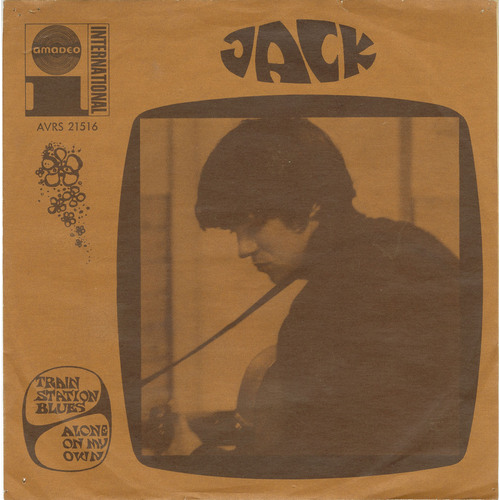
Album / Title
Train Station Blues b/w Alone On My Own
By: Jack Grunsky
Origin: Graz, Austria - Toronto, Ontario, 🇨🇦
Insight
Jack Grunsky was born Hans Grunsky in Graz, Austria, on July 1, 1945, just under eight weeks after the war in Europe ended. His father, Wolfgang Grunsky, was a cellist who had worked at the Mozarteum in Salzburg. In 1951, when Hans was six, father and son emigrated to Canada and settled in Toronto.
Music was the language of the house. He took lessons in cello, piano and recorder, then traded them in high school for guitar, drums and his own voice. He kept the beat for the school dance band and strummed guitar in a folk trio just as the folk boom was sweeping North American campuses. Hans became Jack in Toronto, where, as he put it, nobody knew the name Hans.
Jack's AngelsIn 1964, at nineteen, he finished high school and went back to Austria to study art, first in Linz and then at the Academy of Arts in Vienna. The guitar came with him. In 1966 he formed Jack's Angels with singer Claudia Pohl, singer and guitarist Herbert Wegscheider and bassist Christoph Oberhuber, all Linz natives studying in Vienna, with Berni Prock on drums on the records. They rehearsed in a cellar room in Mauer, on Vienna's southwestern edge, where Jack lived, and built their sound on original songs and close three-part harmony in the style of Peter, Paul and Mary, with Jack out front on lead vocal, acoustic guitar and harmonica.
Vienna's Amadeo label signed them, and in two years Jack's Angels released four albums, Believe in a World, Restless, Our Fantasy's Kingdom and Looking Back, along with a steady run of singles. The German-language 'Ich hör deine Schritte kommen' climbed to number 19 on the Austrian chart in June 1967, and 'The Prince in Love Is Me' became a lasting favourite. Tours took them across Austria, Germany, Switzerland and the Netherlands. The band split in 1968, by which point Jack was counted among the central figures of Austria's Grüne Welle, the folk wave then running through the country's young pop scene, and some listeners heard in him a Viennese Bob Dylan.
Solo years in EuropeAmadeo kept him on as a solo artist. The Way I Want to Live appeared under the billing Jack ... from Jack's Angels, and My Ship followed in 1969, recorded in Vienna with acoustic arrangements by Robert Opratko and Hans Salomon. Its first side closes with 'I'm Turning Home', his tribute to Toronto. Singles kept coming: 'My Ship', 'Train Station Blues', 'Sally McGregor', 'Oh My Love Yes My Love' and, in 1969, 'Catherine' backed with 'Sweeper Woman'. In 1970 André Heller put 'Catherine' on his debut album, Nr. 1, with a German lyric by Reinhard Mey, and it became one of Heller's first radio hits. One of the founding voices of Austropop got an early lift from a song written by a kid raised in Toronto.
Heller also helped connect Jack with the British blues pioneer Alexis Korner. Jack went to London to record Toronto at De Lane Lea Studios on Kingsway, with Martin Birch and Barry Ainsworth engineering and Korner producing. Mick Taylor, recently recruited into the Rolling Stones, played electric guitar on several songs and acoustic bottleneck on another, and Annette Brox added vocals. Released in 1970, it carries 'A Better Look at Toronto', 'Children in a Game' and a new London recording of 'Catherine', and it also became one of the first albums on Munich's new progressive label, Kuckuck.
Kuckuck's founder, Eckart Rahn, had first heard Jack in Vienna, opening for the Small Faces. The label followed Toronto with Buffalo Brian, Newborn Man (1971) and a self-titled album in 1972. 'Back Home to Canada', the last song on Newborn Man, became the theme of a short film for Austrian television, and it said plainly what he was feeling. Years later Jack and Rahn worked together for months restoring the Kuckuck albums for CD, adding as a bonus Jack's own German recording of 'Catherine' with Mey's lyric.
In 1974 the Atom label issued the double album Icarus, which gathered Jack's Angels songs and solo recordings, from 'Train Station Blues' and 'Catherine' to 'Land of the Silver Birch', with Jack recorded live at the Atlantis Folkclub that March.
The European years were crowded. He composed and produced three children's musicals for ORF television, Der Rauchfangkehrer auf dem Regenbogen, Traumauto Nr. 5 and Hans im Glück, and wrote music for film and TV. He recorded with Duke Ellington's bassist Jimmy Woode and the pianist Friedrich Gulda, worked with Udo Jürgens, and shared stages with Joan Baez and Richie Havens. In 1969 he played the airport restaurant in Salzburg at the invitation of Alfred Winter's Szene der Jugend, and at Whitsun 1971 he co-headlined Popendorf, the open-air festival sold as Styria's own Woodstock. From 1971 to 1973 he hosted Folk mit Jack, a weekly half-hour show on the young Ö3 network, opening each broadcast with a cheerful 'Hello Folks' that his Austrian listeners still remember.
Back home to CanadaIn 1974 Jack moved back to Toronto with his wife, Hertha, and their first daughter, Carina. The European record business was changing and he felt himself drifting to its margins, while the folk and folk-rock coming out of North America pulled at him. He found an ally in bassist and producer Chad Irschick, who produced The Patience of a Sailor, released on the Honeybee label in 1978. With his Toronto band he worked the Ontario coffee house and folk festival circuit, turned up on CBC Radio and CTV's Canada AM, and in 1979 took the group back across the Atlantic to tour for his European audience. He went back to school as well, studying at the Royal Conservatory of Music with Sam Dolin, and an arts council grant paid for piano lessons with Darwin Aiken and vocal coaching with Gloria Ferrer.
A new audienceThe turn came in the early 1980s, when his daughter's teacher asked him to come into the classroom and sing with the students. That visit led to a music program at the Toronto Island Montessori School in 1981 and four years as a freelance music teacher in Montessori schools around the city. He discovered he loved the work, and he noticed how little children's music was made with real care. He began writing his own songs, drawing on his travels and his years on European stages, and by the mid-1980s he was back on the road, playing hundreds of schools. Prologue to the Performing Arts took him into its artist-in-schools catalogue, a relationship that has lasted more than thirty years.
He recorded his first children's album, Imaginary Window, in 1989. Children of the Morning followed, with a children's chorus directed by Louise Cullen and his younger daughter Cosima singing lead on one track, and it earned his first Juno nomination in 1992. A manager and a concert agent came on board, then a contract with BMG Kidz, and in 1993 Waves of Wonder won the Juno Award for Best Children's Album along with a Parents' Choice Gold Award. 'Pyjamarama' and 'Wave After Wave' from that record found their way onto children's radio across North America.
Dream Catcher (Juno nomination 1994, Parents' Choice Gold), the concert recording Celebrate! Jack Grunsky Live and Jumpin' Jack (Juno nomination 1997) kept the run going, and the American Library Association named several of them among the year's best children's recordings. Reviewers kept returning to the same qualities: warm vocals, layered arrangements that borrowed from Cajun, Caribbean, African and Latin music, and production values that matched anything made for adults. A typical family concert might open with 'Happy Day', pass through 'Jumpin' Beans', 'Iko Iko' and 'Alligator Stomp', and wind down with 'Sleep My Little One' before the 'Good Bye Song'. Plenty of parents kept the records playing after the kids were asleep.
In 2000 he went independent, licensing new recordings through Casablanca Kids. Sing & Dance won the Juno in 2001, and Playground, Jack in the Box #1 and Jack in the Box #2 followed. Like a Flower to the Sun was nominated in 2004, and My Beautiful World brought his third Juno in 2007. Along the way he produced Fred Penner's Sing with Fred, which took the Juno for Children's Album of the Year in 2003. His symphony program Welcome to the Orchestra played with major orchestras across Canada, and his keynotes and workshops for early childhood educators carried him across Canada and the United States and as far as Cape Town.
Catchy Tune (2008) earned a Juno nomination in 2009, a Parents' Choice Silver Honour and the 2008 SOCAN Children's Music Award. In 2009 he produced Cosima's own children's album, The Whole World Sings With Me, and recorded his first French-language album, Partout où les enfants chantent. Father and daughter teamed up on Hoppin' Socks, which brought a Parents' Choice Award in 2012, the same year he was nominated for Favourite Children's Artist at the CMW Indies. Theatro Muppiloo (2017) is a complete stage musical for kindergarten to grade five, built around a theatre stagehand named Muppiloo who sweeps the empty stage after the show and lets his imagination take over. His school programs have included a solo show, Sing.Listen.Learn, and a duo program with Cosima, Like Father, Like Daughter.
Studio and stage for grown-upsHis home studio has stayed busy with other people's music. He mixed Set in Stone for the jazz trio Nehring, Koller, Braid, mixed the Heillig Manoeuvre's Wait, There's More! and played percussion on it, and wrote 'Citizens of the World' with Susan Aglukark and Chad Irschick for her album Blood Red Earth.
In 2006 he released Coastlines, a NuJazz album with trumpeter John MacLeod, pianist Matt Horner, saxophonist Colleen Allen, bassist Henry Heillig, drummer Lorne Nehring, percussionist Art Avalos and Lenny Graf on woodwinds, and Hertha and Cosima adding vocals. CBC and JAZZ FM put it on the air. Room to Move (2008) mixed bossa nova, samba, urban funk and folk, adding drummer Mark Kelso, trombonist William Carn, saxophonists John Johnson and Perry White, and Ravi Naimpally on tabla. Façade (2012), Miami in Mind (2013) and a set of new songs, Stirring Up the Dust (2015), followed, along with Got You Covered, a five-year home recording project on which Jack, Hertha, Carina and Cosima each picked songs that had filled the family house over the years.
Europe called him back. In March 2018 he played the Great Hall of the ORF RadioKulturhaus in Vienna to a cheering crowd, and then Hörsching with the Spring String Quartet. He told Austrian television that after more than four decades in Canada he still often felt homesick for Austria. That year he released Life Boat, which he described as remakes of old takes, highlights and heartaches: new recordings of Jack's Angels songs such as 'Believe in a World', his European chart singles, 'Patience of a Sailor' and children's songs that fit the theme of a life's journey. Voices in My Head, a folk and adult contemporary set written through the pandemic, includes 'The COVID Bus', 'The Portal' and 'Beautiful to Me'.
The painterArt school never really ended for him. Jack has exhibited paintings since 1977, when he showed at Galerie Herzog in Vienna and Galerie Feichtinger in Linz, and his Toronto shows include Hart House at the University of Toronto, the Toronto Outdoor Exhibition through the 1990s and the Living Arts Centre in Mississauga. His work runs from realism and landscapes to whimsical figures, abstracts and block prints, he paints his own album covers, and he takes commissions from private collectors and commercial clients.
HomecomingIn the fall of 2021, with the tour delayed a year by the pandemic, he made a five-city run through Austria. In Salzburg he played the Jazzit at the invitation of Alfred Winter, the same promoter who had booked him at the airport restaurant in 1969. On October 8 he walked onstage at the Volkshaus in Graz, his first concert in his birthplace since Popendorf fifty years earlier, and sang 'Catherine' and 'Train Station Blues' in the city where Hans Grunsky was born.
Gerhard Wildmoser, a Linz lawyer who had managed Jack's Angels in the 1960s, then proposed a joint album, and for two years producer Martin Seimen of Traun shuttled music files back and forth across the Atlantic. Two Worlds One Memory came out on PlanetM in 2025, shortly before Jack's eightieth birthday: 38 duo and solo tracks from the songbooks of Bob Dylan, Kris Kristofferson, Pete Seeger and their generation, with Cosima Grunsky and Jessie Ann de Angelo joining in. That July, Austria's Ö1 network marked the birthday with a radio retrospective on his part in the first years of Austrian folk and pop.
-Robert Williston
Gallery
Images
4 images
45-Jack Grunsky - Train Station Blues BACK
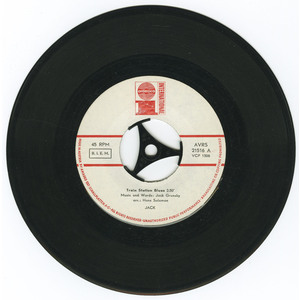
45-Jack Grunsky - Train Station Blues VINYL 01
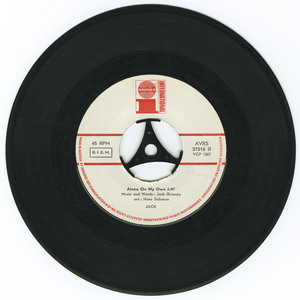
45-Jack Grunsky - Train Station Blues VINYL 02
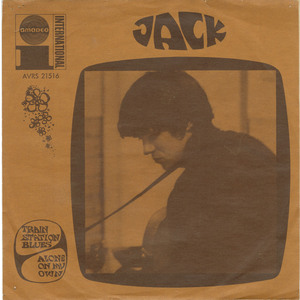
Train Station Blues b/w Alone On My Own
Media
Videos
0 videos
No videos available for this title.
Credits
Musicians
Jack Grunsky: vocals
Songwriting
‘Train Station Blues’ written by Jack Grunsky
‘Alone on My Own’ written by Jack Grunsky
Production
Arranged by Hans Salomon
Release
1968, Amadeo International, AVRS 21516, 7" 45 RPM Single, Austria
Manufactured by Amadeo Österreichische Schallplatten AG
Made in Austria
Rights Society: B.I.E.M.
Matrix/Runout
Side A: IM VCP 1306 (stamped)
Side B: IM VCP 1307 (stamped)
No Comments