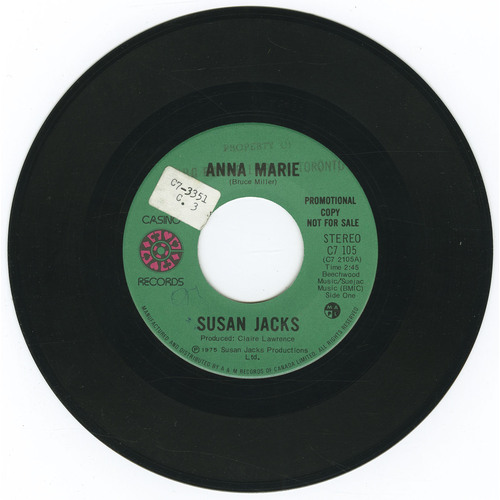
Album / Title
Anna Marie b/w Into the Night
By: Susan Jacks (Susan Pesklevits)
Origin: Saskatoon, Saskatchewan → Vancouver, British Columbia, 🇨🇦
Insight
In the summer of 1970 Susan Jacks was riding in the back seat of a car on the way to an interview in Los Angeles when the driver mentioned, almost as an afterthought, that 'Which Way You Goin' Billy?' had sold a million copies. The record had cost about $125 to make in a small Vancouver studio. It went on to sell close to four million copies around the world, went to No. 1 in Canada and No. 2 on the Billboard Hot 100, earned an American gold record, and became the first million-selling record by a Vancouver act.
She was born Susan Elizabeth Pesklevits in Saskatoon on August 19, 1948, the second of eight children of Janette Pesklevits, a homemaker, and Dick Pesklevits, a teacher. By the age of seven she was singing into the microphone at a local radio station on Saturday afternoons. When she was nine the family moved to Haney in the Fraser Valley, where she sang in school and church choirs, had a radio show of her own at 13, and at 14 was singing at Legion hall dances for a dollar a night. At 15 she joined the Let's Go revue, the Vancouver segment of CBC's national teen program Music Hop. Her first record came in 1966, when she joined Tom Northcott and Howie Vickers as The Eternal Triangle. Their single 'It's True', on Northcott's New Syndrome label, reached No. 16 on Vancouver's CFUN chart that September, and later pressings billed the group as The Eternal Triangle featuring Susan Jacks.
In 1966, 18 and working on her own, she needed a rhythm guitarist for a date at the Elks Club in Hope. Someone told her that Terry Jacks, whom she knew from the Music Hop circuit, was free because his band, the Chessmen, had just broken up. Terry was no lead player, so they brought in Craig McCaw on lead guitar. After trying the names Powerline and Winkin', Blinkin' and Nob, they became The Poppy Family, playing their first show under that name at a small coffee shop in Blubber Bay on Texada Island. Susan and Terry married in 1967, and McCaw brought in Satwant Singh on tabla, giving the group the sitar-and-tabla shimmer that set it apart from everything else on Canadian radio. Susan sang lead and played percussion with real abandon. McCaw remembered her coming offstage in a miniskirt with her legs bruised from the tambourine.
Terry wrote 'Which Way You Goin' Billy?' as 'Which Way You Goin' Buddy?', for a man to sing, and Mike Campbell, who had been on Music Hop with Susan, sang it first. Susan liked the melody but thought the lyric made the singer sound like a wimp, and suggested Terry rewrite it for a woman. They went down the list of her six brothers for a new name and Billy sounded best. Billy liked to say the song did wonders for him with girls. Terry later gave a different account of where the name came from. Either way, the record broke the group around the world. It led off their first album, Which Way You Goin' Billy?, released by London Records in 1969 with Terry producing, At the first Gold Leaf Awards, the forerunner of the Junos, in February 1970, it was named best produced single and the album best produced MOR album, and the single later added two Moffat awards. 'That's Where I Went Wrong' followed it into the Canadian Top 10 and reached No. 29 in the United States.
Beneath the sweetness of Susan's voice, the Poppy Family made some unusually dark records. 'Shadows On My Wall' and 'Where Evil Grows' carried a brooding, domestic menace that few pop singles of the day would touch, and her clear, untroubled delivery made them stranger still. The group sang on Kenny Rogers' Rollin' On The River and other American variety shows, but turned down The Ed Sullivan Show to play Expo 70 in Osaka. Their Nashville-based manager, Dub Allbritten, who also handled Brenda Lee, died in 1971. Susan loved performing live. Terry did not, and the band never committed to the road. Susan later said the lack of management was what brought them down.
After Expo 70, McCaw and Singh were gone, and the Poppy Family was effectively Susan and Terry with session players. Poppy Seeds (London, 1971) still produced a run of hits: 'Where Evil Grows' (No. 6 in Canada, No. 45 in the US), 'No Good To Cry', 'I'll See You There', which went to No. 1 on the Canadian adult contemporary chart, and 'Good Friends?'. Terry wrote and produced, and so the credit tended to flow his way. Susan spent every hour of those sessions in the studio and said that today she would be called a co-producer. At the time, she said, she was simply the chick singer. The wordless 'ah-ah' vocals that became a Poppy Family signature grew out of her ideas in rehearsal, and she sang her own harmonies on the records, a skill she had learned from listening to the Everly Brothers. The studios were not always grand. 'Winter Milk', Joe Fahrni's story of a girl near Williams Lake who falls for a man just passing through, was one of her favourites. A truck can be heard rumbling past the studio during one verse, and they kept the take because they liked it.
In 1972 the Poppy Family name was retired and the couple each recorded a solo album on Goldfish Records, the label they owned together, with Terry producing both. Susan left the marriage early in 1973, before either record came out. Terry's Seasons In The Sun went on to give him an international No. 1 in 1974. Susan's I Thought of You Again gave her two major Canadian hits, 'You Don't Know What Love Is' (No. 3) and the title song (No. 7, and No. 2 adult contemporary), and a Juno nomination for female vocalist of the year. 'You Don't Know What Love Is' came out of a fight. Susan told Terry he didn't know what love is, he said nothing, and a while later he came back with a song built from her words. Newly on her own, she applied for a gas credit card and was turned down. She led her own touring band, Cheese, arranged its music, played the 1973 Pacific National Exhibition, and kept the singles coming with 'I Want You To Love Me' and 'Build A Tower'.
Her second album, Dream, recorded in 1975 with Claire Lawrence of Chilliwack producing most of it and contributing two songs of his own, was the record where she stepped out of the lost-little-girl image the industry had built around her. She moved through country rock, blues and singer-songwriter material by Ken Tobias, Roy Forbes, Kim Carnes, Eric Kaz and Libby Titus, and Kenny Loggins and Jim Messina. Bruce Miller's 'Anna Marie' reached No. 20 on the Canadian pop chart and No. 13 country, her version of Carnes' 'You're A Part Of Me' touched the Billboard Hot 100 at No. 90, and she earned a Juno nomination as country female vocalist. Dream came out on Casino Records, the label Ray Pettinger formed after buying Terry's share of Goldfish. Susan sued him over the use of her money in that buyout and won, but Dream was pulled from the market and her career stalled for years. She eventually recovered the rights and reissued the album in 2015, forty years after she made it.
She signed with Polydor in 1976 and reached No. 5 on the adult contemporary chart with 'Memories Are Made Of You'. In 1977 she met Ted Dushinski, the former BC Lions and Saskatchewan Roughriders defensive back, who became her husband and manager. She stepped away to raise their son, Thad, and came back in 1979. Her return album, Ghosts (CBS, 1980), was produced by Terry, though by her account that was his doing and not her choice. She had made Dream without him and had moved on, but Terry went to the label and secured the job. He had cut 'All The Tea In China' with another singer, disliked the result and asked Susan to try it. Her demo brought the label calling for a full album. On 'Ghosts In Your Mind' her vocal was laid over an existing Terry Jacks recording, but she also got to sing 'We Had It All', a song she had loved for years. Ghosts brought a Juno nomination for 'All The Tea In China' and adult contemporary hits with 'Twice As Strong' and 'Evergreen', the latter also crossing to the country chart. Wanting a harder edge, she then went to Bruce Allen, the manager behind Loverboy, Prism and Bryan Adams. He told her to lose twenty pounds and buy new clothes, and paired her with Powder Blues producer Tom Lavin. The result was Forever (1982), a tougher record built around a title song by Rafe VanHoy that she had found making the rounds of Nashville publishers, and including her version of 'You Don't Have To Say You Love Me', a nod to Dusty Springfield, one of the singers who had shaped her.
In 1983 she moved with Ted and Thad to Nashville and signed with Compleat Records. In 1984 'Another Woman's Man' reached No. 47 on the Canadian country chart, she earned a Juno nomination for country female vocalist, and 'Tall Dark Stranger' saw her voted best new female country artist in Oklahoma. When Compleat folded, she turned to the business she had come to Nashville to learn. She became a staff songwriter, demo singer and producer, sang on fellow Canadian Ralph Murphy's songs, went out for beers with Murphy and Don Everly, whose records had taught her harmony, sang harmonies for Nashville country artists, managed a publishing company, placed a lullaby on a Grammy-nominated children's album, and co-wrote and sang 'Looking For Love' for the film The Last Chance Cafe. Drawing on her Ukrainian roots, she also opened a restaurant that served perogies, deep-fried for Southern tastes. Later she moved into business as an executive with Nashville computer and telecommunications firms.
In 2004 Ted was diagnosed with cancer. The two had separated by then but remained close, and when he said he wanted to go home to Canada, she packed up their lives and brought him back to the Vancouver area. He stayed with her until his death on October 24, 2005. Around the same time she learned that her own kidneys were failing. She kept performing when her strength allowed, and on June 27, 2010, her star was set into the BC Entertainment Hall of Fame. That year her brother Bill, the Billy of the song, gave her one of his kidneys. One of her other brothers named it Wilson, after the volleyball in Cast Away. Within months she was back on stage, and on April 17, 2011, she headlined a benefit for the Kidney Foundation of Canada, the first of many appearances on behalf of organ donation.
In 2014 she reunited with Craig McCaw and Satwant Singh at the Khatsahlano Street Party on West 4th Avenue in Vancouver as the Poppy Family Experience, backed by younger players from The New Pornographers, Black Mountain and Destroyer. Asked whether the group had really been Terry's band, she called that the biggest myth. "The Poppy Family was all of us, period," she said. The following year, in a Cashbox Canada cover story she and writer Don Graham titled It's My Turn, she set down her own account of her career and pushed back against versions of the Poppy Family story that had written her out of it. "I tell the truth, it's all I know how to do," she said. She was writing new songs and planning to record again.
In 2016, as she later told it, she learned she had an extremely rare kidney disease, one of about 200 known cases in the world. A fall put her in hospital on her birthday, pneumonia and sepsis followed, and she was placed in a coma on life support. She was told she had about a thirty percent chance of making it. She came through it, spent three months in hospital and had to learn to walk again. The transplanted kidney failed and she went back on dialysis. She kept working anyway, with five to eight songs nearly finished for a new album, some co-written with Nashville songwriter Roy Hurd and others of his that she had recorded. She planned to finish it once she had a new kidney, and credited her outlook for how well she had come back.
Susan Jacks died at Surrey Memorial Hospital on April 25, 2022, at 73, while waiting for a second transplant. She was survived by her son Thad, her brothers Rick, Gerry, Wayne, Bill and Jim, her sister Cathy, and two half-brothers. On May 4, MP Ken Hardie paid tribute to her in the House of Commons, recalling that she and other West Coast artists had earned their radio play before Canadian content rules existed. The records outlived the industry that undervalued her. D.O.A. took 'Where Evil Grows' to a new audience, and the song has since turned up in the film Sonic the Hedgehog and the series Killing Eve, still carried by the voice of a girl from Haney who started out singing for a dollar a night.
-Robert Williston
Gallery
Images
2 images
45-Susan Jacks - Anna Marie VINYL 02
Anna Marie b/w Into the Night
Media
Videos
0 videos
No videos available for this title.
Credits
Musicians
Susan Jacks: lead vocals
Songwriting
‘Anna Marie’ written by Bruce Miller
‘Into the Night’ written by Claire Lawrence
Publishing
‘Anna Marie’: Beechwood Music / Surejac Music (BMI)
‘Into the Night’: Surejac Music (BMI)
Production
Produced by Claire Lawrence
Release
1975, Casino Records, C7 105, 7" 45 RPM Stereo Single, Canada
Promotional copy, not for sale
Manufactured and distributed by A&M Records of Canada Limited
Phonographic Copyright ℗ 1975 Susan Jacks Productions Ltd.
No Comments