Insight
Figgy Duff took the songs of Newfoundland's outports and played them with drums and amplifiers. Named for the raisin pudding boiled in a bag and served with Jiggs dinner, the St. John's band spent nearly twenty years carrying that sound from community halls and house parties to Mariposa, Cambridge and Glastonbury, and it was at the heart of the province's cultural revival of the 1970s and 1980s.
Noel Dinn built it. Born in St. John's on Christmas Day 1947, he heard traditional music at home, where his father sang and played the fiddle, and rhythm and blues on American radio, from Solomon Burke to Jimmy Reed. He learned to drum in local bands, playing alongside jazzman Ralph Walker and in the Garrison Hill, a group with a horn section. In 1967 he formed the Philadelphia Cream Cheese Band, and then Lukey's Boat, a rock band that began working Newfoundland traditional songs into its sets and took them to Montreal and on to London, England. Fairport Convention and the other English bands mixing folk and rock showed him what could be done. Newfoundland's oral tradition gave him the material.
He formed Figgy Duff in St. John's in 1974. He had heard Pamela Morgan, a teenager from Grand Falls, sing at a drama festival and asked her to join. She turned him down, then said yes when he asked again about a year later, and from then on she and Dinn were the heart of the band through every lineup. Early members included Philip Dinn on vocals and bodhran, Kelly Russell on fiddle, Art Stoyles on accordion, Dave Panting on mandolin and bass, and singer Anita Best. When Stoyles left, Dinn called Geoff Butler in August 1978, and Philip Dinn left early in 1979, leaving the four who made the first album: Dinn, Morgan, Panting and Butler. Dinn drummed, played piano and arranged, and also served as the band's manager, booking agent, bookkeeper and van driver.
The band went looking for songs where they were still sung, and for the ones nobody else was singing. A Canada Council grant let its members travel the island's rural communities and learn from singers and fiddlers in their kitchens and halls, and they also drew on Kenneth Peacock's 1965 collection Songs of the Newfoundland Outports. The record sleeves name the people they learned from. The first album credits Larry Barker of Bonavista Bay, Mose Harris of Lethbridge, Josephine Costard of Cape St. George, Leonard Hulan of Jeffries in the Codroy Valley, Paddy Rossiter of Fermeuse, Ellen Carroll of Red Island in Placentia Bay, and Minnie White of the Codroy Valley, the accordionist known as the First Lady of the Accordion. After The Tempest adds Philip Foley of Tilting on Fogo Island, Jack Carroll of Red Island, Annie Green of Francois on the southwest coast and Mme. Dubé of the French-speaking Port au Port Peninsula. Accordion player Frank Maher of the Battery in St. John's passed on his tunes, and the fiddlers Rufus Guinchard and Emile Benoit of Black Duck Brook supplied many more. Benoit sometimes shared the stage.
Many Newfoundlanders of that generation had grown up feeling that their accents and traditions were second-rate, and Morgan has spoken of the band's music as an answer to that. Figgy Duff called its sound trad-rock. Not everyone at home approved, and some St. John's folk purists objected to the drums and amplifiers. As Morgan put it years later, some people hated them and some thought they were fantastic.
In 1977 Figgy Duff made its first tour of Ireland and England. Toronto became a second base in 1977 and 1978, and in the summer of 1978 the band set out on a cross-Canada tour that opened with three nights at the Horseshoe Tavern. It also played the El Mocambo in Toronto and the Commodore in Vancouver, while its regular room at home was the Ship Inn. It became a fixture on the Canadian festival circuit at Mariposa, Owen Sound and Vancouver, and toured by van on paid dates and on very little money, often without a manager, agent or label. Its American debut came at the Philadelphia Folk Festival, and later trips took it to the Cambridge Folk Festival in 1982, the New Orleans Jazz and Heritage Festival in 1988 and Glastonbury in 1989, with British tours every year from 1985 to 1989 and dates in Germany and the Netherlands. At Expo 86 Dinn told Steve Edge that somebody had to start presenting this music in Vancouver, and Edge started The Rogue, which gave Figgy Duff two sold-out nights at the Cultch in January 1987.
The first album, Figgy Duff, came out on Posterity Records in 1980, produced by Gary Furniss and Tom Treumuth and recorded at Nimbus 9 in Toronto with Morgan, Dinn, Panting and Geoff Butler on button accordion. Dingle's Records issued it in Britain. After The Tempest followed on Boot Records in 1983, adding Derek Pelley on bass. Its title came partly from the band's original score for a 1982 St. John's production of Shakespeare's The Tempest, represented on the record by 'Honour, Riches', and the same year the group prepared a folk opera, A Nobleman's Wedding.
By the end of the decade Dinn wanted the band to carry his own poetry and songs. Weather Out The Storm, released in 1990 on Hypnotic Records through A&M, was built largely on originals by Dinn and Morgan, among them the title track, 'Heart of a Gypsy' and 'Snowy Night', with synthesizers alongside fiddle and accordion and a lineup of Kelly Russell, Frank Maher, Bruce Crummell and Rob Laidlaw. It was nominated for Best Roots and Traditional Album at the 1991 Juno Awards.
In his last two years Dinn produced The Colour of Amber, Morgan's album of traditional songs with Anita Best, along with Emile Benoit's Vive la Rose and Downstream. Downstream, released in June 1993, was written entirely by Dinn and Morgan, opens with his 'Freedom' and is dedicated to Emile Benoit. Dinn was already ill with throat cancer. On May 14, 1993, The Rogue held a fundraiser in Vancouver to help pay for his treatment. He died in St. John's on July 26, 1993, at 45, and Morgan wound the band down soon after.
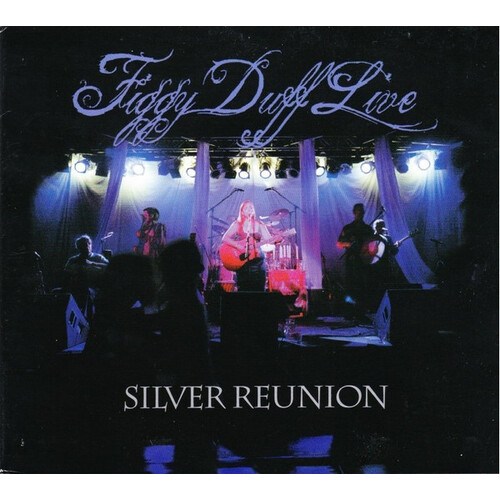
Morgan gathered the band's recordings under her own label, Amber Music, and in 1995 released Retrospective 1974-1993, which included previously unreleased material from across its history. Dave Panting went on to Rawlins Cross, and Kelly Russell and Frank Maher formed the Plankerdown Band. Morgan carried on as a solo artist and composer, work the East Coast Music Association recognized with its Stompin' Tom Award in 2024. Figgy Duff reunited in 1999 for a silver anniversary tour, and its July 16 show at the Delta Hotel in St. John's became Figgy Duff Live: Silver Reunion, released in 2008, when the band reunited again to mark the release. Philip Dinn died in November 2013.
In 2016, at the 40th Newfoundland and Labrador Folk Festival in Bannerman Park, the Folk Arts Society gave Figgy Duff its Lifetime Achievement Award. Morgan accepted it and called the moment bittersweet, because the man who had spearheaded the band was not there to see it. That evening Figgy Duff played again with Morgan, her brother George Morgan, Dave Panting, Kelly Russell and Derek Pelley, and Noel Dinn's great-nephew took the drums for one song.
-Robert Williston
Gallery
Images
3 images
Figgy Duff Live Silver Reunion (2)
Figgy Duff Live Silver Reunion (3)
Live Silver Reunion
Media
Videos
0 videos
No videos available for this title.
Credits
Musicians
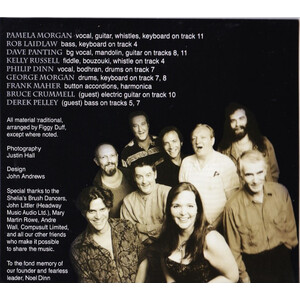
Pamela Morgan: vocal, guitar, whistles, keyboard (11)
Rob Laidlaw: bass, keyboard (4)
Dave Panting: backing vocal, mandolin, guitar (8, 11)
Kelly Russell: fiddle, bouzouki, whistle (4)
Philip Dinn: vocal, bodhran, drums (7)
George Morgan: drums, keyboard (7, 8)
Frank Maher: button accordions, harmonica
Bruce Crummell (guest): electric guitar (10)
Derek Pelley (guest): bass (5, 7)
Production
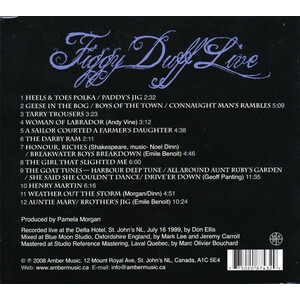
Produced by Pamela Morgan
Recorded live at the Delta Hotel, St. John’s, NL, July 16, 1999, by Don Ellis
Mixed at Blue Moon Studio, Oxfordshire, England, by Mark Lee and Jeremy Carroll
Mastered at Studio Reference Mastering, Laval, Quebec, by Marc Olivier Bouchard
Songwriting
All material traditional, arranged by Figgy Duff, except where noted
‘Woman Of Labrador’: Andy Vine
‘Honour, Riches’: words by Shakespeare, music by Noel Dinn
‘Breakwater Boys Breakdown’: Emile Benoit
‘Drive’er Down’: Geoff Panting
‘Weather Out The Storm’: Morgan/Dinn
‘Brother’s Jig’: Emile Benoit
Artwork / Design
Justin Hall: photography
John Andrews: design
Dedication
To the fond memory of our founder and fearless leader, Noel Dinn.
Special thanks
Special thanks to the Shelia’s Brush Dancers, John Littler (Headway Music Audio Ltd.), Mary Martin Rowe, Andre Wall, Compusult Limited, and all our other friends who make it possible to share the music.
Release
Amber Music, 8743-2, Canada, 2008
CD
℗ © 2008 Amber Music Limited, 12 Mount Royal Ave, St. John’s, NL, Canada A1C 5E4
www.ambermusic.ca, info@ambermusic.ca
MAPL
Made in Canada
Barcode: 7 75020 87432 9
No Comments