Album / Title
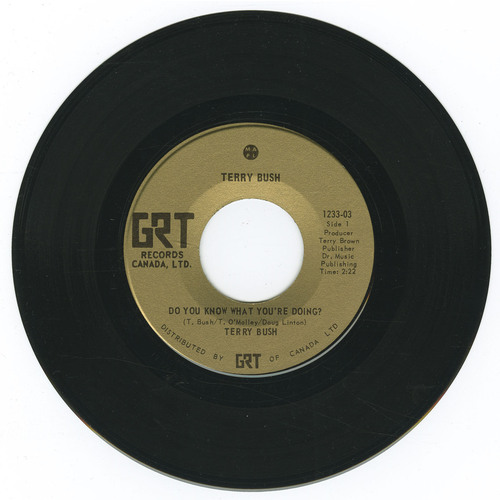
Do You Know What You're Doing? b/w Fare Thee Well
By: Terry Bush
Origin: Toronto → Ajax, Ontario, 🇨🇦
Insight
Terrence Teakle Bush was born in Toronto, Ontario, on April 29, 1942, the youngest of three sons of Canadian painter Jack Bush and his wife Mabel. Music was part of the household even though neither parent worked professionally in it. His father played piano by ear and loved jazz, his mother also played, and during family summers at Lake of Bays in Muskoka, Jack taught the young Terry songs on the ukulele. Bush remembered learning ‘Ain’t She Sweet’ when he was about ten.
The guitar came next. Bush later traced the fascination to a television commercial featuring a cowboy carrying one. He received a guitar for his birthday and practised relentlessly, by his own account until his fingers bled. By the middle of the 1950s his listening had turned toward the first wave of rock and roll, particularly Elvis Presley, Ricky Nelson and Carl Perkins, while guitarists James Burton and Scotty Moore became important models. His first remembered public performance came at a school father-and-son banquet in 1955, where he played and sang ‘That’s All Right Mama’ and ‘Blue Suede Shoes’. His improvised guitar strap was a piece of rope.
After high school Bush joined Dave O’Neill & The Convertibles and, by about nineteen, was touring in the United States. The experience lasted roughly a year and was hardly glamorous. He returned to Toronto with a Telecaster and Fender amplifier but little money, and took a mailroom job at MacLaren Advertising. His father encouraged him to return to school, and Bush enrolled in Electronic Technology at Ryerson Polytechnical Institute. He earned honours during his first two years but left in his third when he discovered that the program contained none of the audio training he had hoped to pursue.
Ryerson nevertheless put him close to the Toronto music scene that would shape his career. Bush spent time at the original Blue Note on Yonge Street, where the house band was The Silhouettes, featuring the young Doug Riley on organ. Bush auditioned, joined the group and began a musical friendship with Riley that would continue through bands, commercials, studios and records for years.
From the Silhouettes, Bush moved into Robbie Lane & The Disciples. The timing placed him directly in one of the most important transitions in Toronto rock and rhythm and blues. Robbie Lane’s group had become the backing band for Ronnie Hawkins after the musicians who would become The Band had moved on. Bush had long wanted to play with Hawkins, and said later that he jumped at the chance because he had always wanted to play with the Hawk. He remained with the arrangement until June 1965. The Disciples subsequently developed a profile of their own, and by 1966 were the house band for the CTV television program It’s Happening. Bush’s guitar became a prominent part of the group’s recordings and broadcasts.
While Bush was still playing with the Disciples, a seemingly routine advertising assignment changed the direction of his career.
At MacLaren he had known producer Tony Tudhope. Tudhope later approached Bush about creating rock music for a campaign advertising Baby Ruth candy bars. Bush called Doug Riley, and together they wrote ‘Baby Ruth’ and its companion piece. What was supposed to remain advertising music escaped into the record business.
RPM Weekly reconstructed the story in April 1965. Tudhope had assembled young Toronto musicians to make the commercial sound authentic to teenage listeners. A white-label promotional recording was circulated to radio stations in conjunction with the campaign. CKEY personality Glenn “Big G” Walters began playing it regularly, listeners started asking record stores for the record, and Red Leaf Records co-founder Stan Klees traced the recording back through Hallmark Recording Studios. Red Leaf hurried it into commercial release as The Butterfingers. RPM put the situation succinctly: the Butterfingers as an actual band did not exist; they were pickup musicians whose commercial had created its own public demand. Bush and Riley wrote both sides.
‘Baby Ruth’ became a Canadian chart record and turned a jingle writer’s sideline into a serious occupation. By that April, RPM was reporting that Red Leaf was negotiating a worldwide release for the record through a major American company. Bush later remembered it, to his knowledge, as the first Canadian rock-and-roll jingle to make that transition. More important than the claim of being first was what followed: advertising music increasingly became Bush’s profession. After ‘Baby Ruth’ he studied arranging and composition, and in 1967 formed Terry Bush Productions. His longtime friend Jim Pirie became a central arranger in the company’s work.
Bush’s advertising catalogue eventually became enormous. Among his better remembered campaigns was ‘Man That’s Coffee’ for Maxwell House, which he composed and produced using the Baja Marimba Band; the group subsequently recorded the piece as a record. Other Bush work included airline campaigns, cigarette commercials, ‘I Wanna Go To The Zoo, Zoo, Zoo’ for the Metropolitan Toronto Zoo, ‘Life In The City’ for the opening of the Toronto Eaton Centre, and later ‘I Adore My 64, My Commodore 64’. The Toronto Zoo itself revived Bush’s 1976 jingle during its fortieth-anniversary celebrations in 2014.
The commercial business also put Bush near the centre of Toronto’s rapidly changing recording industry. In 1969 he became one of the partners in Revolution Sound Studios, alongside Terry Brown, Doug Riley, Mort Ross, Norman Riley and Fred Webster. Billboard reported that Revolution Sound was one of four companies operating under the Revolution organization.
The studio mattered. When Billboard surveyed Toronto’s recording boom the following year, it credited Terry Brown, Doug Riley and Terry Bush with creating a facility aimed specifically at the emerging rock market. Revolution Sound opened in November 1969 with Toronto’s first sixteen-track capability. Within months it had recorded Edward Bear, Mother Tucker’s Yellow Duck, Crowbar, King Biscuit Boy and music for The Ray Stevens Show. It was soon renamed Toronto Sound Studios. Bush was therefore involved not only in writing and playing records but in the development of one of the studios that helped modernize Canadian rock recording at the beginning of the 1970s.
His own name moved onto GRT Records through the Dr. Music Productions operation built around Terry Brown and Doug Riley. In early 1971, Bush released ‘Do You Know What You’re Doing?’ / ‘Fare Thee Well’ as GRT 1233-03.
‘Do You Know What You’re Doing?’ had begun as a recording for the Council on Drug Abuse rather than as a conventional pop single. Bush wrote it with Terry O’Malley and Doug Linton and sang the recording, while Terry Brown produced it. The public-service recording received enough radio attention that GRT issued it commercially. By early February 1971, Billboard reported that it had already sold more than 10,000 copies. GRT even placed CODA drug-information literature alongside the record in Sam the Record Man stores.
The song climbed rapidly. It entered the RPM national chart at No. 90 in February, reached No. 48 on March 6, and held at No. 50 the following week. It also crossed the border: RCA Victor issued the single in the United States as 74-0413, where it received American radio exposure. The Canadian chart run then collapsed, and the record stood at No. 79 by March 27. Bush's own account of what happened is blunt. He has said the record, having become a hit, was pulled from Canadian radio, an unusual fate for a song written to discourage drug use.
Bush was simultaneously involved in one of the stranger Canadian records of 1971. In February, after Prime Minister Pierre Trudeau’s now-famous House of Commons “fuddle duddle” episode, Bush was having lunch with his brother Jack and friend Gary Alles. By the end of lunch the three had developed a song. Bush wrote the music, they recorded it within days, and GRT released ‘Do The Fuddle Duddle’ as 1233-04 under the name House of Commons.
Bush played guitar and bass and sang on the record, with Doug Riley among the musicians; Riley wrote the instrumental B-side, ‘Funky Fuddle Duddle’. Bush remembered the entire process from topical joke to record shop taking about two weeks. ‘Do The Fuddle Duddle’ reached No. 82 on the RPM national chart on March 27, 1971, and RPM later placed it No. 86 among its year-end singles.
By August, RPM was describing the GRT arrangement with Terry Brown, Doug Riley and Dr. Music Productions as a success, pointing specifically to Bush’s ‘Do You Know What You’re Doing?’ and the House of Commons record. Bush also remained part of the larger Riley circle, playing guitar in the first large Dr. Music ensemble during its early-1970s period.
Bush continued recording under his own name. His 1972 GRT single ‘Baby, I Love You’ / ‘Gentle Lady’ was produced by Terry Brown, with both sides arranged by Bush. ‘Baby, I Love You’ was his own composition; ‘Gentle Lady’ was credited to Terry Bush and Jack Bush. These recordings sat at the intersection of the two careers he was now running simultaneously: recording artist and commercial composer.
Radio supplied another outlet. Bush sang ‘This Country In The Morning’, written with Terry O’Malley and arranged by Jim Pirie, for the CBC Radio program of the same name. A CBC Radio Canada broadcast transcription paired Bush’s vocal performance with an instrumental version by the Jim Pirie Orchestra. Bush’s own archive dates his CBC performance to 1971.
By the middle of the decade his ability to write music around a specific piece of Canadian culture had become a specialty. For the inaugural Canada Cup hockey tournament in 1976, Terry Bush Productions created ‘Come On Let’s Play (...Let’s Play Hockey)’, written by Bush and John Crossen and arranged by Jim Pirie. Bill Misener sang the English version and Pierre Sénécal the French version. The song opened the televised games, linking Bush’s commercial work directly to one of the defining Canadian sporting broadcasts of the decade.
That same skill would produce the recording by which he became known internationally.
During development of the new CTV version of The Littlest Hobo in the late 1970s, producer Simon Christopher Dew approached Bush about writing a new theme. Bush was already writing with advertising lyricist John Crossen. Bush composed the music and sang the demo; Crossen supplied the words.
It was not an immediate triumph.
Bush later told SOCAN that their first version was rejected outright, the producers finding it too country. The production company went to New York for a jazz-flavoured alternative, rejected that one as well, and eventually returned to Bush and Crossen. Considerable rewriting and several studio sessions followed before ‘Maybe Tomorrow’ reached its finished form. Bush’s musical objective was surprisingly simple: he wanted something singable, with the forward motion of the dog running through the landscape. Crossen’s words supplied the restless character of a dog who could help people everywhere but could never be persuaded to stay.
Another decision proved crucial. CTV wanted the theme handled as work for hire. A musician friend advised Bush not to surrender his songwriting royalties. Bush therefore wrote the music without taking the proposed upfront payment and retained his writer’s royalty, although he did not retain the publishing. As he later put it, he wrote it for nothing and kept his royalties. It was an unusually consequential decision for a television theme whose life nobody could yet predict.
The Littlest Hobo premiered on CTV in 1979 and ran until 1985. Each episode followed the ownerless German shepherd from one community and set of people to another, and ‘Maybe Tomorrow’ became inseparable from the dog’s departures. Bush’s voice, rather than an anonymous session singer, was the voice heard over the theme.
The series travelled quickly. By 1981, while The Littlest Hobo was still in its third season, executive producer Ed Richardson reported that it had already been sold to more than 65 countries and 35 markets in the United States. Its international audience continued to grow, with the program developing an especially strong following in Britain.
For years ‘Maybe Tomorrow’ largely lived through the television series and its international syndication. Then, in 1999, Bush discovered that the original recording was being used in a National Westminster Bank commercial in Britain. He had not known the campaign was being made and had not realized how strongly The Littlest Hobo had survived in British popular memory. The advertisement generated inquiries about where the song could be purchased. British pop group Scooch subsequently recorded its own version.
The unexpected British revival persuaded Bush and Christopher Dew to make the song commercially available in Bush’s own voice. During the summer of 2000, Bush recorded a twelve-song CD in the basement studio of his Ajax home. He reconstructed ‘Maybe Tomorrow’ as closely as he could to the television version and incorporated an additional verse written by Crossen. A January 2001 Ajax News Advertiser article reported that international fan demand had driven the project and that Dew served as executive producer.
The resulting Maybe Tomorrow album revealed much more of Bush’s songwriting than the television theme. Alongside the new ‘Maybe Tomorrow’ were ‘I Asked Her Why’, ‘I Know A Place’, ‘Strange’, ‘Old Cowboys’, ‘My Dreams’, ‘Dreams And Miracles’, ‘Why Me’, ‘Down Here’, ‘One Last Time’ and ‘Youthful Feeling’.
There was also a song simply called ‘Dolly Parton’, written by Bush. It later became part of the album’s digital release, where it remains alongside ‘Maybe Tomorrow’. Bush had recorded the song more than a quarter-century before Parton’s death on August 25, 2026, at the age of 80.
‘Maybe Tomorrow’, meanwhile, kept travelling. The NatWest advertisement was followed by other British campaigns. Dulux Paints used Bush’s newer recording in 2011; Greggs Bakery used the Scooch version; the song later appeared in a Canadian Co-op campaign. Bush has said there have also been cover versions in other languages, including Japanese and Spanish. He told SOCAN that in Britain he had even learned of people singing the song together in pubs at the end of the night.
It also continued resurfacing inside Canadian culture. The theme has been heard in the film Goon, on Canadian Idol and on Corner Gas, while later artists have continued to reinterpret it. English folk singer Kate Rusby recorded ‘Maybe Tomorrow’ for Hand Me Down, the covers album she made during the 2020 lockdown and released on her own Pure Records label that August.
Bush returned to his own songwriting catalogue again with the digital album Through My Life in 2019. Its twelve tracks included ‘I Want To Be Happy’, ‘Anniversary’, ‘Youthful Feeling’, ‘Gentle Lady’, ‘Feather’, ‘Old Cowboys’, ‘Dreams And Miracles’, ‘It Wasn’t Me, It Was You’, ‘Mobile Jane’, ‘Sing Me A Song’, ‘What In The World Is Happening’ and ‘Irene Goodnight’. Several songs reached back into material he had been carrying for years, making the release as much an opening of his archive as a conventional new album.
Bush also took steps to preserve the less visible part of his career. In 2009 he was asked to donate his collection of commercial tapes to the Canadian Broadcast Museum, where the recordings were to be transferred and the original tapes retained as part of the collection. For a composer whose work had often existed in sixty-second or thirty-second broadcasts rather than conventional records, the archive documented a substantial body of Canadian music that could otherwise easily disappear.
His father’s work has remained another responsibility. Bush serves as President of the Jack Bush Heritage Corporation, handling matters concerning the estate and copyright of Jack Bush’s art. When Canada Post honoured his father with stamps in 2009, Terry spoke publicly about Jack Bush’s pride in his Canadian roots.
By then Terry Bush had largely retired from commercial writing and settled in Ajax. The jingle deadlines, studio sessions and endless advertising campaigns had receded, but ‘Maybe Tomorrow’ refused to become an old television theme.
In June 2026, that story unexpectedly opened again. Crave announced that Seth Rogen and Evan Goldberg’s Point Grey Pictures, Lionsgate Canada, Rose Oushalkas and Christopher Dew’s New Hobo Productions were developing a new live-action reimagining of The Littlest Hobo. It was announced as the first scripted Canadian-market project under Point Grey’s television arrangement with Lionsgate.
Less than two weeks later, Bush was interviewed about the song and the new production. More than forty years after the original series, he said he was still astonished by the emotional response ‘Maybe Tomorrow’ generated around the world. He had only recently learned that another Hobo series was being planned. His reaction was characteristically brief: “It’s amazing, and humbling.”
-Robert Williston
Gallery
Images
2 images
45-Terry Bush - Do You Know What You're Doing VINYL 02
Do You Know What You're Doing? b/w Fare Thee Well
Media
Videos
0 videos
No videos available for this title.
Credits
Songwriting
‘Do You Know What You’re Doing?’ written by Terry Bush, Terry O’Malley and Doug Linton
‘Fare Thee Well’ written by Terry Bush and Jack Bush
Production
Produced by Terry Brown
Publishing
‘Do You Know What You’re Doing?’ published by Dr. Music Publishing
‘Fare Thee Well’ published by Overlea Music
Canadian Content
MAPL designation appears on both sides
No Comments