Album / Title
Interviews 1985 + First Live Show
By: Sacrifice
Origin: Scarborough → Toronto, Ontario, 🇨🇦
Insight
Sacrifice emerged from Scarborough, Ontario, in 1983 and became one of the defining bands of Canada’s first generation of thrash metal. Built around vocalist-guitarist Rob Urbinati, lead guitarist Joe Rico, bassist Scott Watts and drummer Gus Pynn, the group developed a sound founded upon speed, tightly constructed riffs, twin-guitar interplay and an enduring refusal to reshape its music for changing commercial fashions. Alongside Razor, Voivod and Annihilator, Sacrifice is widely recognized as part of Canada’s formative thrash-metal vanguard.
Urbinati and Rico began playing together while still in their teens. Their influences ranged from Black Sabbath, Judas Priest, Iron Maiden, Rush and Motörhead to the increasingly aggressive music of Anvil, Exciter, Venom, Metallica and Slayer. Scott Watts joined on bass, while an early configuration included vocalist John Baldy and drummer Craig Boyle. The young musicians initially learned through cover songs, but ‘Turn in Your Grave’ soon established the heavier direction their original material would take.
The Toronto scene surrounding them was small but intensely committed. The Record Peddler was one of the few local stores where young listeners could obtain imported and underground metal, while Larry’s Hideaway provided a meeting place for musicians and fans drawn to punk, hardcore and increasingly extreme forms of heavy metal. Sacrifice and Slaughter became closely associated with this emerging community, sharing stages, contacts, recordings and an audience whose loyalty helped place Toronto on the international tape-trading map.
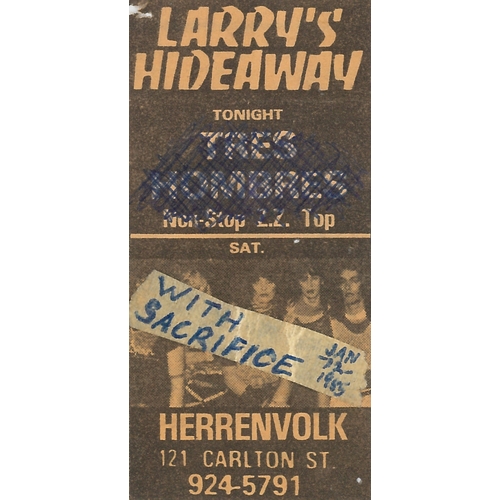
Sacrifice played its first documented concert at Larry’s Hideaway on January 12, 1985, opening for the glam-metal group Herrenvolk. The set consisted primarily of material by Exciter, Metallica and Slayer, with Urbinati stepping forward to sing the band’s original ‘Turn in Your Grave’. Though still unpolished, the group found an audience hungry for something heavier than the established local rock circuit was providing. Urbinati later remembered headbangers gathering at the front for Sacrifice while Herrenvolk’s audience largely watched from their seats.
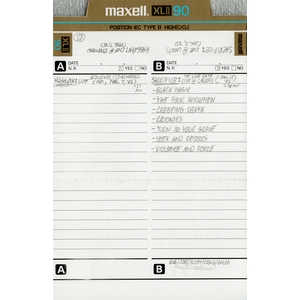
Early rehearsal tapes containing cover songs and primitive original material were copied and circulated through the underground. A January 1985 recording included ‘The Four Horsemen’, ‘Violence and Force’, ‘Creeping Death’, ‘Turn in Your Grave’ and ‘Crionics’. These tapes were informal, but their appearance on traders’ lists gave Sacrifice an identity beyond Toronto before the band possessed a professionally recorded release.
Following the departure of Baldy and Boyle, Urbinati became the permanent lead vocalist. The band briefly performed with drummer Ernst Flach, including an all-Slayer cover set, before finding its essential fourth member in Gus Pynn. Urbinati, Rico and Watts later recalled recognizing almost immediately that Pynn understood the music, shared their influences and possessed the energy the group required.
A crucial figure in Sacrifice’s development was Brian Taylor, a member of Toronto hardcore band Youth Youth Youth and an employee at the Record Peddler. Taylor offered to finance studio recordings for both Sacrifice and Slaughter, recovering the cost through cassette sales at the store. Sacrifice accepted and recorded The Exorcism at Accusonic Studio in Toronto on June 16, 1985, with Taylor producing and Paul Galliene engineering.
The eight-song demo captured the classic Urbinati-Rico-Watts-Pynn lineup and included ‘Sacrifice’, ‘Turn in Your Grave’, ‘Burned at the Stake’, ‘The Exorcism’, ‘Decapitation’, ‘Warrior of Death’ and ‘Beyond Death’. Although the group later recognized the recording’s technical limitations, it gave Sacrifice a tangible identity and became an important document of Toronto’s developing extreme-metal underground.
Cassette trading carried the group far beyond the city. Watts took copies of The Exorcism to Florida, where the recording reached musicians and fanzine writers connected with the early death-metal community. Urbinati later emphasized that tapes and fanzines were virtually the only means by which an unsigned Canadian band could build an international audience. Mail and trade requests began arriving from the United States, Europe, South America and other distant markets, proving that a raw recording made by teenagers in Toronto could travel farther than the band itself.
Opening for Exodus at Larry’s Hideaway in August 1985 gave Sacrifice its first major local breakthrough. The show introduced a broader audience to Toronto’s underground bands and noticeably increased attendance at Sacrifice’s subsequent appearances. When record-company interest followed, the group chose to work with Taylor’s Diabolic Force operation and Fringe Product rather than pursue an offer from Attic Records, preferring people who understood the scene from which it had emerged.
Sacrifice entered Future Sound Studio during the autumn of 1985 to record its first album. Released in January 1986, Torment in Fire was primitive, confrontational and almost violently unrefined. Taylor produced the sessions, Ted Kent engineered them, and Al Warnock created the front-cover artwork. The album’s crude sound and youthful occult-horror imagery would later make some members uncomfortable, but its lack of polish became central to its underground appeal. It documented young musicians learning in public while pushing toward an intensity few Canadian albums had yet attempted.
Sacrifice did not remain in that musical position for long. Even before Torment in Fire appeared, the band had begun composing more intricate material and drawing upon the dynamics of Mercyful Fate, Trouble, Iron Maiden, Rush and Exodus. Punk and hardcore remained part of its musical vocabulary, represented by a 1986 pre-production recording that included a version of Discharge’s ‘The Possibility of Life’s Destruction’. Rather than softening its music, Sacrifice was learning how to make it more distinctive.
On July 25, 1986, Sacrifice appeared at the Coronet in Kitchener, opening for King Diamond and Megadeth. The surviving soundboard recording captures the band at the precise point when the raw violence of Torment in Fire was developing into the sharper and more sophisticated attack of its second album. Later that year, Sacrifice appeared at Montréal’s No Speed Limit Festival and opened for Slayer during the Toronto stop of the Reign in Blood tour, further establishing the group as one of Canada’s most formidable live thrash acts.
The second album, Forward to Termination, was recorded at Grant Avenue Studio in Hamilton and released in 1987. Produced by Sacrifice and Brian Taylor, it represented an enormous advance in composition, playing and production. Songs such as ‘Terror Strikes’, ‘Afterlife’, ‘The Entity’, ‘Cyanide’ and ‘Light of the End’ were tightly arranged and immediately memorable, while the extended ‘Flames of Armageddon’ brought progressive pacing and elaborate instrumental development into the band’s vocabulary.
The video for ‘Re-Animation’ brought Sacrifice its greatest mainstream visibility. It entered regular rotation on MuchMusic and was later used in association with the channel’s metal programming. The exposure made the musicians recognizable across Canada and introduced the band to listeners far beyond the underground cassette network. Nevertheless, the visibility was not matched by sustained tour support. Sacrifice played the inaugural Milwaukee Metal Fest and limited dates with major American bands, but proposed tours repeatedly collapsed because of weak booking, inadequate financing or limited label resources.
The contradiction would define much of Sacrifice’s original career: its albums travelled internationally, its reputation grew, and its audiences remained devoted, yet the infrastructure required to convert that support into continuous touring was rarely present.
During 1988 and 1989, Sacrifice continued writing while resisting the commercial changes reshaping much of thrash metal. A late-1988 pre-production session included new material and a revised version of ‘Sacrifice’, with Watts reportedly playing lead guitar. Surviving demos from this period document the development of material that would appear on the band’s third album and preserve heavier, less polished versions of several songs.
Recorded at Phase One Studios and released in November 1990, Soldiers of Misfortune expanded the group’s writing without abandoning its identity. The title track, ‘In Defiance’, ‘Existence Within Eternity’, ‘A Storm in the Silence’ and the extended ‘Truth (After the Rain)’ demonstrated greater rhythmic and thematic scope. The band was disappointed by what it considered a thin final production, but Urbinati continued to rank several of the album’s compositions among his favourites.
A video for ‘Soldiers of Misfortune’ received Canadian airplay, and Sacrifice undertook a national tour with Razor, bringing two of the country’s most important speed-metal bands together from coast to coast. Urbinati later remembered Sacrifice being treated like national metal heroes in cities the group had never previously visited, a testament to the reach of MuchMusic and the band’s recordings even when conventional promotion remained limited.
Following this period, Gus Pynn left and was replaced by former Dark Legion drummer Michael Rosenthal. Sacrifice appeared again at the Milwaukee Metal Fest and completed its first substantial American tour, supporting Bolt Thrower alongside Believer. The package reflected the growing shift from thrash toward death metal, but it finally allowed Sacrifice to perform for American listeners who had followed the band through tapes and imported records for years.
The fourth album, Apocalypse Inside, was recorded at Phase One in December 1992 and produced by Sacrifice, Razor guitarist Dave Carlo and engineer Eric Ratz. Urbinati, Rico and Watts were joined by Rosenthal, whose playing contributed directly to the construction of songs including ‘Salvation’. The album’s heavier guitar sound, dark atmosphere and detailed arrangements brought the studio recording closer to the force of Sacrifice’s live performances. Urbinati later described it as the original-era album that gave him the strongest sense of accomplishment.
Scott Watts departed after the recording and was replaced for touring by Kevin Wimberley. Sacrifice travelled through the United States with Death and Gorefest during the summer of 1993, but the timing was difficult. Traditional thrash had lost much of its commercial support, while labels and audiences increasingly favoured death metal, alternative metal and newer divisions within heavy music. Metal Blade subsequently dropped the group, and the members concluded that they no longer possessed the energy to begin again with another company. Sacrifice ended its first period of activity late in 1993.
The catalogue nevertheless continued to circulate through reissues, cassette trading, collectors and word of mouth. Sacrifice reunited in 2006, but the musicians did not immediately commit to a permanent return or a new album. They first had to determine whether they could still create material worthy of the name. Their standard was simple but severe: new songs had to sound unmistakably like Sacrifice and had to stand beside the earlier recordings rather than weaken the band’s legacy.
The result was The Ones I Condemn, released in 2009. It was not designed as a nostalgic reproduction of the 1980s but as a continuation of the group’s established musical language: fast, intricate, abrasive and driven by the chemistry of Urbinati, Rico, Watts and Pynn. Contemporary performances demonstrated that the new material could sit naturally beside ‘Sacrifice’, ‘Re-Animation’ and other early songs without sounding like the work of a different band.
Sacrifice subsequently performed selectively in Europe, Japan, North America and South America. Its connection with punk and hardcore also remained important. In 2010, Sacrifice and Propagandhi released a split single on which Sacrifice covered Rush’s ‘Anthem’ and Propagandhi interpreted Corrosion of Conformity’s ‘Technocracy’. The project reflected the long-standing overlap between the group’s thrash-metal identity and the hardcore culture that helped nurture Toronto’s early scene.
Released on February 21, 2025, Volume Six arrived sixteen years after The Ones I Condemn. Produced by Urbinati and recorded principally at Phase One with engineer Darius Szczepaniak, it once again featured Urbinati, Rico, Watts and Pynn. The album contained ten new compositions and a cover of Toronto hardcore group Direct Action’s ‘Trapped in a World’, with guest vocals by Brian Taylor—linking the record directly to the person who had financed The Exorcism four decades earlier.
The long interval did not result from a lack of commitment. Urbinati began developing material around 2017, but the pandemic interrupted rehearsals and stalled the writing process. The band initially considered an EP and proceeded with a full album only after accumulating enough material that every member supported. Sacrifice deliberately avoided sterile modern perfection: the drums were not triggered, the musicians did not record to a click track, and natural changes in tempo were accepted when they preserved the energy of the performance.
Urbinati summarized the band’s modern outlook with characteristic bluntness:
“We repay everyone by not fucking up our albums.”
In February 2026, Sacrifice officially issued Live in Kitchener ON 07/25/1986. Captured directly from the mixing desk while the group opened for King Diamond and Megadeth, the recording documents the transitional period between Torment in Fire and Forward to Termination. It joins official live releases from Toronto and Japan in preserving a dimension of the group that its members often felt their studio albums could not fully capture.
Sacrifice’s influence has never depended upon sales figures. Max Cavalera has named Forward to Termination among his three favourite thrash albums, placing it beside releases by Nuclear Assault and Dark Angel. Later generations of thrash, death-metal and hardcore musicians have continued to recognize the band’s riffs, drumming and uncompromising approach.
The Museum of Canadian Music’s presentation now extends that history beyond the familiar studio catalogue. The Exorcism, early rehearsal tapes, the previously undocumented August 11, 1985 rehearsal at Scott Watts’ house, rare live recordings and archival interviews reveal the work that took place between the official releases. They present Sacrifice not merely as a sequence of finished albums, but as young musicians learning, experimenting, exchanging tapes, testing songs and helping create a Toronto scene that had scarcely existed when they began.
-Robert Williston
Gallery
Images
3 images
FOR MOCM USE
Sacrifice / Interviews 1985 + First Live Show
Interviews 1985 + First Live Show
Media
Videos
0 videos
No videos available for this title.
Credits
In Transit
No Comments