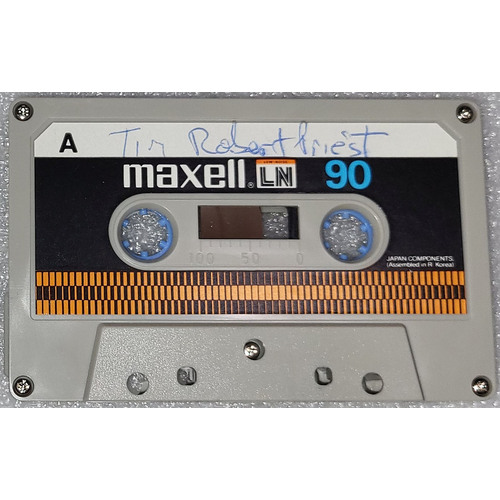
Album / Title
Robert Priest Demo
By: Robert Priest
Origin: Thames, England, UK → Toronto, Ontario, 🇨🇦
Insight
Robert Priest is an English-born Canadian poet, novelist, playwright, journalist, performer and singer-songwriter whose career has consistently crossed the boundaries between literature, music, theatre, broadcasting and children’s entertainment. Born in Walton-on-Thames, England, in 1951, he immigrated to Canada as a child and grew up in Scarborough, Ontario. By the mid-1970s, he was performing poetry and original songs in Toronto, developing a distinctive style in which spoken word, melody, satire, humour and political commentary became inseparable.
Priest became an active participant in Toronto’s independent literary and music communities during the late 1970s and early 1980s, moving between poetry readings, folk venues and the city’s developing alternative-rock circuit. Accounts of this formative period associate him with groups including The Defayds and The Great Big Face Band, through which he brought electric rock arrangements and theatrical energy to his lyrical performance poetry. His work could move freely from politically charged satire and absurdist humour to intimate acoustic songwriting.
His first commercial recording, Robert Priest, was released by Airwave Records in 1982. Produced by Keith Elshaw, the five-song EP featured Neo Chapman on acoustic, electric and rhythm guitars; Blair Packham and Danny Levy on rhythm guitar; Matthew Greenberg on bass; Glenn Martin on drums; Ronnie Wiseman on piano, organ and synthesizer; and Lea Harper and Lynn Harper on backing vocals. Songs including ‘Little Gun’, ‘Run, Run, Run’, ‘Inflation’, ‘I Follow the Smoke’ and ‘Little Wheel’ established the socially alert, politically engaged and darkly playful approach that would remain central to his work.
Archival material preserved by the Museum of Canadian Music also includes an early Robert Priest demo, tentatively dated circa 1982, containing otherwise unreleased material from the period surrounding his first commercial recording.
During the early 1980s, Priest and musician Eric Rosser worked as resident topical songwriters for the CBC Radio program Is Anybody Home, composing and performing new songs inspired by current events. Their collaboration developed into The Boinks, an imaginative children’s music and performance group combining songs, stories, poetry, comedy, visual art and audience participation.
The Boinks’ principal album, Summerlong, was released in 1984. Produced by Alan Guettel, it paired Priest’s lyrics, stories, vocals and trumpet with music, piano and vocals by Bongo Herbert. The recording also featured musical director David Thompson, guitarist Neil Chapman, bassist David Woodhead and drummer Ben Cleveland-Hayes, with artwork and design by Ross MacDonald, credited as Rudi McToots. Its playful mixture of science fiction, comedy and children’s storytelling demonstrated Priest’s ability to write for young audiences without abandoning the imagination, musicality and social awareness of his adult work.
Alongside his children’s recordings, Priest developed an increasingly adventurous mixture of rock, poetry and performance art. In 1986 he released ‘Congo Toronto’, co-written with Neo Chapman, backed with the Priest composition ‘I Think We Better Rock Awhile’. Its collision of spoken-word performance, rhythm, satire and alternative rock became one of his defining early recordings. The accompanying video received MuchMusic exposure, introducing his unconventional musical poetry to a broader Canadian audience.
Other recordings from this period included ‘Broken Star’ b/w ‘Can’t Say Goodbye’, Rottweiler Pacifist and Joy Junkie 88. Together, these releases positioned Priest within Toronto’s independent rock culture while retaining the literary identity that distinguished him from conventional singer-songwriters.
Priest achieved his greatest commercial songwriting success with ‘Song Instead of a Kiss’, co-written with Alannah Myles and Nancy Simmonds. Recorded by Myles for her 1992 album Rockinghorse, the dramatic ballad reached the top of the Canadian singles chart and later earned its writers a SOCAN airplay award. Originating in Priest’s poetry, the song demonstrated how naturally his literary writing could be transformed into popular music.
His 1997 album Tongue ’N’ Groove, released through EMI Music Canada, brought together many strands of his career. Combining spoken word, funk, folk, rock, political satire and theatrical performance, the album featured contributions from Alannah Myles, Marc Jordan, Hugh Marsh, Neil Chapman, Micah Barnes, David Woodhead, Steve Webster, Rebecca Jenkins, Michael White and numerous other Canadian musicians.
Priest wrote all of the album’s lyrics, with an additional chorus contribution from Marc Jordan, and participated extensively in its production and mixing. The recording presented him not simply as a poet accompanied by musicians, but as a fully developed songwriter, vocalist, producer and bandleader.
He continued recording with projects including Feeling the Pinch, BAAM! and Love Is Hard. His songwriting collaborators have included Alanis Morissette, Alannah Myles, Marc Jordan, Melanie Doane, John Capek, The Jitters, Staggered Crossing, Julian Taylor and composer Srul Irving Glick. His work with Taylor continued Priest’s long-standing engagement with justice, protest, community and human dignity.
In parallel with his recording career, Priest became one of Canada’s most prolific and distinctive literary voices. His poetry collections include The Visible Man, The Man Who Broke Out of the Letter X, The Mad Hand, Scream Blue Living, Reading the Bible Backwards, Previously Feared Darkness and If I Didn’t Love the River. The Mad Hand received the Milton Acorn Memorial People’s Poetry Award, while Reading the Bible Backwards became a Canadian poetry bestseller.
His writing for children and young adults includes The Ruby Hat, Ten Big Babies, The Secret Invasion of Bananas, Rosa Rose, The Wolf Is Back, Knights of the Endless Day, The Paper Sword, Second Kiss and Missing Piece. His stage works include The Coming, Knights of the Endless Day and Minibugs and Microchips, the latter receiving a Chalmers Playwright Award.
Priest has also written and performed extensively for radio and television. He contributed cultural journalism to Toronto’s NOW Magazine, appeared as Dr Poetry on CBC Radio’s spoken-word program Wordbeat, and created songs and material for children’s television, including productions associated with Sesame Street and Sesame Park. He has taught poetry and songwriting, served as a writer-in-residence, mentored emerging writers and performed at literary, folk, spoken-word and music festivals across Canada and internationally.
Few Canadian artists have sustained such a continuous exchange between poetry and popular music. Across independent demos, children’s albums, rock singles, music videos, major-label recordings, books, broadcasts and live performances, Robert Priest has treated the poem and the song as closely related forms of public expression—vehicles for humour, protest, wonder, affection and imaginative freedom.
-Robert Williston
Gallery
Images
2 images
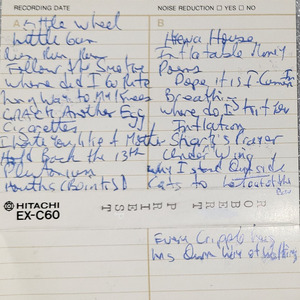
Robert Priest / Robert Priest Demo
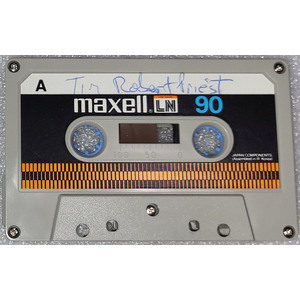
Robert Priest Demo
Media
Videos
0 videos
No videos available for this title.
Credits
In Transit
No Comments