Insight
Witches Hammer were among the earliest bands to bring speed metal and thrash metal into Vancouver’s underground, developing a raw and aggressive sound at a time when the city had almost no established metal scene capable of supporting them. Formed in North Delta, British Columbia in 1984, the band grew out of teenage rehearsals and basement jam sessions involving guitarist Marco Banco and a small circle of young musicians drawn to the rapidly changing sound of heavy music.
The early group featured Banco on guitar, Ray Prizmic, known as Rayy Crude, on vocals, Steve “Naïve” Withrow on bass and Rayy’s brother, John E. Prizmic, on drums. Shawn Pitts also played guitar during the band’s earliest period.
Banco had begun playing guitar only a few years earlier, influenced first by the heavy rock and metal of Black Sabbath, Judas Priest, Motörhead, Iron Maiden, Saxon and Kiss, then by the faster and more extreme records appearing in the early 1980s. Exciter, Venom, Razor, Metallica, Slayer, Mercyful Fate, Bathory and Sodom helped point the way towards the music Witches Hammer would create.
Banco later recalled that a 1983 basement session included songs by Exciter, Metallica, Slayer, Venom, Anvil and Saxon, at a time when “thrash metal” had not yet become common terminology. The musicians were still school-age, learning the new style almost as quickly as it was being invented.
The name Witches Hammer came from the Malleus Maleficarum, commonly translated as The Hammer of the Witches, which Banco encountered while looking through the occult section of his junior high school library. Before settling on the name, he had used Death and Oblivion for early musical projects.
Witches Hammer entered Fiasco Brothers Studio in New Westminster in late 1984 to record their first proper demo. Money was scarce, and the band had to perform as tightly and quickly as possible to reduce studio time and tape costs. Much of the material was recorded live from the floor with limited overdubbing.
The resulting self-titled demo, circulated in 1985, introduced the band’s combination of breakneck rhythms, dark imagery, sharp guitar leads and Rayy Crude’s abrasive vocals. Banco was approximately fifteen years old when the recording was made.
At the time, Vancouver offered few opportunities for a band playing music this extreme. Witches Hammer initially found more acceptance among punk and hardcore groups than within the city’s conventional rock circuit. Banco later described Witches Hammer as Vancouver’s first speed metal band and recalled that the group could obtain shows only with punk bands until other local metal acts began to emerge.
The overlap between metal and punk became an important part of the band’s development, giving their music a violent directness that separated it from more polished heavy metal.
The band’s early activity brought them onto bills connected with some of the most important touring metal acts of the period. Banco recalled appearing with Exciter, Exodus, Metal Church and Sacred Blade while still only sixteen years old. Witches Hammer also traded tapes through underground networks, fanzines, college radio and contacts with other bands, gradually extending their reputation beyond British Columbia despite having no significant promotional budget or established label support.
A second demo, commonly known as Damn Fuckin’ Rights, followed in 1986. Recorded again at Fiasco Brothers Studio, it was completed quickly, largely live and with few retakes or overdubs. The material developed the band’s sound into something heavier, more controlled and increasingly complex without sacrificing its primitive force.
Songs from the group’s first two demos later formed the basis of the 2003 Nuclear War Now! Productions compilation Canadian Speed Metal.
Subversive Productions subsequently offered to release a Witches Hammer 7-inch EP. The band argued that a 12-inch record would provide better sound and a stronger visual presentation, and the label agreed.
The self-titled Witches Hammer EP was issued in 1987 in a plain white jacket with photocopied artwork by Dax Howell attached to the front and back. By then, Mike E. Death had joined Banco as a second guitarist, allowing the group to build a fuller arrangement around separate rhythm and lead parts.
Steve Withrow left the band around this period and was replaced by Dan V., also known as Danno, whose bass playing Banco later compared to the melodic style of Steve Harris.
The EP was produced under extremely limited circumstances. Subversive Productions itself was operated by teenagers, and neither the band nor the label possessed the money or distribution network required to reach a large audience. Estimates of the number of copies pressed have varied considerably, while approximately 500 remaining unsold copies were reportedly destroyed in a house fire during the 1990s.
Whatever the original quantity, the record became one of the key physical documents of Vancouver’s first wave of extreme metal.
Following the EP, Witches Hammer continued playing locally, often opening for touring bands, and completed a brief western Canadian tour. Their combination of metal riffing, frantic speed and hardcore aggression gained the attention of younger musicians in the developing Vancouver underground.
Black Winds of Blasphemy later identified Witches Hammer as an important influence. Blasphemy’s first live appearance was reportedly opening for Witches Hammer, placing the two groups in direct succession within the history of extreme metal on Canada’s West Coast.
In 1988, Witches Hammer returned to Fiasco Brothers Studio to record what was intended to become their first full-length album. The sessions included previously recorded material alongside new songs such as “Inner Sanctum,” “Stretching into Infinity” and “Captain Breakdown.”
Dax Howell again supplied the artwork, which was also adapted for a band T-shirt. The album was never issued as originally intended, however, and the recordings became the last substantial studio material completed before the members began going their separate ways.
By the end of the decade, the original Vancouver underground was changing. Members were growing older and moving towards work, education, families and other musical projects, while increasing violence and hard-drug use around the scene made local performances less appealing.
Witches Hammer played their final shows with Armoros at Vancouver’s Smilin’ Buddha Cabaret in 1989. The club, one of the foundational venues of Vancouver punk and independent music, closed shortly afterwards. The band was finished by 1990.
The musicians followed separate paths. Mike E. Death became involved with Procreation, while Danno moved to Milwaukee and joined Centurion.
Marco Banco was invited to join Blasphemy almost immediately after Witches Hammer’s final performances. Banco toured with the band and played guitar on its landmark 1990 album Fallen Angel of Doom...., one of the most internationally influential extreme metal records produced in Canada. He remained with Blasphemy for approximately three years before leaving as hard-drug use increasingly affected the group’s environment.
John E. Prizmic died in 1997. For many years, the surviving members considered his absence an important reason not to revive Witches Hammer. In a 2007 interview, Banco and Rayy Crude stated that the band would not reform because Prizmic’s contribution belonged to its original period and lineup.
Although Witches Hammer had attracted limited attention during their original existence, their recordings gradually gained recognition among collectors and historians interested in the beginnings of Canadian speed, thrash and black metal.
Nuclear War Now! Productions began working with the band in the early 2000s, establishing one of the label’s longest-running associations. The label issued Canadian Speed Metal in 2003, collecting recordings from the band’s early demos, followed by the 7-inch Death of No Reprieve in 2004.
In 2005, Nuclear War Now! released Stretching into Infinity, combining the five tracks from the 1987 EP with material from the unreleased 1988 recording sessions. The compilation finally preserved and circulated a substantial part of Witches Hammer’s later 1980s work. It was reissued on vinyl in 2018, bringing the recordings to another generation of metal listeners.
Banco remained active in heavy music, later playing with Tyrants Blood and other Vancouver groups. While archiving old Witches Hammer cassettes and rehearsal tapes, he discovered numerous unfinished songs, riffs and lyrics dating from approximately 1983 to 1989. The amount of surviving material prompted him and Rayy Crude to reconsider their earlier opposition to reforming the band.
Witches Hammer returned in 2018, with Banco and Crude joined by guitarist Jesse James Jardine, bassist AJ Kovar and drummer Stephen Shaw. Mike E. Death was also involved during the initial reunion period.
The revived group made an important early appearance at the first Never Surrender festival in Berlin. The performance demonstrated that the new lineup could preserve the character of the early recordings without simply imitating them.
The band’s first full-length album, Damnation Is My Salvation, appeared through Nuclear War Now! Productions in 2020, more than three decades after the abandoned 1988 album.
Produced by Marco Banco, the album combined newly written material with new recordings of “Frozen God,” “Deadly Mantis” and “Witches Hammer,” songs originally heard on the band’s early demos. It placed the group’s fast and hostile 1980s style within a heavier and more technically developed modern recording while retaining the jagged riffs, abrupt changes and dark atmosphere that had defined Witches Hammer from the beginning.
Devourer of the Dead followed in 2021. The album again joined new compositions with reconstructed material from the band’s original period, including “Rabid Captor,” “Fatal Attacker” and “Final Storm.” Its release confirmed that the reunion was not merely a brief return for live performances or archival reissues, but a productive second phase capable of extending the band’s catalogue.
Witches Hammer subsequently assembled one final album from new compositions and material preserved on rehearsal tapes, basement recordings and aging cassettes.
Final Storm, scheduled for release by Nuclear War Now! Productions on August 30, 2026, is presented as the concluding chapter in the band’s history. Its nine tracks include new recordings of “Mantle of Death” from the 1985 demo and “Death of No Reprieve” from the 1986 period, along with the newly composed “Nocturnal Oblivion” and the instrumental “Malicious Assault.”
The remaining songs were developed from riffs, fragments and unfinished ideas written during the band’s formative years. Much of the material was reconstructed from decades-old cassettes and completed through collaboration among the current members.
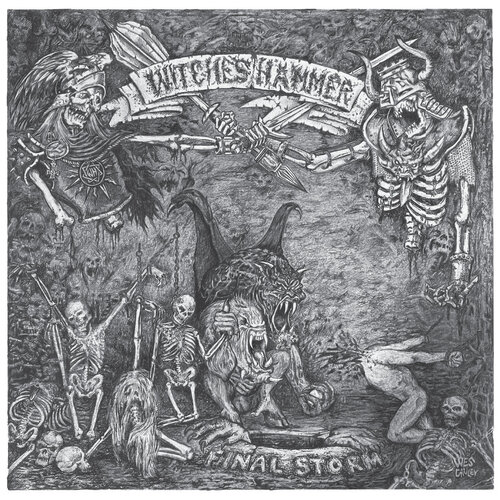
The cover artwork for Final Storm was originally drawn by Wes Gauley in 1988 for the full-length album Witches Hammer never released. Restored decades later by Beatrice Share, the image connects the unfinished ambitions of the original band with its final recorded statement.
Witches Hammer’s importance rests not on record sales or widespread recognition during their first lifetime, but on how early they arrived and how naturally they joined influences that had not yet hardened into fixed categories.
Their music drew from traditional heavy metal, the first generation of speed and thrash, the darkness of Venom, Bathory and Sodom, and the aggression of Vancouver punk and hardcore. They helped establish an environment in which bands such as Blasphemy and Procreation could develop, while Banco’s later work carried a direct link from Witches Hammer into some of the most uncompromising Canadian metal of the following decades.
-Robert Williston
Forty years in the making, Final Storm serves as the triumphant final chapter in Canadian Speed Metal cult, Witches Hammer's history. Rather than reinventing themselves, the band has remained faithful to the speed and thrash metal sound that has defined their legacy, delivering nine tracks that seamlessly stand alongside their previous two acclaimed albums. The record bridges past and present, combining material from the band's earliest days with newly forged compositions to create a fitting Final Storm.Two songs on the album trace their origins directly to Witches Hammer's legendary demo era: "Mantle of Death" from the band's 1985 debut demo and "Death of No Reprieve" from their 1986 follow-up. Alongside these resurrected classics are two completely new tracks, "Nocturnal Oblivion" and the instrumental "Malicious Assault." The remaining songs are built from a treasure trove of unreleased riffs, rehearsal tapes, and basement recordings created during the band's formative years in the 1980s. Much of the material was painstakingly assembled from decades-old cassettes, with the band collaborating to complete and refine unfinished ideas into fully realized songs.
Lyrically, Final Storm continues Witches Hammer's tradition of drawing inspiration from a wide spectrum of dark subjects, ranging from mythology, religion, and literature to film and real-world themes. Musically, the album remains rooted in the classic metal records that shaped the band, channeling the spirit of albums such as Seven Churches, Hell Awaits, Sentence of Death, British Steel, Killers, and Bonded by Blood.
The album's striking cover artwork carries a story of its own. Originally drawn by Wes Gauley in 1988 for an album that was never released, the piece remained unseen for nearly four decades before being carefully restored by Beatrice Share. Intended to adorn what could have been Witches Hammer's debut full-length, it now serves as the cover for their final statement; a fitting and symbolic conclusion to a journey that began in the underground metal scene of the 1980s. Final Storm is both a celebration of the band's past and a powerful final testament to the enduring spirit of the Canadian Speed Metal cult.
Gallery
Images
1 image
Final Storm
Media
Videos
0 videos
No videos available for this title.
Credits
Artwork
Cover artwork by Wes Gauley
Artwork restored by Beatrice Share
Release date
August 30, 2026
Copyright
All rights reserved
No Comments