Insight
The Young Lions were one of the bands that carried Toronto punk from the city’s first late-1970s wave into the faster, more politically engaged hardcore scene of the early 1980s. Built around guitarist and vocalist Mike McCurdy, later credited as Michael James, bassist and vocalist Chris Genest, and drummer Steve Kuzell, the group combined the directness of punk with reggae, dub, American hardcore and an unusually broad musical outlook. Their songs confronted racism, militarism, nationalism, political repression and the threat of war, but the band’s importance extended beyond its recordings. The Young Lions helped create places to rehearse, organized and supported shows, worked with Rock Against Racism and gave other musicians access to the small network they were struggling to build.
McCurdy and Genest met while attending Humberside Collegiate in Toronto’s west end. Neither fit comfortably into the school’s established social groups, and they connected through records. Genest had already discovered the Ramones, Sex Pistols and the Clash, while McCurdy introduced him to the Yardbirds and Howlin’ Wolf. Punk gave them permission to begin writing without waiting to become accomplished musicians. They did not need solos, technical display or the approval of the conventional rock world. They could write from instinct and emotion, then learn by doing.
One of McCurdy’s earliest songs was originally called “Green Army Eyes,” a personal piece inspired by a former girlfriend. Genest suggested reshaping it around social commentary, and the song became “Things Are Gonna Change.” That rewrite established much of the direction the pair would follow. “Young Amerika” reflected the political climate of the Reagan era, while “National Security” explored concerns about government power and personal freedom. “Royal Killers,” “Freedom Fighter” and “Guns and Children” addressed war, political conflict and the effects of violence on ordinary people. Decades later, Chris Genest noted that many of the themes still felt relevant.
The group took its name from Irwin Shaw’s novel The Young Lions and the 1958 film adapted from it. Its anti-war subject suited a band forming at a time when the Cold War, the nuclear arms race and the possibility of another world war occupied daily thought. Anti-racism was equally central. The Young Lions became closely associated with Toronto’s Rock Against Racism movement after local organizers approached them at a show. The band embraced the organization immediately and became one of the groups most closely identified with its Toronto activity. They played benefits, supported organizing efforts and treated racial equality as part of the band’s purpose rather than a separate political cause.
Musically, the Young Lions drew heavily from the Clash, Stiff Little Fingers and the Ruts, along with the Ramones, Dead Boys and the developing American hardcore movement. Reggae and dub were just as important. Toronto’s Jamaican community had made reggae a living part of the city, and the Young Lions found common ground with local reggae and ska musicians, particularly the 20th Century Rebels. To the band, punk and reggae were parallel forms of rebel music. Both could speak about injustice, exclusion and political struggle, and both could be created outside the established music business.
The centre of the Young Lions’ early world was a two-storey garage near Dufferin Street, north of Queen. The building had once been used as a worm-processing plant and still contained remnants of its former equipment. It became the band’s rehearsal room, living quarters, social space and occasional performance venue. There was no heat, hot water, shower or proper stove. A former cold-storage room provided some insulation, and mattresses were placed along the walls to reduce the sound. The Young Lions rehearsed there, but they also opened it to Youth Youth Youth, the 20th Century Rebels and other bands that needed somewhere to play. Touring musicians sometimes slept there, and the rent was occasionally covered by charging other groups to rehearse.
The garage embodied the resourcefulness of Toronto punk at a time when formal rehearsal complexes barely existed and established clubs often refused to book punk bands. It was rough, uncomfortable and frequently chaotic, but it gave a developing community a home. A fire eventually brought the arrangement to an end. Once the authorities discovered that people had been living in the building, the space could no longer continue. Genest later regarded the loss of the garage as the beginning of the Young Lions’ gradual collapse. The band had lost not only a rehearsal room but the physical centre around which its friendships, recordings and daily life had been organized.
The Young Lions emerged while Toronto’s earlier punk generation was still active, but the younger scene had to build much of its own infrastructure. The band played wherever it could, including the Turning Point, Larry’s Hideaway, the Upper Lip and the Horseshoe Tavern, along with temporary rooms, church basements and working-class bars that might tolerate punk for a night. They developed a close relationship with Youth Youth Youth and shared many bills with them. The Young Lions also appeared with D.O.A., the Subhumans, Dead Kennedys, T.S.O.L., Articles of Faith and Youth Brigade, and travelled to places such as London and Windsor, often for little more than food and enough gas to get home.
At one Concert Hall show with Youth Youth Youth and the Dead Kennedys, Youth Youth Youth vocalist Brian Taylor had not arrived by the time his band was due to play. The Young Lions tried to stretch their own opening set to buy him time, but eventually had to finish. McCurdy then stepped forward and sang with Youth Youth Youth, relying on his familiarity with their songs and filling whatever gaps remained with a convincing scream. The incident reflected the closeness of the two bands and the practical solidarity that held the Toronto scene together.
The Turning Point became another important home. Genest recalled approaching the older couple who operated the otherwise nearly empty bar and offering to bring in twenty or thirty people if they allowed the band to play. The owners agreed, and the room became a dependable punk venue for a period. In a scene where clubs could disappear after a single incident, any room willing to offer repeated bookings mattered. Promoters including Jill Heath and another local organizer remembered only as Ian worked constantly to secure venues and keep shows moving from one temporary location to the next.
Heath became one of the Young Lions’ strongest supporters and an important promoter and photographer within Toronto punk. Her photographs and reports helped connect the local scene to the wider North American underground through publications such as Maximumrocknroll. She later credited the Young Lions with helping draw her into the Toronto scene after encountering a Rock Against Racism notice connected to the band. The Young Lions’ influence was often felt in this way. They encouraged people to attend, organize, photograph, write, form bands and participate rather than remain spectators.
Because pressing vinyl was beyond the group’s means, the Young Lions first distributed their recordings on cassette. Genest remembered that the band admired the fact that Bad Brains had issued music on tape and saw cassette duplication as an affordable extension of the same do-it-yourself ethic. Covers could be photocopied, copies could be dubbed in small quantities and the music could circulate without a label or pressing plant.
The exact chronology of the early tapes remains complicated. Genest recalled two formal cassette releases, along with additional sessions and tapes that circulated in different forms. One early recording was made inside the garage by a neighbour named Rick who owned an eight-track machine. Genest estimated that the session contained approximately ten or twelve songs. The band later recorded in professional studios, including Accusonic and Trinity, but masters were lost, copied or dispersed, and not every version can now be reconstructed with certainty.
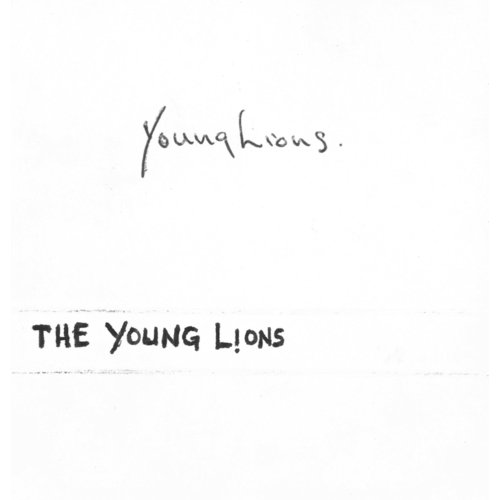
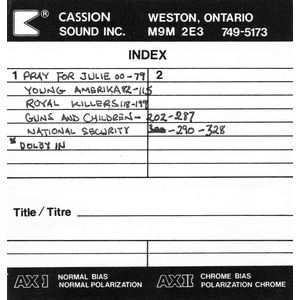
The 1982 cassette Freedom? What Freedom?, issued by Ghetto Blaster Records, contains “Young Amerika,” “National Security,” “Royal Killers” and “Pray for Julie.” Its fold-out cover identifies Chris Genest on bass and vocals, Steve Kuzell on drums and Mike McCurdy on guitar and vocals, and states that the recording was made at Accusonic Studios in Toronto. A separate cassette contains those same four songs plus “Guns and Children.” Its handwritten Cassion Sound index card confirms a five-track programme, all recorded on the first side. Because that copy has no title or date, it is best described as an untitled five-track demo or promotional cassette from approximately 1982.
The Young Lions were also documented on T.O. Hardcore ’83, the cassette compilation that captured Toronto’s emerging hardcore scene alongside A.P.B., Chronic Submission, Dead End, Direct Action, Youth Youth Youth and Zeroption. The collection was recorded and assembled at Accusonic Studio in the spring of 1983 and released that May. The Young Lions contributed “Shithole,” “Progress,” “Lizard for a Day” and “Defy the State,” four recordings that show the group moving between short, forceful hardcore and a broader punk approach.
Their song “In the Fields” appeared on the BYO Records compilation Something to Believe In. The inclusion connected the Young Lions to a wider North American network and placed them alongside Youth Youth Youth, Zeroption and groups from other regional scenes. The band was grateful to be represented, although Genest later remembered that the final mix did not sound as intended. As with many independent compilations of the period, the group recorded its part, sent away the master and had little control over what happened afterward.
Another unusual chapter involved SCTV. Through a Toronto promoter with connections in television and film, the Young Lions were brought into a studio to provide the music for the Queen Haters, the fictional punk band featured in the “Mel’s Rock Pile” sketch. The producers wanted something that sounded authentically punk rather than a conventional studio musician’s imitation, so the Young Lions worked up a simple, aggressive backing track. The SCTV cast then performed “I Hate the Bloody Queen” over the recording. The musicians were not visible in the finished sketch, but their performance became part of one of the program’s most memorable musical parodies.
The band also wrote “Made in England,” a rebuke to local listeners who treated British punk as inherently superior to music being made in Toronto. The song argued that a record did not become important simply because it carried a British stamp and that audiences ignoring their own city were weakening the scene they claimed to support. Youth Youth Youth later performed and recorded the song, a gesture Genest regarded as a meaningful sign of respect between the bands.
The Young Lions never treated punk as a narrow musical formula. For McCurdy, Genest and Kuzell, punk meant freedom from musical boundaries as much as opposition to political and social authority. Rehearsals might move from hardcore into reggae, country, blues or an improvised jam without warning. McCurdy in particular continued to develop as a guitarist, bringing more layered and experimental playing into the band. The Young Lions did not abandon punk when their music widened. They applied punk’s permission to experiment.
That development can be heard on their only LP, Welcome to the Freak Show. The first five songs were recorded at Wexford Studios in November 1983. The remaining tracks were recorded at Soundpath Studios in September 1985, and the album was mixed between September and December 1985 at Enormous Studios and Soundpath Studios in Toronto. Produced by the Mod Squad and engineered by Tom Atom and Rick Lightheart, the record allowed McCurdy to build up guitar parts, experiment with reversed tape and use the studio in ways that had been impossible on the demos.
The LP combined new material with songs reaching back into the band’s early years. “Shithole,” “Pray for Julie,” “Royal Killers,” “United” and “Freedom Fighter” appeared alongside “Freak Show,” “Gutter Rat Blues,” “One Brick at a Time,” “Outlaws” and the instrumental “Motor City Jam.” Brian McCullough added piano to “United” and “Outlaws.” The result was broader and less easily categorized than the early tapes, bringing punk, rock, blues and the loose intensity of the band’s rehearsals into the same record.
The lengthy recording process reflected the band’s financial limitations and increasingly unstable circumstances. Work began at Wexford, stopped when the money ran out, and resumed much later at Soundpath. By then, the Young Lions were already drifting apart. Genest had moved to Portland, Oregon after a succession of changes in his personal life, but returned to Toronto for approximately a week to help complete the record. Welcome to the Freak Show was issued by Yodel Gems Recordings in 1986, with a February 1987 promotional sheet accompanying some copies. The band did not formally announce its end. Rehearsals stopped, members moved away and the group simply ceased to function.
The Young Lions left behind only a small official catalogue, but their reputation survived through tapes, compilations, personal recollections and the testimony of people who had seen them. Older members of the Toronto scene repeatedly recommended the band to the generation that followed, often describing them as a bridge between the city’s first punk groups and the hardcore community that emerged in the early 1980s. Their mixture of the Clash and Stiff Little Fingers with the speed of hardcore gave them a recognizable musical identity, but it was their political commitment, generosity and community work that made the deeper impression.
In 2009, Schizophrenic Records issued 1982–1984 From the Vaults, an LP and bonus 7-inch collecting seventeen early recordings. The set restored “United,” “Young Amerikkka,” “National Security,” “We Wanna Riot,” “Shithole,” “Rich Kid,” “Guns and Children,” “Things Are Gonna Change,” “One Brick at a Time,” “Goodnight Belfast,” “Bloodless,” “Defy the State,” “Made in England,” “Royal Killers,” “Freedom Fighter,” “Pray for Julie” and “Folsom Prison Hardcore.” The accompanying booklet included archival photographs, an interview and first-hand recollections that preserved much of the group’s history.
Mike Graham’s booklet notes add a vivid account of the band away from Toronto. He remembered joining the Young Lions on a trip west in 1981, travelling with them through difficult conditions, sleeping wherever they could and eventually being stranded near Kenora after the van failed in bitter weather. His recollection portrays the group as exhausted, argumentative, funny and remarkably resilient, living with little money and few comforts while trying to carry their music across the country. The longer interview material documents the garage, the demos, Rock Against Racism, the Toronto clubs, the Queen Haters session and the band’s political outlook in the members’ own words.
-Robert Williston
Gallery
Images
2 images
Young Lions / The Young Lions Demo INSIDE
The Young Lions Promo
Media
Videos
0 videos
No videos available for this title.
Credits
In Transit
No Comments