Insight
Uncaging a Lost 1968 Vancouver Island Psych Recording
By Robert Williston, March 3, 2026
Easily one of the year’s most talked-about Canadian archival rock releases, Where Did The Sunshine Go? exists because Victoria promoter Marcus Pollard rescued an unmarked Glass Cage acetate from a Vancouver Island thrift shop and painstakingly traced its origins until the long-forgotten band resurfaced. Issued by Jason Flower’s Supreme Echo Records, the first vinyl pressing of 500 sold out well before the release date, prompting a swift second pressing.
Yet the release as heard today exists because of Jason Flower’s exhaustive restoration work. While Pollard uncovered the recording, Flower undertook the painstaking technical, archival, and production process required to bring a damaged, bent acetate back to life — work driven not by commercial incentive, but by a deep commitment to preserving Canadian music history.
Some records aren’t released. They resurface.
In the summer of 1968, five Nanaimo teenagers — Norm Roth (vocals, guitar), Wayne Harbord (lead guitar), Clayton Millan (bass), Terry Morrison (organ), and Doug Hastings (drums) — recorded a live performance at the grand opening of Fuller Lake Arena in Chemainus, British Columbia. The recording took place on Saturday, August 3, 1968 — the same weekend the Newport Pop Festival was unfolding in Southern California. The set was captured by local audio retailer Jack Taylor (“Pop”), owner of Sewing & Sound on Nanaimo’s Commercial Street, using reel-to-reel machines and a simple two-microphone setup. Taylor, a sewing machine dealer who quietly transferred new LPs onto 8-track cartridges for teenagers cruising Nanaimo in Chargers and Mustangs, ran cables across the arena floor and mixed the entire band down to a single channel. There was no rehearsal, no level check — just one take.
Only three acetates were cut.
No commercial release followed. The band later changed its name to Lemon and dissolved by 1970. The recordings disappeared.
At the time of the recording, The Glass Cage were already gaining regional momentum. They had shared a Nanaimo Legion stage with The Guess Who the night Randy Bachman acquired his now-legendary 1959 Les Paul — the guitar that would later power “American Woman” and eventually sell for over $250,000. In 1969, under the name Lemon, they performed at the Aldergrove Beach Rock Festival before a crowd estimated at 25,000 — one of Canada’s earliest large-scale outdoor rock gatherings — and later appeared at Kelowna’s OgoPogo Rock Festival. Their move to Vancouver brought management under Craig McDowell and placed them in orbit with bands that would evolve into Trooper, briefly positioning them within British Columbia’s expanding rock infrastructure.
Nearly fifty years later, in 2016, Pollard discovered a battered, unmarked acetate in a Port Alberni thrift shop. It simply read “Side One” and “Side Two.” Expecting little, he eventually played it — and was stunned by what came through his speakers: raw, organ-driven West Coast psychedelia recorded with urgency and ambition. The cavernous arena reverb — a natural byproduct of the empty Fuller Lake space — became an accidental sixth instrument, amplifying a teenage “wall of sound” created by towering homemade Fender-style cabinets loaded with multiple Jensen speakers.
For two years he searched for its origins. Dozens of collectors and archivists had no answers. Then in 2018, after posting about the mystery recording online, he received a message from Norm Roth — the band’s original singer.
The Glass Cage had been found.
Pollard reunited surviving members Roth, Harbord, Millan, and eventually Morrison as well, reconnecting musicians who had not seen one another since the late 1960s. Morrison later heard the restored recording before his passing in 2025, while drummer Doug Hastings had already passed away.
Determined to give the recordings proper treatment, Pollard partnered with Victoria archivist and label head Jason Flower of Supreme Echo. What followed was a multi-stage restoration effort that pushed the limits of analogue transfer and digital repair. The original acetate was physically bent and would not sit flat on a turntable. It required ultrasonic cleaning using demineralized water, careful stylus selection, and repeated transfer attempts — including adjustments to tone-arm weight that tested equipment tolerances — simply to achieve a stable playback without skips.
The first transfer revealed severe groove wear and a noise floor that in places exceeded the frequency range of the music itself. Flower enlisted restoration specialist Peter Conheim of Red Channels in California, along with engineer Jessica Thompson, to analyze and recover what could be preserved. As Flower later recalled, “the severity of damage and noise floor on the first acetate transfer was so extreme that I was not certain what Peter Conheim would be able to do with it.” Through detailed frequency isolation and manual correction of groove damage, they extracted a usable master from what initially appeared compromised beyond expectation.
A breakthrough came when Thompson identified that the noise floor extended across a broader dynamic range than the musical content itself, allowing large portions of unwanted frequency spectrum to be removed without significantly affecting the music. As Flower explained, “Jessica realised that the noise floor was broader in dynamic range than the music content itself, which allowed us to cut a very large part of the frequency spectrum without removing much of the music.”
Just as the project was nearing lacquer preparation, a second, flatter acetate surfaced through a surviving band member. Rather than proceed with the nearly completed master, Flower made the decision to restart the entire restoration process from the beginning. “For sure I was in shock when a second acetate in better condition was discovered, thinking of how much work we’d already done,” Flower recalled, but the team ultimately agreed the improved source justified starting over. A new mono-specific transfer system was employed, revealing previously obscured high-frequency detail — cymbal shimmer, inter-song interaction, and the natural air of the arena. Previously buried elements such as cymbals and between-song banter became audible for the first time, giving the performance a greater sense of presence. The final master represents the result of multiple transfers, forensic audio repair, and hundreds of hours of restoration and production work.
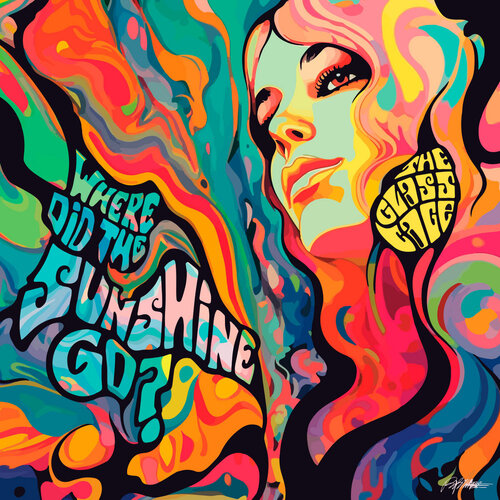
Flower’s role extended far beyond issuing the record. He oversaw sequencing, production management, archival research coordination, and packaging development, transforming what might have remained a collector’s curiosity into a fully realized historical document. Pollard simultaneously researched Nanaimo’s largely undocumented 1960s music scene, producing an extensive booklet chronicling the band and their contemporaries. The cover art was commissioned from legendary 1960s poster artist Bob Masse, further grounding the release in the visual language of the era it represents.
The resulting LP, Where Did The Sunshine Go?, was released on February 24, 2026 by Supreme Echo.
The album captures six originals written by Roth alongside a version of "Outside Woman Blues" and a brief outro jam. The entire performance runs just twenty-two minutes — six and a half songs — recorded straight through. Musical highlights include the fuzz-driven opener “I Think I Love You,” Roth’s first original composition; the West Coast shimmer of “All Alone”; the intertwining organ-and-guitar interplay likened by the band to a game of Snakes and Ladders; the subtle key change in “When I See Her”; and a rave-up ending used to signal a dance-floor break. "Outside Woman Blues" was originally recorded in 1929 by Blind Joe Reynolds and later covered by Cream on their 1967 album Disraeli Gears. The sound is unpolished but powerful — cavernous arena reverb, Farfisa organ lines cutting through thick guitar tones, teenage intensity preserved without studio intervention. It is less a reissue than a delayed transmission from Vancouver Island’s underground psych scene.
Critical response was immediate. Mike Stax of Ugly Things called it “a remarkable discovery,” praising the band’s ability to move between hard-hitting, organ-driven R&B and harmony-based psychedelic material. Modern garage-psych figure John Dwyer (Osees) described it as a “garage rock gem,” while CBC Radio’s Grant Lawrence publicly championed the release. Launch events at Neptoon Records in Vancouver drew strong attendance, and a Royal BC Museum presentation in Victoria sold out.
For the surviving band members, now in their seventies, the release represents something far greater than nostalgia. It is recognition. Terry Morrison was still alive when the project began and was able to hear the rediscovered acetate before his passing in 2025. His daughter later attended the release celebration, where the recording that preserved her father’s performance was heard publicly for the first time.
Doug Hastings also passed from cancer. Norm Roth continues working in Burnaby, while Clayton Millan recently retired as a bus driver. What began as a one-night recording captured by a sewing machine dealer has now been preserved as part of British Columbia’s recorded history.
Reflecting on the long restoration process, Flower later noted, “the entire time working on a project I played the album repeatedly to the point of holding great intimacy with it… I am still not remotely sick of the Glass Cage songs.” He added that during the process he and Marcus Pollard often found themselves singing along to the recordings while reviewing the material. “The cherry on top was when we did the album release celebrations and saw singer-songwriter Norm Roth doing the exact same thing,” Flower recalled. “My heart was full.”
-Robert Williston
Musicians
Norm Roth: lead vocals, guitar
Wayne Harbord: electric guitar
Clayton Millan: bass
Terry Morrison: electric organ, keyboards
Doug Hastings: drums
Production
Compilation produced and coordinated by Jason Flower
Recorded live by Jack Taylor (“Pop”) at Fuller Lake Arena, August 3, 1968
Transferred from original acetate by Dan Shortt
Restoration by Jessica Thompson and Peter Conheim
Booklet edited by Frank Manley
Liner notes and booklet editing by Marcus Pollard
Design by Michael Tension
Notes
Originally recorded live in 1968 at Fuller Lake Arena, Chemainus, British Columbia
Transferred and restored from original acetate sources
Outside Woman Blues written by Blind Joe Reynolds (1929)
Released by Supreme Echo in 2026 in mono format with deluxe packaging including an 8-page booklet
Gallery
Images
6 images
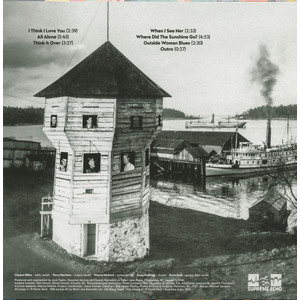
Glass Cage - Where Did the Sunshine Go BACK
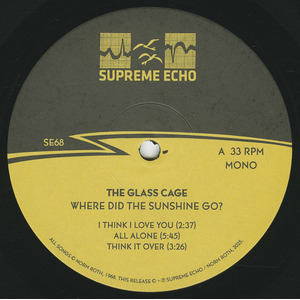
Glass Cage - Where Did the Sunshine Go LABEL 01
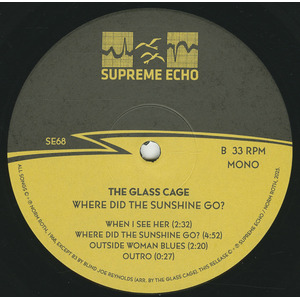
Glass Cage - Where Did the Sunshine Go LABEL 02
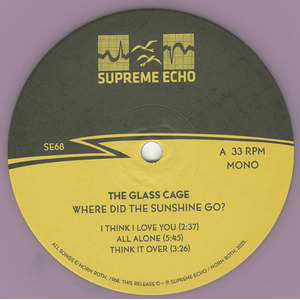
Glass Cage - Where Did the Sunshine Go LABEL COLOUR 01
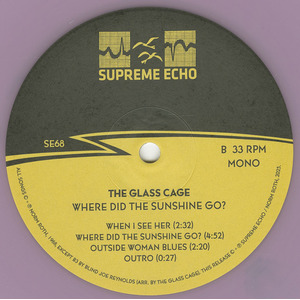
Glass Cage - Where Did the Sunshine Go LABEL COLOUR 02
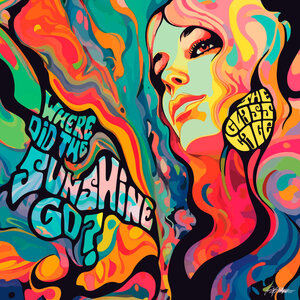
Where Did the Sunshine Go?
Media
Videos
0 videos
No videos available for this title.
Credits
In Transit
No Comments