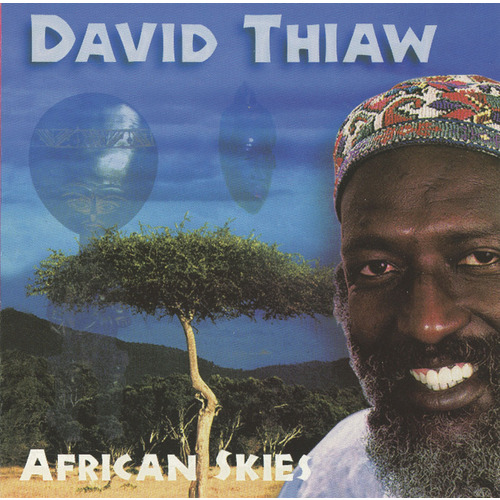
About This Title
David Thiaw is a Senegal-born vocalist, percussionist, composer, and cultural educator whose music bridges the traditional rhythms of West Africa with the global diaspora he has inhabited since the 1970s. Raised in Dakar, he grew up within the sound world of Wolof and Lebou drumming traditions: sabar, tama, djun djun, and the djembe that would later become his signature instrument. His earliest musical memories—family songs, call-and-response gatherings, and the communal night-drumming of the rainy season—remain the emotional core of his work.
Thiaw left Senegal as a young man and eventually settled in Canada, becoming one of the earliest artists to introduce West African drumming to Canadian audiences. By the mid-1970s he had brought one of the first djembes into the country, leading a long-running community drum circle on Montreal’s Mount Royal and teaching a generation of musicians who would later form part of his ensemble DOMBA. His approach blended respect for traditional forms with a desire to expand the vocabulary of African percussion within contemporary settings.
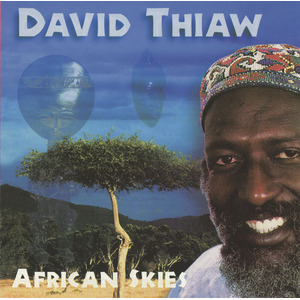
His album African Skies (1996), recorded in Calgary with a group of Canadian and international collaborators, is the fullest expression of his musical worldview. Interweaving Senegalese, Malinke, Nigerian, and Ghanaian songs with his own compositions, the record moves from ancestral material to personal memorial pieces such as “Titi’s Groove,” written for his late daughter. The album’s liner notes reveal Thiaw as both storyteller and cultural archivist: reflecting on diaspora, childhood memories, African folklore, and the spiritual lives of masks and drums displaced from their homelands.
Thiaw’s work as a performer spans festivals, educational programs, multicultural arts initiatives, and collaborations with dancers and community ensembles. His concerts often function as both performance and pedagogy, introducing audiences to the social histories embedded in each rhythm. Whether leading DOMBA or performing solo, his music emphasizes the power of percussion as a means of communication—echoing his belief that sabar drumming, historically used to accompany speech, helped shape forms of expression that resonate in contemporary popular music.
Now based in Western Canada, Thiaw continues to record, teach, and share the traditions he grew up with in Dakar. His career stands as a long bridge between continents: rooted in West African heritage, shaped by the Canadian communities he has taught and performed within, and driven by a commitment to keeping the stories, spirits, and voices of his ancestors alive through music.
-Robert Williston
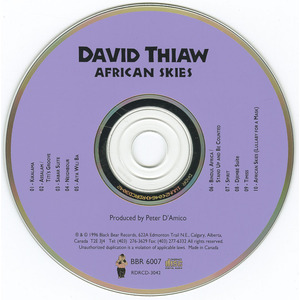
01 – Kikalama (Traditional Senegal)
My mother sang this to me many years ago. I just know it as a welcoming song she liked. When I sing it, I can still hear her voice. I also enjoy the joyful simplicity of its call and response.
02 – Assalam (Traditional Senegal)
This is a greeting song heard quite often during the rainy season, called kassak. At night people gather around the fire, the air is cool; the drums are brought out. It is a time for song, folk tales, laughter and dance.
Titi’s Groove (David Thiaw)
This happy, soothing song is for the memory of my deceased daughter Anne Marie (Titi, age 23). It comes from things I remember her singing, from the many shared memories, and from my heart. I am forever grateful that she gave me and her clan so much spirit. “I can see your heart, Titi. But it sounds so far.”
03 – Sabar Suite (David Thiaw)
Sabar is a highly concerted form of drumming developed by Wolof and Lebou people. It is a drum family and style totally unique to Senegal. Played with hand and stick, sabar drumming encourages innovative improvisation. I am convinced that because sabar was used to accompany speech, it played a significant role in the development of what we in North America know as rap.
04 – Neighbour (Traditional Nigerian)
Nigerian pop musician Sonny Okosun made this song a hit more than 20 years ago. I feel the lyrics are very appropriate in view of the global village the world is becoming.
05 – Aita Wili Ba (Traditional Malinke)
It’s time for work, it’s time for harvest! The accompanying drums — djembe and djun djun — play a combination of lamban and djan. This arrangement was inspired by elements of traditional djembe and sabar drumming styles.
06 – Bindul Africa / Stand Up And Be Counted (Osibisa: English lyrics | David Thiaw: Wolof lyrics)
This song talks about the African Diaspora. It would be such a miracle, say the lyrics, if many of Africa’s exiles could return, “to help build a dream.” In Wolof I ask my fellow Africans to reflect on the taste of bitterness, to forget the great shame of slavery, and to find courage, and through “fallow” (accomplishment), raise its head in pride. “Woi na la tey. Ya yi aduna.” I sing you today, Mother Africa, mother of all worlds.
07 – Spirit (Traditional Ghana)
You can hear the first part of this lively call and response song in Ghana to this day. It is sung with accompanying kpanlogo drums. The last riff, written by me, is for all the working children of the world. It honours the memory of little Iqbal Masouh, a tiny powerhouse from Pakistan who raised world consciousness of the shameful destiny awaiting him and thousands of others forced to toil as indentured carpet weavers. He paid with his life and I feel it was not in vain.
08 – Djembe Suite (David Thiaw)
The djembe is a centuries-old drum from West Africa. It is played in Senegal, Guinea, Mali, Ivory Coast, Sierra Leone, Burkinafaso and Liberia. Its versatility has made it into one of the most sought-after drums of African origin. Back in the 70s, I brought one of the first djembes to Canada, and the drumming circle I started in those days still meets today on summer Sunday afternoons on Mt. Royal in Montreal. I would never have guessed then that I would be contributing to the phenomenon which African drumming has become in Western society now. My own band, DOMBA, is composed of native-born Canadians who have been introduced to African music, my style. The Djembe Suite shows it is not where you were born that matters, but what your spirit and soul say.
09 – Timiss (David Thiaw)
In Wolof, “timiss” means dusk. Senegal, with its long coast line, is at the westernmost tip of Africa. I miss the sunsets in Dakar, the capital. If you stand on the Corniche in the early evening looking out over the Atlantic Ocean, the waning sun reflecting off the water blends with the receding tide to tinge the air a soothing blue.
For me this is timiss, a prelude in blue light to the arrival of Africa’s starry night. The air has changed after the heat of the day when the harmattan blows in from the Sahara. Now the alizé, a cool refreshing breeze, glides in off the ocean.
10 – African Skies (Lullaby for a Mask) (David Thiaw)
Throughout the western world, African masks are undoubtedly the main representatives of the continent’s culture. But to me, they look so lonely in their museum exhibit cases with captions at their feet. They remind me of dead butterflies: their wings will never flutter again. As a child of Africa, I know they had a rich past life. I am sure that at night, after the visitors have gone, they whisper in their many African languages: Tsokhwe, Dan, Basonge, Bobo, Bateke. They reminisce of Africa, its people, wildlife, skies and smells. In this song, Tsichwara, the horse antelope of the Bama, says, “Africa mon na, Africa sor na” (It was a painful journey and now you are so far). The masks miss the thunder of the drums, the sweat of the dancers who wore them, the dust raised by the many dancing feet, and the smell of the satiated earth after the long-awaited rains.
Musicians
David Thiaw: lead vocals, African drums (djembe, djembe, lambu, sabar, tama), kalimba, shekere
Brent Van Dusen: djun djun with kenkeni, sengba and bells, various percussion
Jean-Christophe Leroy: djembe, sabar, percussion (kit)
Pat Bellevue: saxophone
Douglas Gelley: bass
Craig G. McCaul: guitar
Bonnie Lawrence: flute
Willo Joosen: keyboards
Andrea Bagan: harmony vocals
Gemira McClary: harmony vocals
Brent Van Dusen: harmony vocals
Douglas Gelley: harmony vocals
Songwriting
‘Kikalama’ traditional Senegal
‘Assalam’ traditional Senegal
‘Titi’s Groove’ written by David Thiaw
‘Sabar Suite’ written by David Thiaw
‘Neighbour’ traditional Nigerian
‘Aita Wili Ba’ traditional Malinke
‘Bindul Africa / Stand Up and Be Counted’ English lyric by Osibisa; Wolof lyric by David Thiaw
‘Spirit’ traditional Ghana
‘Djembe Suite’ written by David Thiaw
‘Timiss’ written by David Thiaw
‘African Skies (Lullaby for a Mask)’ written by David Thiaw
Production
Arranged by David Thiaw and Brent Van Dusen
SFX by Peter D’Amico (thanks to The Hollywood Edge)
Produced by Peter D’Amico for Boxer Productions
Engineered by Peter D’Amico, except ‘Sabar Suite’ and ‘Djembe Suite’ engineered by David Horrocks
Bed tracks recorded December 1995 at Sundae Sound Recording Studios, Calgary, Alberta
Additional recording and vocals at Boxer Studio, Calgary, Alberta
Artwork
Photography (African Sky) by Carol Peterson, Calgary
Photography by David Thiaw, Photographic Reflections, Penticton
Masks photographed by Garret Parsons, Calgary
Cover art by Stormy Days Productions
Gallery
Images
5 images
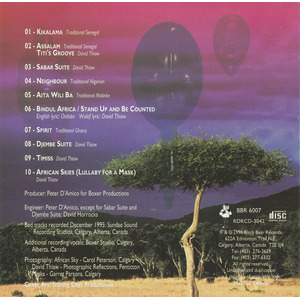
CD-David Thiaw - African Skies BACK
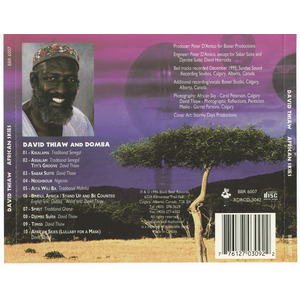
CD-David Thiaw - African Skies INLAY
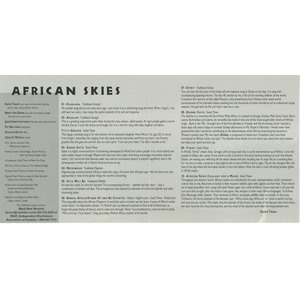
CD-David Thiaw - African Skies INSIDE
CD-David Thiaw - African Skies CD
African Skies
Media
Videos
0 videos
No videos available for this title.
No Comments