Album / Title
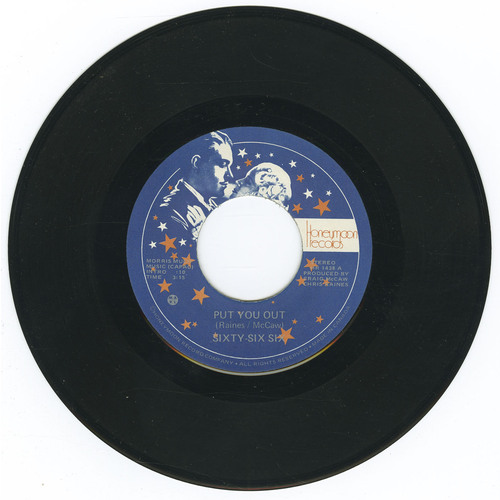
Put You Out b/w Life's On Fire
By: Sixty-Six Six
Origin: Vancouver, British Columbia, 🇨🇦
Insight
Sixty-Six Six formed in Vancouver, British Columbia, in 1974, bringing together a group of musicians whose varied backgrounds gave the band a distinct place in the city’s mid-1970s rock underground. The lineup featured drummer Gary Glacken, bassist Curt Klassen, lead guitarist Craig McCaw, keyboardist and vocalist John Mitchel, guitarist and vocalist Chris Raines, and sisters Kendra and Roz Sprinkling on vocals. Though the group only lasted until 1976, its members arrived with enough pedigree to draw immediate attention on the Vancouver circuit.
The band’s origins tied together two notable threads from the previous decade: Chris Raines came from Python, a respected Vancouver name whose lone 1972 single “Shock Treatment” b/w “Pink Ladies” later became a cult collector’s item, while Craig McCaw had helped shape the sound of the Poppy Family, the top-selling Canadian group of the late sixties and early seventies. Their presence gave Sixty-Six Six a level of musicianship that set them apart from other local groups emerging from the garage and dancehall scene.
The group’s formation grew out of the Bill Lewis Music shop on Broadway in Vancouver, where Raines had begun working after Python dissolved. The store and its downstairs recording facility, Bullfrog Studios, functioned as a gathering point for the city’s musicians. It was there that Raines met McCaw, who had recently left the Poppy Family, and the two quickly discovered a shared interest in writing and performing new material. With the addition of John Mitchel and the Sprinkling sisters — whose strong vocal presence added a soulful dimension to the band’s sound — Sixty-Six Six soon expanded into a seven-piece ensemble.
The group’s unusual name referred to McCaw’s 1966 Stratocaster six-string guitar. Despite its harmless origin, audiences frequently interpreted the name as “666,” leading to confusion and the mistaken belief that the band had some kind of satanic theme — something the musicians repeatedly had to explain away.
Working primarily in Vancouver clubs and regional venues, Sixty-Six Six developed a tight, melodic sound rooted in guitar-driven rock but coloured by the members’ diverse influences. Promoter Paul Mercer became involved with the band and began presenting them to record companies, briefly raising expectations that the group might break out beyond the local circuit.
Their sole commercial release, the 1975 single “Put You Out” b/w “Life’s On Fire” on Honeymoon Records (HR 1438), was written and produced by Chris Raines and Craig McCaw and recorded at Vancouver’s Little Mountain Sound. Issued in small quantities and seldom seen outside Western Canada, the single has since become a collector’s item among enthusiasts of mid-1970s independent Vancouver rock.
Although the group dissolved in 1976, its members continued to leave footprints across the local music landscape. Gary Glacken moved on to the Out of Hand Jive Band; John Mitchel and Kendra Sprinkling later provided backing vocals for the dance-music project Sweet 202; and Kendra went on to sing backup for Denise McCann during McCann’s late-1970s run of disco and rock releases. Craig McCaw entered a more experimental and production-oriented phase that would eventually lead to his long career composing music for film, television, and planetarium shows.
While short-lived, Sixty-Six Six captured a transitional moment in Vancouver’s mid-1970s music scene, linking the city’s psychedelic and pop legacy to the evolving independent rock culture of the decade. Their lone 45 remains the clearest document of a band whose members went on to shape a surprisingly wide range of creative paths.
-Robert Williston
Craig McCaw: lead guitar
Kendra Sprinkling: lead vocals
Roz Sprinkling: vocals
John Mitchel: vocals, keyboards
Chris Raines: vocals, guitar
Curt Klassen: bass
Gary Glacken: drums
Written and produced by Chris Raines and Craig McCaw
Published by Morris Much Music
Gallery
Images
2 images
45-Sixty-Six Six - Put You Out VINYL 02
Put You Out b/w Life's On Fire
Media
Videos
0 videos
No videos available for this title.
Credits
In Transit
No Comments