Insight
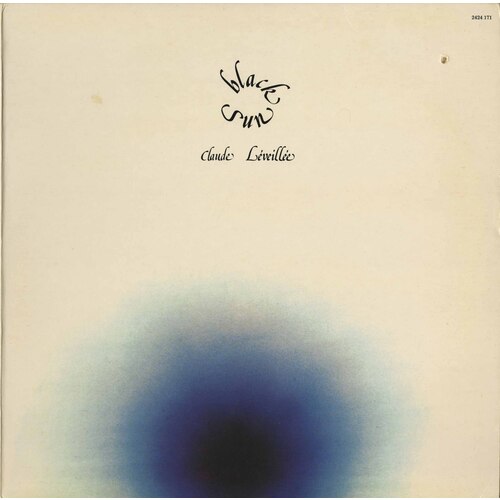
Released in 1978, Black Sun stands as one of the most unusual and overlooked records in Claude Léveillée’s vast body of work. Best known as one of Québec’s great chansonniers—a singer-songwriter, pianist, poet, actor, and a towering figure in francophone Canadian culture—Léveillée was rarely associated with progressive or instrumental music. Yet on Black Sun, he steps into a strikingly different world: a moody, cinematic, largely instrumental suite shaped by atmosphere, tension, and emotional depth. The result is a rare and deeply compelling album that sits at the crossroads of Québec chanson, theatrical composition, and late-1970s progressive music.
The album originated as music written for a ballet commissioned by choreographer Eva Von Gencsy for COJO, based on a dramatic concept by celebrated playwright Marcel Dubé. In a 1978 interview, Léveillée explained that the music had actually been recorded roughly two years earlier, then later edited, resequenced, and remixed before being issued as an LP. That background helps explain the album’s unusual structure and sense of narrative flow. Rather than functioning like a conventional song-based release, Black Sun unfolds like a staged suite translated to vinyl—its pieces moving through moments of grandeur, solitude, suspense, and reflection with the logic of a dramatic work rather than a pop album.
Michel Lefrançois played a central role in shaping the album’s final form. Léveillée himself praised Lefrançois in interviews for his sensitivity as an arranger and his ability to transform material without sacrificing its emotional core. On the album, Lefrançois’s contributions are immense: beyond co-composing selected pieces, he provides electric piano, synthesizers, Mini-Moog, A.R.P., elka, guitars, cithare, and a wide palette of textures that give Black Sun its distinct sonic identity. Together, Léveillée and Lefrançois created a record that is symphonic and exploratory, yet never cold or academic. Its progressive qualities come not from flashy virtuosity, but from mood, orchestration, pacing, and the careful blending of classical, jazz, folk, and theatrical elements.
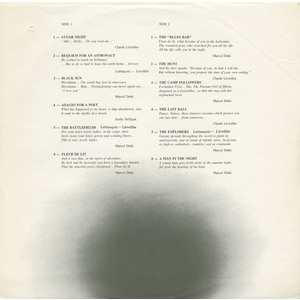
Though often described as a progressive instrumental album, Black Sun is not entirely instrumental in spirit. The inner sleeve frames each composition with literary fragments and poetic cues drawn from Claude Léveillée, Marcel Dubé, and Émile Nelligan, revealing that the album was conceived as a dramatic and literary work as much as a musical one. Those textual references deepen the sense that this is a soundtrack to an unwritten film or a forgotten stage production—music that suggests characters, settings, and emotional arcs even when no voices are present.
Within Claude Léveillée’s discography, Black Sun remains a genuine outlier—and that is precisely what makes it so fascinating. By 1978, he had already established himself as one of Québec’s most important cultural figures, with songs interpreted by artists such as Édith Piaf, Monique Leyrac, Pauline Julien, and André Gagnon, and with a career that extended into theatre, television, and orchestral composition. Rather than repeating his established formula, Black Sun reveals another side of his artistry: ambitious, textural, and quietly adventurous. Long overlooked and difficult to find, it has become a sought-after gem for collectors and a rewarding discovery for listeners interested in the more atmospheric and exploratory corners of Canadian music history.
-Robert Williston
Musicians
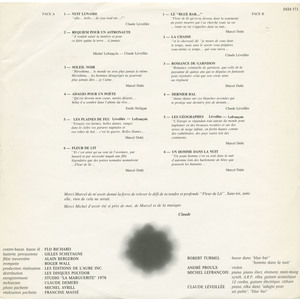
Claude Léveillée: piano, elka on 'Adagio Pour Un Poète' and 'Le "Blue Bar..."'
Michel Lefrançois: piano, electric piano, Eminent, Mini-Moog synthesizer, A.R.P., elka, acoustic 12-string guitar, electric guitar, cithare
Flo Richard: double bass, electric bass
Robert Turmel: bass on 'Le "Blue Bar..."' and 'Un Homme Dans La Nuit'
Gilles Schetagne: drums, percussion
Alain Bergeron: flute
Roger Wall: trumpet
André Proulx: violin
Songwriting
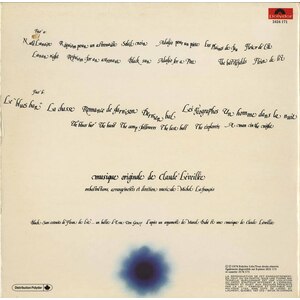
'Nuit Lunaire' (“allo… hello… do you read me…?”) written by Claude Léveillée
'Requiem Pour Un Astronaute' (“il voulait saisir la lumière et pour ce faire quitta la terre… à jamais.”) written by Michel Lefrançois and Claude Léveillée
'Soleil Noir' (“Hiroshima… le monde ne sera plus jamais le même Hiroshima… les hommes désagrégés ne pourront plus jamais dire… je t’aime.”) written by Marcel Dubé
'Adagio Pour Un Poète' (“Qu’est devenu mon coeur, navire déserté… hélas il a sombré dans l’abîme du rêve…”) written by Emile Nelligan
'Les Plaines De Feu' (“Essuyez vos larmes, belles dames, rangez dans le cèdre vos parures nuptiales et vos robes de bal… c’est la guerre, Belles Dames…”) written by Claude Léveillée and Michel Lefrançois; text by Marcel Dubé
'Fleur De Lit' (“Et c’est ainsi qu’au vent de l’aventure, par hasard et par nécessité naquit une fille légendaire que des poètes nomades nommèrent… Fleur de lit…”) written by Marcel Dubé
'Le "Blue Bar..."' (“Fleur de lit qu’es-tu devenu dans la tourmente un poète meurtri qui t’as cherché toute sa vie … toute sa vie t’appelles dans sa nuit…”) written by Marcel Dubé
'La Chasse' (“et le chevreuil dit ‘je meurs de vous dans le temps, mais sans le savoir vous préparez vous-même ce temps… qui vous tuera…’”) written by Claude Léveillée
'Romance De Garnison' (“Romance criminelle de garnison, que celle de la paysanne de quinze ans qui se déguisa en fantassin pour rejoindre celui que son coeur aime au régiment”) written by Marcel Dubé
'Dernier Bal' (“danse danse sur ces blanches secondes qui te protège une dernière fois de demain…”) written by Claude Léveillée
'Les Géographes' (“L’Europe se répandait tout autour du monde pour implanter en des brousses reculées et sur des terres de neige infinie, en forêts hautes comme des cathédrales, des pays vastes tels des continents.”) written by Claude Léveillée and Michel Lefrançois; text by Marcel Dubé
'Un Homme Dans La Nuit' (“Un jeune homme s’en va seul dans la nuit d’automne loin des hurlements de bêtes que poussent les humains…”) written by Marcel Dubé
Published by Éditions De L’Aube Inc.
Production
Production / réalisation: Les Éditions De L’Aube Inc.
Recorded in 1976 at Studio “La Marguerite”
Technical / engineering by Claude Demers
Distributed by Les Disques Polydor
Manufactured by Polydor Ltée
Mastered at Masterdisk
Lacquer cut by BK at Disques SNB Ltée.
Artwork
Sleeve photography by Michel Avrill
Sleeve design by Francine Massé
Gallery
Images
6 images
full-Claude_Leveeillee-Black_Sun_BACK
Claude Léveillée - Black Sun INSERT SIDE 01
Claude Léveillée - Black Sun INSERT SIDE 02
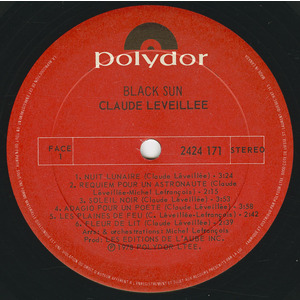
Claude Léveillée - Black Sun LABEL 01
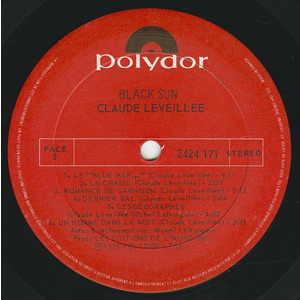
Claude Léveillée - Black Sun LABEL 02
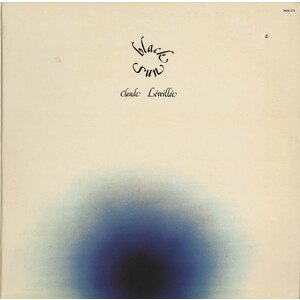
Black Sun
Media
Videos
0 videos
No videos available for this title.
Credits
In Transit
No Comments