Information/Write-up
Catherine McKinnon (born May 14, 1944, Saint John, New Brunswick) is one of the most distinctive and enduring vocalists to emerge from Canada’s Atlantic provinces—an artist whose career bridged folk revival, orchestral pop, television stardom, and musical theatre, while maintaining a reputation for vocal purity, interpretive intelligence, and uncommon emotional restraint.
Raised in a peripatetic household that moved frequently across Canada, McKinnon was exposed early to broadcasting and performance. She made her radio debut at just eight years old in Saint John and appeared on television by age twelve in London, Ontario—an unusually early entrée into the professional entertainment world that placed her squarely within Canada’s formative broadcast era. She later studied music at Mount Saint Vincent College in Halifax, grounding her natural vocal gifts in formal training.
McKinnon’s national breakthrough came in 1962 when she became a featured soloist on CBC Television’s Singalong Jubilee, a Halifax-based program that would become one of the most important launchpads for Atlantic Canadian talent. Her poised presence and crystalline soprano quickly distinguished her from her peers, and she soon became one of the program’s central figures during its most influential years.
Her recording career took off with the release of Voice of an Angel (1964), an album that established her as a leading interpreter of folk and traditional material at the height of the 1960s folk revival. The record was a commercial success and positioned McKinnon as a national star, balancing accessibility with refinement. She followed it quickly with Voice of an Angel II (1964), confirming that the debut had not been a novelty but the arrival of a major new voice.
Throughout the mid- and late-1960s, McKinnon became a familiar presence on Canadian television. She appeared regularly on Don Messer’s Jubilee, Music Hop, and starred in her own CBC Radio series, That McKinnon Girl. In 1965, she was awarded the RPM Award for Top Female Singer, a precursor to the Juno Awards, reflecting her prominence during a period of rapid change in Canadian popular music.
Her repertoire evolved steadily. While rooted in folk, McKinnon demonstrated a rare ability to move fluidly between traditional material, contemporary songwriting, and orchestral pop. Her recording of Buffy Sainte-Marie’s “Until It’s Time for You to Go” became a modest hit in 1966 and revealed her gift for understatement—never oversinging, always allowing the lyric to breathe.
Albums such as Something Old Something New (1967), Both Sides Now (1968), and Everybody’s Talkin’ (1969) captured this expansion in scope. Critics responded enthusiastically. Writing in the Toronto Telegram in 1969, Peter Goddard praised her voice as “rich, controlled, completely sure in its sense of pitch,” while The Globe and Mail’s Blaik Kirby famously described it as “a sound so ravishingly beautiful you could worship it.”
In 1966, McKinnon relocated from Halifax to Toronto, placing herself at the center of Canada’s television and theatrical industries. She appeared in the Spring Thaw revue in 1967, guested on Wayne & Shuster, and starred in a succession of television projects, including CTV’s River Inn (1968–69) and The Catherine McKinnon Show (1970–71). She later co-hosted Global Television’s Everything Goes (1974) and also appeared on television in the United Kingdom, extending her profile internationally.
As the 1970s progressed, McKinnon increasingly embraced the role of sophisticated nightclub and concert performer. Her repertoire broadened to include torch songs, ballads, and contemporary standards, and she demonstrated a natural affinity for orchestral settings. Her 1970 album Catherine McKinnon, recorded with the Jimmy Dale Orchestra, showcased her elegance as a pop interpreter, while live performances with the Saskatoon and Winnipeg Symphony Orchestras and the Hamilton Philharmonic confirmed her versatility.
In 1972, she portrayed painter Emily Carr in The Wonder of It All, a CBC-TV musical written by her husband at the time, actor and comedian Don Harron, in collaboration with director Norman Campbell. From that point onward, theatre became an increasingly central focus of her career. Throughout the 1970s and 1980s, McKinnon appeared in major stage productions across the country, including the Charlottetown Festival, Rainbow Stage in Winnipeg, Theatre Plus in Toronto, Theatre New Brunswick, and the Neptune Theatre in Halifax. Her performances ranged from musical comedy to dramatic roles, often alongside Harron, and reflected a deepening commitment to character-driven work.
Although her recording output slowed, McKinnon returned to the studio with a self-titled album in 1980, reaffirming her continued engagement with music alongside her theatrical work.
Music was very much a family affair. Her younger sister, Patrician Anne McKinnon, also enjoyed a successful career as a singer and regular CBC television performer, releasing an album in 1984 that included the minor hit “Blue Lipstick.” Patrician Anne’s career was cut short by illness; she died in 2001 following a long battle with cancer.
Catherine McKinnon and Don Harron divorced in 2005, but her legacy as a performer remained firmly intact. In 2012, she was awarded a Lifetime Achievement Award at the East Coast Music Awards, recognizing her profound contributions to Canadian music and performance.
Best known to many for her definitive rendition of “Farewell to Nova Scotia,” Catherine McKinnon stands as a rare example of an artist who successfully bridged Canada’s folk revival, broadcast golden age, and theatrical tradition—an interpreter of exceptional taste whose voice remains one of the most beautiful and unmistakable ever produced by this country.
-Robert Williston
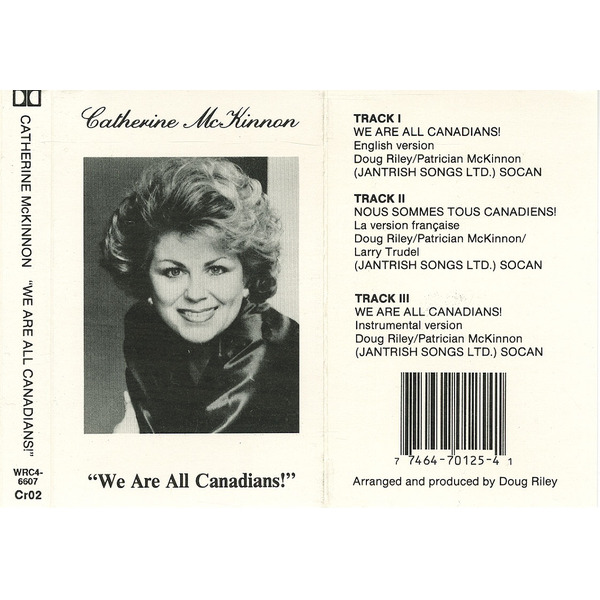
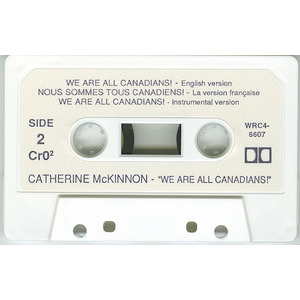
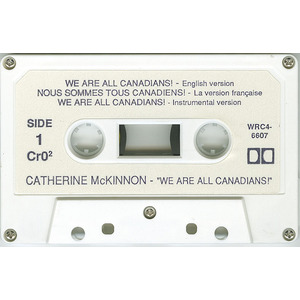
Written by Doug Riley and Patrician McKinnon
Arranged and produced by Doug Riley
No Comments