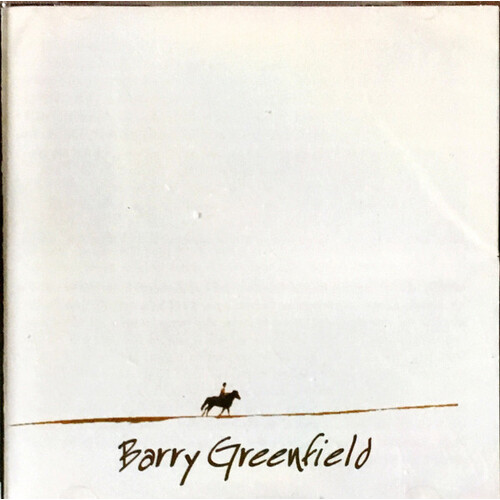
Album / Title
Barry Greenfield #3 (The White Album)
By: Barry Greenfield
Origin: Manchester, England, 🇬🇧 - Rhodesia (Zimbabwe) → Vancouver, British Columbia, 🇨🇦
Insight
Barry Greenfield was born in Manchester, England, late in 1950. His childhood took him from Britain to Rhodesia, now Zimbabwe, and South Africa before his family settled in Vancouver in 1967. He had already begun playing guitar and writing songs as a teenager. Greenfield has often spoken about the effect of growing up in Rhodesia, particularly his early exposure to racism and inequality. Those experiences stayed with him and later surfaced in songs about war, politics, prejudice and social responsibility.
Vancouver placed him in the middle of an extraordinary period in popular music. In 1968 he attended a Vancouver Coliseum concert featuring Herman's Hermits, The Who and Buffalo Springfield. That same year, he watched John Lennon and Paul McCartney appear on American television discussing Apple, their new company, and its interest in finding new writers and artists. Greenfield took the invitation far more literally than most teenagers watching at home. Still only 17, he bought a ticket to London and arrived at Apple Records at 3 Savile Row carrying a cheap acoustic guitar and no appointment.
Greenfield's account of what happened at Apple forms the opening part of his 2025 memoir, My Journey to Blue Sky. He recalled encountering Lennon and Yoko Ono at the office before meeting Beatles press officer Derek Taylor. When Taylor asked if he had a tape, Greenfield admitted that he had never recorded his songs. Instead, he played them on the guitar he had brought from Canada. Taylor liked what he heard and helped move him into meetings at EMI, where more of his songs were heard and two were demoed. An Apple single was discussed, but Greenfield backed away. At that point he saw himself primarily as a songwriter and did not feel ready for the public life of a recording artist. He returned to Canada to finish school and continue his studies.
Music soon pulled him back to Britain. During a return to Manchester around 1970, a chance conversation on a double-decker bus led Greenfield to Lol Creme, who in turn directed him to manager Harvey Lisberg. Greenfield went to Lisberg's home with his guitar. Lisberg heard part of a song and called Graham Gouldman, already one of Britain's most successful young songwriters through songs such as "For Your Love," "Bus Stop" and "No Milk Today." Gouldman came over, listened and asked Greenfield to write a single.
The result was "Sweet America," written against the background of the Vietnam War. Gouldman produced the recording at Strawberry Studios in Stockport with Eric Stewart, Kevin Godley and Lol Creme, the musicians who would shortly become 10cc. Gouldman played bass and guitar, Godley played drums, Creme played rhythm guitar and Stewart worked on the recording with Peter Tattersall. Gouldman also helped Greenfield complete the middle section of the song and sang on the finished recording.
Philips released "Sweet America" in Britain in 1971. Tony Blackburn selected it as his BBC Record of the Week, giving Greenfield his first significant national exposure. Greenfield stayed close to Gouldman during this period, writing, learning and, for a time, living with the Gouldman family. Decades later he still regarded Gouldman as one of the people who taught him how songs were built.
Back in Vancouver, Greenfield was studying and working weekends at the Hudson's Bay Company when another opening appeared. He persuaded the store to let him write and record a radio jingle and was given $600 to make it. Greenfield later recalled spending about $150 on the jingle and using the remaining money to record one of his own songs, "New York Is Closed Tonight."
Through a series of connections, the tape reached Bo Diddley, who carried it to New York publisher Fred Ahlert Jr. Ahlert heard something in the song and began pursuing Greenfield. After months of telephone calls and a meeting in San Francisco, Greenfield agreed to work with him.
"New York Is Closed Tonight" was released in Canada in 1972 on Laurie Records, credited simply to Greenfield. The song described a polluted, decaying New York, using the city as the setting for a broader warning about what people were doing to their environment. Canadian radio responded. It reached No. 34 on RPM's national singles chart and spent two weeks at No. 1 on RPM's Adult Contemporary chart. In Vancouver it reached No. 7 on CKVN and remained on the station's chart for 11 weeks. The song also received a Certificate of Honour for Canadian Music.
Its success brought Greenfield into RCA. In 1973 he went to Hollywood to make his first album, Blue Sky. He chose the young David M. Kershenbaum to produce it and worked with arranger Jimmie Haskell. The musicians assembled for the sessions included Larry Carlton, Joe Osborn, Dean Parks, Larry Knechtel, Larry Muhoberac, Jim Gordon, Russ Kunkel, Gene Estes and Milt Holland. Greenfield was still in his early twenties, surrounded by players whose names would appear on hundreds of major recordings over the following decades.
Blue Sky was built around Greenfield's own songs, including new versions of "New York Is Closed Tonight" and "Sweet America," along with "Free the Lady," "On the Road to Safety," "Suicide," "Concert Fever," "Milkman" and "Jack and Jill." The arrangements moved his writing well beyond the simple voice-and-guitar form in which many of the songs had begun. Kershenbaum and Haskell gave the record a broad Los Angeles studio sound, but Greenfield's songs remained at its centre.
The Hollywood sessions also supplied stories Greenfield would continue telling for the rest of his life. While working at RCA he met Harry Nilsson and, according to Greenfield's recollection, spent several hours with him in another studio working on a mix. Ringo Starr and producer Richard Perry later arrived. Greenfield remembered being fascinated by Nilsson's understanding of the studio and by how completely the atmosphere of the room changed when Starr walked through the door. It became one of his recurring "Barry Tales" and eventually found its way into his writing and interviews.
Blue Sky appeared on RCA Victor in 1973, but the career launch expected to follow it never really happened. Greenfield later described trouble between Fred Ahlert and RCA and a breakdown in the support surrounding the record. A further RCA single was issued, but the label's push quickly disappeared. More than fifty years later, the album would be revisited as a record that had somehow slipped from view despite the quality of the musicians, arrangements and songs involved.
Greenfield nevertheless spent the next several years working on the road. He toured with John Lee Hooker and later shared bills with Supertramp, among many others. His account of the Hooker tour describes a young acoustic songwriter suddenly travelling with one of the central figures in the history of the blues, playing his own set before Hooker each night and watching how the older musician commanded a room. Greenfield remembered Hooker as one of the people who taught him that performing had to begin with the desire to play.
A second album followed the RCA record. A Canadian pressing credited to Greenfield appeared on Goldfish Records in 1974, with the material later issued through Casino. The sessions drew on Vancouver musicians and included production work by Ken Lundgren, with Terry Jacks producing "Canada Sky." The single became another Canadian radio success, reaching No. 35 on RPM in March 1975.
By then Greenfield had experienced much of the life he had been offered at 17 and declined. He had recorded in Britain and Los Angeles, made records for Philips and RCA, worked with major studio musicians and spent years playing concerts. After a festival appearance in the Okanagan, he decided to leave the professional music business. Years later, when asked about the decision, Greenfield said simply that he was no longer enjoying it and could see that the business would only become harder.
He did not stop writing.
Greenfield built a financial planning business in Vancouver, married, raised a family and continued accumulating songs. Some travelled considerably farther than he did. Buffy Sainte-Marie recorded two songs from Blue Sky, "Sweet America" and "Free the Lady," for her 1976 album Sweet America. Greenfield later said the connection began with a demo he had given to Joni Mitchell. His songs were also recorded by other artists, and he collaborated at various times with writers including Randy Bachman and Graham Gouldman.
By the late 1990s Greenfield was recording again. The return produced Cold Water Cure, King of the Wolves, #3 (The White Album) and, in 2006, Heavy Horses. His writing had not become less political with age. King of the Wolves included "Landmines" and "Pink Ghetto," while "The Road Home" addressed soldiers returning from the war in Iraq. Joey "Shithead" Keithley of D.O.A. became an enthusiastic supporter and encouraged Greenfield to get back on stage. Heavy Horses, made with guitarist David Sinclair, brought much of the music back toward voice, guitar and the song itself.
Greenfield continued recording through the following decades. Exposed Soul appeared in 2008, followed by further projects including This Blue, The Beautiful Band, My Day in Auschwitz and Graceful. He also worked with Vancouver multi-instrumentalist Mick Dalla-Vee as the Wizard Brothers. Their work included The Quiet Canadians, another chapter in a catalogue that moved freely between personal writing, politics, memory, family and the musicians who had first sent Greenfield toward a guitar as a teenager.
One subject never disappeared: Blue Sky.
In 2024 Greenfield returned to the album and issued Blue Sky (Deluxe Edition), remastered and expanded with early recordings and demos. The reissue coincided with renewed attention from Britain's Record Collector, which devoted a feature to Greenfield and the circumstances surrounding the original album. The record that had received so little attention in 1973 was finally given another hearing.
That return to the past also led Greenfield to books. My Journey to Blue Sky was published by New Haven Publishing in 2025. Rather than attempting to cover every year of his life, the memoir concentrates on the road from his 1968 visit to Apple through the making of Blue Sky and his years in the music business. Greenfield drew on old journals, diaries and memories of the people who were there, revisiting encounters with Derek Taylor, John Lennon, Graham Gouldman, Harry Nilsson, Kenny Rogers, Mike Nesmith and others.
He followed it in 2026 with All You Need Is Courage. This time Greenfield chose fiction. Its central character, Adam Bond, is a young Canadian songwriter who enters Apple Records in 1968 and takes the road Greenfield himself walked away from. More than half a century later, Greenfield could finally imagine the other version of the story.
Through all of these changes, the constant has been the writing. When Greenfield corresponded with the Museum of Canadian Music in December 2023, shortly after his 73rd birthday, he said that he still wrote every day. He had just completed another song, "Here Comes Spring."
-Robert Williston
Gallery
Images
1 image
Barry Greenfield #3 (The White Album)
Media
Videos
0 videos
No videos available for this title.
Credits
Production
Produced by Barry Greenfield and David Sinclair
Engineered, mixed and mastered by Commodor Perry Barrett
Produced in Vancouver, Canada
Publishing
Published by Zab Music
SOCAN
Copyright
© Barry Greenfield
No Comments