Insight
Paul Laine left home at thirteen and was working bars at fifteen, years before he was legally allowed to be in most of them. At seventeen he did something stranger than any of that. He started a management company with two friends, Les Horne and Fran Adamson, partly as a way to raise the money to record himself. The first demo went nowhere. He put more money into it and cut it again, and the response was only slightly better. He cut it a third time. That one worked.
CBS came first with an offer. Once one major label was interested the others followed, and Laine signed with Elektra. The same demo reached Terry David Mulligan, and through that connection Laine ended up managed by Bruce Allen Talent, the Vancouver organization behind Bryan Adams and Loverboy. He was barely twenty, and the machinery that carried the biggest Canadian rock careers of the era was suddenly around him.
He knew exactly who he wanted to make the record. Bruce Fairbairn had Bon Jovi, Aerosmith and Loverboy behind him and was one of rock's most sought-after producers, and Laine kept at it until Fairbairn said yes. The sessions ran at Little Mountain Sound in Vancouver while that building was turning out some of the biggest hard rock records in the world. Fairbairn produced, with Erwin Musper engineering and mixing most of the record and Ken Lomas handling Main Attraction. Years later, when the album was reissued in Europe, Laine thanked Fairbairn “for making a young punk's dream come true.”
The band Laine assembled around himself was Kenny Kaos on guitar, Scott Brown on bass and backing vocals, Pat Steward on drums and Paul Gogo on keyboards and backing vocals. The sessions pulled in a wider circle as they went. John Webster played keyboards, Rene Worst added bass and fretless bass, Ryan Blood sang backing vocals, Joani Bye sang on Heart Of America, and Mickey Curry sat in on drums. Fairbairn put himself on the record too, credited with hell piano on the seven-minute opener One Step Over The Line.
And then there is James Cotton. One of the great postwar blues harmonica players turns up on Doin' Time, blowing harp and throwing in scat vocals on a track that swings the album hard away from everything around it. Laine starts inside a straight blues and keeps pushing his voice harder until the thing tears open, and when Cotton comes in the record briefly stops being a hard rock album at all.
Stick It In Your Ear came out on Elektra in 1990. Laine sang and played guitar, acoustic guitar, keyboards and piano, and wrote or co-wrote all nine songs. Kenny Kaos shared the writing on One Step Over The Line and Main Attraction, Scott Brown joined Laine and Kaos on Doin' Time, and Mike Norman and Brown wrote Is It Love with him. Dorianna, built on an organ intro that the single edit cut away, layered guitars and a chorus that will not leave, reached No. 76 in Canada late in 1990. The ballad Is It Love followed it to No. 93.
The album has never wanted for advocates. Reviewing it for the Museum of Canadian Music, Mike Ladano gave Stick It In Your Ear four and a half out of five and called it possibly the last great debut of the hard rock age. He heard Deep Purple in the long instrumental stretch of One Step Over The Line, a real anthem in We Are The Young sung by someone young enough to mean it, and in Doin' Time one of the best rock and blues tracks this side of Badlands. His argument was that the record deserved a bigger shot than it got, more than a good many albums by established bands who were sliding at the same moment.
The record later received a European reissue through Long Island Records. The new edition added four bonus tracks, My Hometown, Only Your Heart, Keep On Running and After The Rain. The booklet also gave the original sessions a fuller technical credit, naming George Marino at Sterling Sound in New York for the original digital mastering. The reissue itself received additional mastering by Mike Behm and was digitally remastered by Adrian von Ripka at Bauer Studios in Ludwigsburg, Germany.
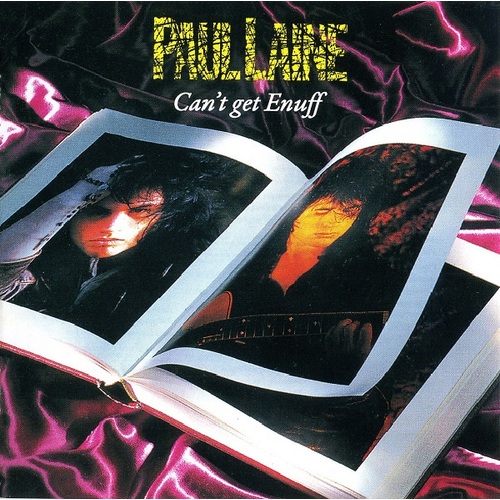
The timing was the problem, and it was nobody's fault. Laine had a Bruce Fairbairn production, a major label and two Canadian chart singles, and within about eighteen months the North American record business decided it wanted something else entirely. No second Elektra album followed. He stayed working regardless, arranging and singing backing vocals on other people's sessions, including work connected to the Scorpions and Poison's multi-platinum Flesh & Blood. A second solo record, Can't Get Enuff, appeared in Europe on Escape Music in 1996.
By then his voice had already done something the label campaign never managed. In 1993 Bruno Ravel and Steve West of the New York band Danger Danger were looking for a singer, came across Stick It In Your Ear, and hired the man on it.
He walked into a mess. Danger Danger had finished their third album, Cockroach, with original singer Ted Poley, then fired him, and the lawsuits that followed froze the record where it stood. Laine re-recorded every vocal on it. Epic then decided to shelve the album anyway. It sat unreleased for most of a decade, and when it finally came out in 2001 it came out as a double disc carrying both versions, one sung by Laine and one by Poley, which has to be one of the odder objects in American hard rock.
The rest of his run with the band was more productive than that beginning suggests. Dawn arrived in 1995, Four The Hard Way in 1997, The Return Of The Great Gildersleeves in 2000, and Live And Nude in 2005. The material moved away from the bright pop metal of the band's first records and gave Laine room for a heavier and often darker delivery. He stayed eleven years and left in 2005.
After that he built a working life rather than chasing another deal. He fronted his own band Shugaazer, co-owned a recording studio in Vancouver, and moved steadily into writing, producing and playing on other people's projects. In 2007 he wrote, produced and performed all the music for the web series Connected Life on MSN Canada. His compositions have since turned up in film and television, including A Man Called Otto, America's Got Talent and Pawn Stars.
The bands kept coming. He fronted Darkhorse, whose album Let It Ride was released in 2014. Two years later he went back in with Bruno Ravel and guitarist Rob Marcello as The Defiants, whose self-titled debut appeared on April 15, 2016 and was followed by Zokusho in 2019 and Drive in 2023, turning what could have been a nostalgia exercise into a real second catalogue. He also works with Lee Revill in Jet Set Junkies.
Then in 2024 the story folded back on itself. Ra McGuire and Brian Smith had retired from Trooper in November 2021, giving the band their blessing to carry on, and Paul Laine became the lead singer of one of the most recognizable Canadian rock bands there is. The lineup he joined includes Gogo on keyboards and Scott Brown on bass, the same two musicians who had been standing behind him at Little Mountain Sound in 1990. Trooper's own introduction of him puts it simply enough, calling them longtime friends and former bandmates.
That is the shape of it. A kid gets himself out of the house at thirteen, funds his own demos through a company he started at seventeen, talks Bruce Fairbairn into making his record, puts James Cotton on it, and watches the industry change its mind about the entire genre within a year of release. The album keeps working anyway. It gets him an eleven-year job in New York, survives long enough to earn a European reissue, and thirty-four years later it turns out the band he built to play those nine songs never really dispersed. The label campaign lasted a few months. The singer is still going.
-Robert Williston
Gallery
Images
3 images
Laine, Paul - Can't Get Enuff

Laine, Paul - Can't Get Enuff
Can't Get Enuff
Media
Videos
0 videos
No videos available for this title.
Credits
Musicians
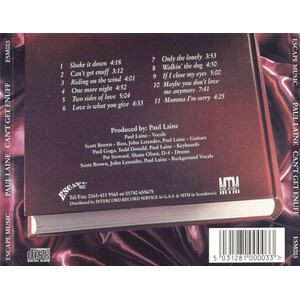
Paul Laine: vocals, guitar, keyboards, backing vocals
John Letendre: guitar, backing vocals
Scott Brown: bass, backing vocals
Pat Steward: drums
Shane Olsen: drums
D-4: drums
Paul Gogo: keyboards
Todd Donald: keyboards
Production
Produced by Paul Laine
Engineered by Paul Laine, Jamie Slater, Scott Little John and Joel Van Dyke
Additional engineering by Joel Van Dyke
Assistant engineer: Stacey Cameron
Mixed by Jamie Slater and Scott Little John
Mastered by Steve Morris and Tim Duncan at The Cutting Rooms
Songwriting
“Shake It Down” written by Paul Laine and Scott Brown
“Can't Get Enuff” written by Paul Laine and Scott Brown
“Riding On The Wind” written by Paul Laine
“One More Night” written by Paul Laine and Brad Darrid
“Two Sides Of Love” written by Paul Laine
“Love Is What You Give” written by Paul Laine
“Only The Lonely” written by Paul Laine
“Walkin' The Dog” written by Paul Laine and Scott Brown
“If I Close My Eyes” written by Paul Laine
“Maybe You Don't Love Me Anymore” written by Paul Laine
“Momma I'm Sorry” written by Paul Laine
Artwork
Photography by Ron Butchko
Design and artwork by Visual Eyes
Lyrics typed by Barrie Kirtley
Manufacturing and distribution
Distributed by Intercord Record Service
Distributed by MTM Music
Glass mastered at Nimbus
Release information
Barcode: 5 031281 000033
Scanned barcode: 5031281000033
Matrix / runout: C2448 ESM 003 · ·MASTERED BY NIMBUS·
Mastering SID code: IFPI L123
Mould SID code: ifpi 2310
No Comments