Insight
Billy Martin was a Harlem-born trumpeter, bandleader and soul-jazz performer whose Canadian recordings form one of the more compelling bridges between early 1960s nightclub R&B and the harder funk sound that emerged in Montreal near the end of the decade. Born and raised in New York City, Martin attended Benjamin Franklin High School, where he majored in music. After graduation he played with groups around New York before travelling to Europe, performing in clubs in Paris and then studying for a year at the Frankfurt Conservatory in Germany. He later returned to New York and enrolled at the Manhattan Conservatory of Music before touring north into Canada, where he worked in Toronto and Montreal.
Martin came to Montreal in 1960 and became a regular presence on the city’s R&B and nightclub circuit. A skilled trumpet player and bandleader, he led several related groups through the 1960s, including the Billy Martin Orchestra, Billy Martin and His Orchestra, and later Billy Martin & The Soul Jets. His Canadian recordings appeared mainly through London Records of Canada, followed by releases on Trans-World and Onion Records. These records document a musician who moved easily through dance-band R&B, twist-era club music, soul-jazz instrumentals and, by the end of the decade, a much heavier funk sound.
The musicians around Martin changed over time, but known associates included saxophonist John Scott, guitarist Thomas Chapman, organist Joe Johnson, vocalist Rickey Day and drummer Gilles Béland. John Scott was featured on The Mellow Sax of John Scott with the Billy Martin Orchestra, while Rickey Day, a Cincinnati-born vocalist formerly associated with The Drifters, was featured on Knock On Wood. The liner notes to that album state that Day joined Billy Martin’s Orchestra in January 1967, adding both vocals and organ to Martin’s established sound.
During the 1960s Martin’s groups were active in Canada and the United States, appearing in clubs and showrooms along the eastern circuit. Doin’ Their Thing, issued by London in 1969 under the name Billy Martin & The Soul Jets, captured the group adapting recent pop, soul and soundtrack material into instrumental nightclub arrangements. Its repertoire included ‘Get Back,’ ‘Proud Mary,’ ‘Nothing But A Heartache,’ ‘Back At The Chicken Shack,’ ‘Music To Watch Girls By,’ and the group’s own single sides ‘The Strut’ and ‘Peaches And Cream.’ The back-cover notes explain that The Soul Jets were deliberately choosing vocal hits and turning them into instrumentals, a strategy that fit the fast-changing club market of the late 1960s. The same notes also place the group at Montreal’s Esquire Show Bar, Toronto’s Embassy, and summer engagements in Atlantic City, New Jersey.
By 1970 Martin’s music had moved decisively into funk. Strawberry Soul, issued in Canada on Trans-World TWF-9540, is one of the strongest documents of his mature period. The album mixed originals and contemporary soul-jazz material including ‘Funky Feelin’,’ ‘One More Time,’ ‘Egg Roll,’ ‘Watermelon Man,’ ‘Phillie Dog,’ ‘It’s Your Life,’ ‘Moon Ride,’ ‘Stax,’ ‘If You Care’ and ‘Prayer Meetin’.’ Its sound was rawer and more rhythm-driven than Martin’s earlier London albums, with organ, horns and a compact funk-band feel that placed it firmly within the Black R&B and soul-jazz club tradition developing in Montreal and Toronto.
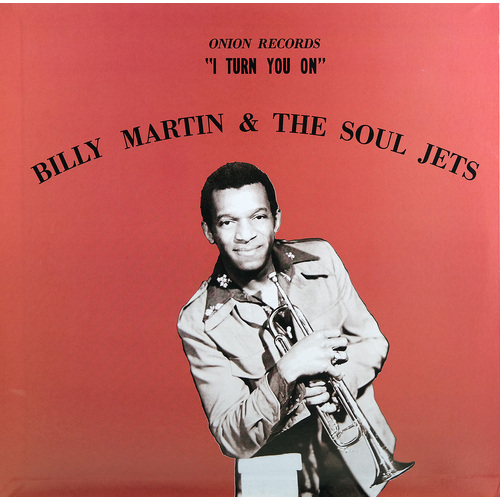
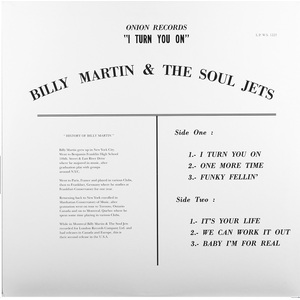
Martin’s later LP I Turn You On, released in the United States on Onion Records, continued in the same soul and funk direction. Credited to Billy Martin & The Soul Jets, the album included extended versions of ‘I Turn You On,’ ‘One More Time,’ ‘Funky Feelin’,’ ‘It’s Your Life,’ ‘We Can Work It Out’ and ‘Baby I’m For Real.’ Its back-cover biography repeats Martin’s New York, European and Canadian background, noting that while in Montreal, Billy Martin & The Soul Jets recorded for London Records Company Ltd. and had releases in Canada and Europe. The record also identifies Billy Martin as leader and trumpet player, confirming his role as the group’s central musical figure.
Because Martin’s name is shared by other artists, some discographical attributions require caution. A family note from Jeffrey Martin Bottjer clarifies that the Billy Martin / The Road Runners White Lightin’ record was recorded by Bottjer’s father on Long Island around 1974, and is not by the Montreal-based Billy Martin associated with London, Trans-World, Onion Records and The Soul Jets. That record should therefore be separated from this artist’s discography.
Billy Martin’s career remains only partly documented, but his surviving Canadian recordings show a musician who adapted quickly across changing Black popular styles. From early 1960s dance-band R&B to late 1960s and early 1970s funk, his records preserve the work of an American-born bandleader who made some of his most distinctive recordings in Canada. Doin’ Their Thing, Strawberry Soul and I Turn You On now stand as important Canadian funk and soul-jazz titles, closely tied to Montreal’s nightclub circuit and to a period when Black American and Canadian musicians were reshaping the sound of live R&B north of the border.
-Robert Williston
Gallery
Images
4 images
BillyMartin-LPCD-GRAPHICS-A_BACK
Billy Martin & The Soul Jets – I Turn You On
Billy Martin & The Soul Jets – I Turn You On
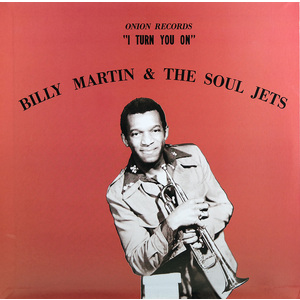
I Turn You On
Media
Videos
0 videos
No videos available for this title.
Credits
Musicians
Billy Martin: leader, trumpet
Billy Martin & The Soul Jets: performers
Songwriting
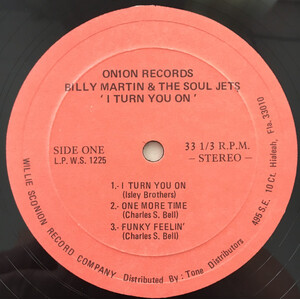
‘I Turn You On’ written by The Isley Brothers
‘One More Time’ written by Charles S. Bell
‘Funky Feelin'’ written by Charles S. Bell
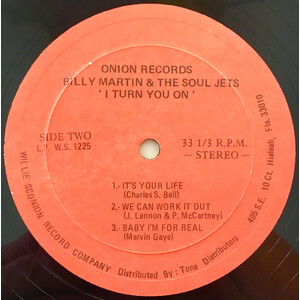
‘It's Your Life’ written by Charles S. Bell
‘We Can Work It Out’ written by John Lennon and Paul McCartney
‘Baby I'm For Real’ written by Marvin Gaye
Manufacturing and Distribution
Record company: Willie Sconion Record Company
Distributed by Tone Distributors Inc.
Onion Record Company
Distributed by Tone Distributions, 495 S.E. 10 Ct., Hialeah, Florida 33010
Notes
Onion Records L.P. W.S. 1225
Stereo
United States
33 1/3 RPM
No Comments