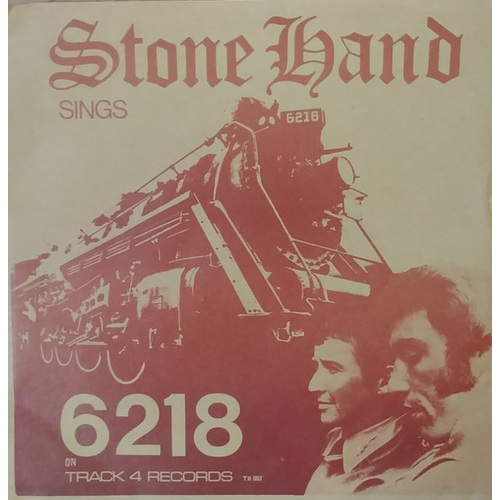
Album / Title
6218 b/w Song of Trains (picture sleeve)
By: Stone Hand
Origin: St. Thomas, Ontario, 🇨🇦
Insight
Stone Hand were a folk duo from St. Thomas, Ontario, formed in 1970 by singer-songwriters and guitarists Mike Mulhern and Don Mathers. Mulhern had studied voice for eight years and taught himself guitar before going out as a solo performer in late 1969. Mathers played guitar, banjo and harmonica, had studied piano and trumpet, and had sung with high school trios and a college duo.
The duo's best-known record began during Mulhern's solo year. Playing the York Hotel in London, Ontario, he met the proprietor, Ed Assaf, a railway enthusiast whose hotel carried paintings and memorabilia of Canadian steam locomotives. Mulhern sang his own 'Song of Trains' at the audition, and Assaf suggested the two of them write something about Canadian National 6218, the 4-8-4 that CN had brought back under steam in 1964 for excursion service.
They worked on the song over the following months. An early version was cut at Track 4 in London, the studio run by Walter Crasser, and after revisions it was recorded again. Crasser took on Mulhern's management and promotion, and it was during this stretch that Mathers came in and Stone Hand began.
'6218' and 'Song of Trains' went into the act right away. On January 24, 1971, the duo rode an Upper Canada Railway Society excursion from Toronto to Orillia, where a CBC crew filmed them for This Land. Both songs went out nationally on February 24 and again on July 14, ten days after 6218 made its final excursion runs. Stone Hand also appeared on CFPL-TV in London and on CBC-TV's The Performers.
Club dates ran through southwestern Ontario across 1971, with television work in London, At Random in January, auditions at Steele's Tavern in Toronto and the Playboy Club in Montreal, Talent Scope on April 3 and After Noon on April 5. Bookings carried the duo into eastern Canada and later into the United States.
'6218' backed with 'Song of Trains' was issued by Track 4 as TR-003, produced by Paul Mills. The Upper Canada Railway Society put the single in front of railway enthusiasts and offered copies with a Stone Hand poster of locomotive 6218. Billboard reported the release in August 1971 and returned to it later to note that the record was getting good reaction.
For CBC Radio Canada transcription disc LM 135, with a broadcast expiry of November 15, 1972, Stone Hand recorded four songs: 'Jane Street Song' and 'Mary Margaret Haggerty', both Mulhern's, 'Midnight Sunshine' by Mike Hasek, and 'Nova Scotia' by Sim Rushton. Rushton had come to Ontario from Springhill, Nova Scotia, and got to know the duo there, and 'Nova Scotia' stayed in their repertoire.
Five years on they were still recording for the CBC. LM 428, from 1976, carried four more Stone Hand performances: 'Headin' for the Bay', 'Today', 'The Auctioneer' and 'Katie'. The notes describe two musicians from St. Thomas who had been playing together for five years, in clubs across southern Ontario, eastern Canada and the United States, with numerous television appearances behind them. Mathers was by then a full-time musician, writing songs and playing guitar, while Mulhern wrote and performed alongside work as a newspaper columnist. Paul Mills produced the four sides in Toronto, with L. Morey engineering. The first three were uptempo numbers and 'Katie' a ballad.
Mulhern also recorded under his own name. Autumn's Come, issued in 1975 on his own Mulhern label as MUL 5001, held ten songs, among them a new reading of 'The Jane Street Song', with Johnny Noubarian of Celsius on keyboards. Mulhern's newspaper work continued alongside the music, later as a reporter and editor with the London Free Press.
-Robert Williston
6218, well-known as the number of CN's last active steam locomotives, now also the name of a song - a song which is produced by Track 4 Records of London, Ontario, and recorded by an up-and-coming Canadian folk-singing duo, the Stone Hand. The record is currently being made available to railfan clubs across North America (and is currently available from the UCRS) and is the result of a long train of events that began two years ago at the York Hotel in London. Ed Assaf, the hotel proprietor, and a long-time rail-buff, was auditioning a new singer for his Thursday night entertainment spot. The artist, one Mike Mulhern, performed a self-composition, "The Song of the Trains, " as one of his audition selections. Mr. Assaf liked the song and was pleased with the fact that Mike was interested enough in trains to write a song about them. This is when the idea to compose a song about 6218 was born. The locomotive, the last active steamer on CN, was a subject of interest to Assaf. His hotel, being directly across the street from the CN Tower in London, contained a number of oil paintings of famous Canadian steam locomotives, as well as a number of rail artifacts prominently displayed about the wall s o f the building. Mr. Assaf told Mulhern the story of the locomotive and suggested they collaborate on a song about the engine. A number of tunes and lyric ideas changed hands between the two over the next three months, and when the first draft of the song was completed, it was recorded at Track 4's studios, operated by Walter Crasser. Crasser subsequently became Mike' s manager and diehard promoter of the song. The initial recording of the song prompted the writers to initiate some changes in the structure of the song, and it was then completed in its present melodic form two weeks later. The song was again recorded at Track 4. Shortly after the take was completed, Mulhern teamed up with singer-guitarist Don Mathers to form what is now known as Stone Hand. Together they began performing and promoting the song "6218" along with Assaf and Crasser. Their promotion efforts have taken Stone Hand on the UCRS winter excursion of January 24, 1971, from Toronto to Orillia, where a film crew from the CBC television show "This Land" filmed the group and their song. The song and also "The Song of the Train " were broadcast on the "This Land" television show nationally on February 24, 1971 (and again on July 14). The song has also been performed on CFPL-TV in London, and article s on the song and the train have been published in newspapers throughout the country. The subject of the Stone Hand's song “6218” needs very little introduction to railfans. Although the recording may not help to keep the engine in operation, it is designed to preserve the memory of the locomotive, and in some way preserve the memory of steam. The flipside of the record is a beautiful treatment of the song that started it all "The Song of the Train". Stone Hand, themselves, have felt an affinity towards Canadian railways. Mulhern, as already mentioned, to the point of having already written a song about trains, and Don Mather s as a one-time employee of the railway. Mathers - guitarist, banjoist, harpist, and vocalist, has been doing musical things for most of his 23 years. He started with four years of pian o lessons, then two years of banjo, three years of trumpet, and five years of guitar. Along the way he sang with two high school trio s and one college duo. Mulhern, on the other hand, wanted to become a singer most of his life, but he let banking, soldiering, journalism and acting have their time in his life first. When he reached for the inevitable late i n 1969, he had eight years of vocal training and one year of self-taught guitar to press his claim. Si x months of working as a single precede d his alliance with Don and the beginning of Stone Hand. Stone Hand have, since their meeting, been appearing in many clubs and hotel s throughout Ontario, developing their act to the point of being the country' s most promising folk duo. They have appeared on CBC-TV's "The Performers", and numerous local television appearances promoting themselves and their song about 6218. This, combined with the release of the final recording of the song, produce d by well-known folksinger Pau l Mills, has established Stone Hand's reputation with not just rail - fans, but al l facet s o f the public, throughout Canada. To obtain a copy of Stone Hand's song about 6218 (flipside "The Song of the Train"), the Upper Canada Railway Society has a limited number of these records available. Send $1.19 (plus 58 Ontario Sales Tax) to UCRS Publications Sales Department, Box 122, Termina l A, Toronto 116, Ontario, and you r record will be mailed out promptly, along with an attractive 8-1/2" by 17" poster of Stone Hand with steam locomotive 6218.
Gallery
Images
10 images
View All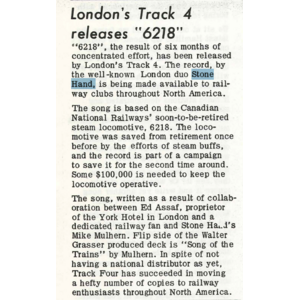
Stone Hand - RPM JuL 10, 1971
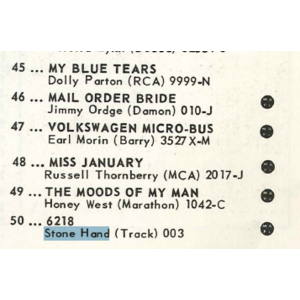
Stone Hand - RPM Aug 7, 1971
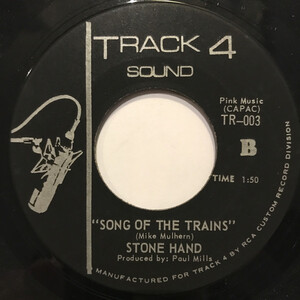
Stone Hand / 6218 b/w Song of Trains (picture sleeve)
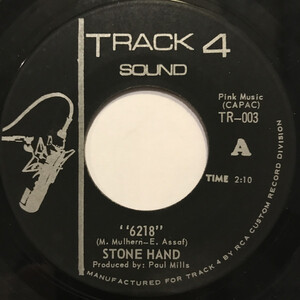
Stone Hand / 6218 b/w Song of Trains (picture sleeve)
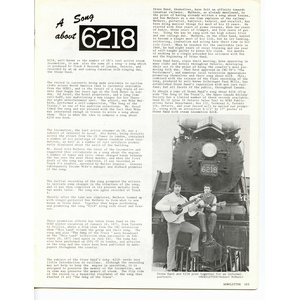
page 11 from Newsletter Upper Canada Railway Society July 1971 - The Retirement of 6218
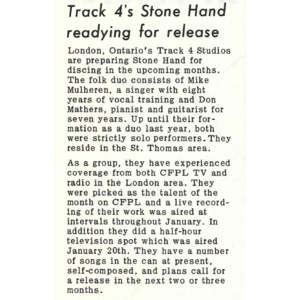
Stone Hand - RPM Jun 2, 1971
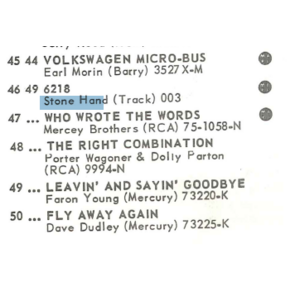
Stone Hand - RPM Aug 21, 1971
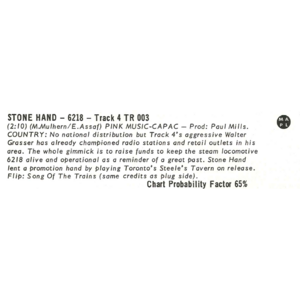
Stone Hand - RPM JuL 17, 1971
Media
Videos
0 videos
No videos available for this title.
Credits
In Transit
No Comments