Album / Title
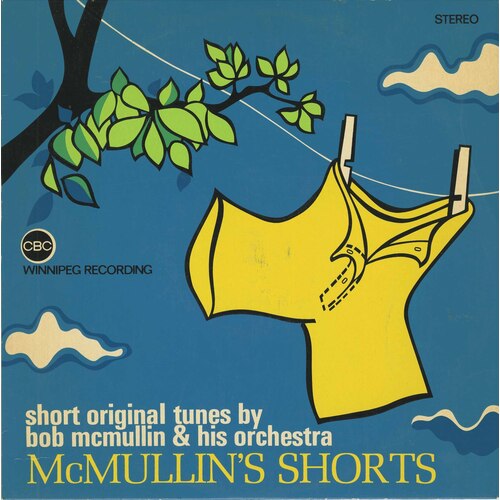
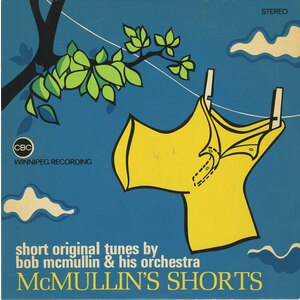
McMullin’s Shorts: Short Original Tunes By Bob McMullin & His Orchestra
By: Bob McMullin
Origin: Lewiston, Utah, 🇺🇸 → Raymond → Edmonton, Alberta → Winnipeg, Manitoba, 🇨🇦
Insight
Robert Wesley “Bob” McMullin was born on April 29, 1921, in Lewiston, Utah, where his father Wesley worked as a mechanic at the local sugar factory. The family’s roots were in Raymond, Alberta, where Wesley’s parents had settled in 1902, and when Bob was small the McMullins went back for good. His parents, Wes and Ruby, played in dance bands, sang in church choirs and acted in productions at the Raymond Opera House. Bob took one year of piano lessons in 1935 and never had another formal lesson. His older brother Nolan put him on drums in his dance band at age eleven, and travelling to dances across southern Alberta with the older players, he picked up clarinet, saxophone and trumpet. He learned to read music singing in the church choir and was writing arrangements for school concerts while still a boy. Friends and family called him Moon.
In January 1941 he left Raymond for Calgary to go to school and try out for a band. He got the job, and that summer, playing a dance engagement at Sylvan Lake, he met Joan Glover of Edmonton. They married on May 22, 1942, and within weeks Bob had enlisted in the Royal Canadian Air Force as a bandsman. Their daughter Patricia was born in November 1943. Posted overseas, McMullin rose from the ranks to share leadership of his band and was finally made conductor of the RCAF dance band the Modernaires, which played for Allied troops in England, France, Germany, Belgium and Holland. Off duty, he went to every concert and opera he could reach, following along in pocket study scores, and that was how he taught himself orchestration. Delius became his obsession. Homesick for the mountain lakes and streams of Waterton, where the family had spent its summers, he spent six months writing his first orchestral work, the Rocky Mountain Suite, in two movements, ‘The Swallow’s Nest’ and ‘Pass River’.
Discharged in Winnipeg in the summer of 1946, he sent the score to Harold Cluff, his old RCAF sergeant, who passed it to Sir Ernest MacMillan. MacMillan had the Toronto Symphony Orchestra read through it after a rehearsal at Massey Hall and asked for the orchestral parts. Retitled Sketches from the Rocky Mountains, the work premiered on a live CBC broadcast from Massey Hall on March 16, 1948, with its 26-year-old composer in the audience for the standing ovation. The Toronto Symphony recorded ‘Pass River’ for Radio Canada International in 1950, and the suite was later taken up by the Montreal Symphony and, with McMullin on the podium, the Edmonton Symphony.
By then he was a fixture at CBC Edmonton. Hired to play clarinet and trumpet in the station orchestra, he was conducting it for the network program Edmonton Marches On by March 1947. At night he played clarinet with the Bob McMullin Sextet at the Trocadero Ballroom and led a quartet at Chic’s Supper Club. When CBC opened its new Edmonton station, CBX, on September 8, 1948, McMullin wrote the arrangements for the inaugural broadcast. In December 1950 he, singer Jerry Forbes and producer Fred Diehl sent a demo called Linger Awhile to the CBC regional talent board in Winnipeg. It was picked up for the network, heard from British Columbia to Ontario, and in June 1952 renamed The Bob McMullin Show. The Edmonton Symphony commissioned his Essay for Orchestra, which premiered on January 26, 1954.
In 1955 the CBC moved him to its prairie headquarters in Winnipeg, and the city became home for the rest of his life. The Bob McMullin Show carried on from there into the 1960s. He arranged for the Royal Winnipeg Ballet with choreographer Paddy Stone and for the Winnipeg Winter Club’s ice revue, and in 1956 he composed and conducted the score for the Prairie Playhouse radio serialization of Frederick Philip Grove’s novel Our Daily Bread, the first of more than 70 radio dramas he would score. When CBWT launched the late-night variety show Club 41 in 1957, McMullin was its arranger and conductor. Through the 1960s his orchestra backed a run of Winnipeg-produced network series, among them The Peggy Neville Show, The Ed Evanko Show and Miriam Breitman’s summer show. He still found time for concert writing: Prairie Sketches, commissioned by the Ontario Music Educators’ Association for school orchestras, was premiered by the CBC Symphony Orchestra in April 1959.
As one of the most respected musicians on staff, McMullin could hire any player in town, and the one he hired most was a young guitar prodigy named Lenny Breau. Breau could not read music, so McMullin gave him his parts a day or two ahead of each session. He used him on hundreds of CBC dates, wrote showcases for him on his series A Touch of Jazz, and in time Breau learned to read. When the network built a summer series around Breau in 1966, The Lenny Breau Show, it was McMullin’s orchestra behind him.
The Guess Who came through the same door. McMullin was music director for the Winnipeg segments of the CBC teen shows Music Hop and Let’s Go and wrote out the charts for the house band every week. When the Guess Who auditioned for the job, freshly back and broke from a disastrous trip to England, Randy Bachman claimed the band could read. Two of them could. Bachman phoned McMullin a few days before the audition to ask how the charts were coming, McMullin kindly told him which songs he was writing up, and the band bought the records and learned every part by ear. They got the gig, and two years of weekly national television helped make them stars. In October 1968 McMullin brought the band together with the Winnipeg Symphony Orchestra under new music director George Cleve, arranging and conducting a program that included the whole of Sgt. Pepper’s Lonely Hearts Club Band, a medley of James Bond themes and Guess Who originals. Both nights sold out. Frank Morriss, the veteran critic who had little use for rock and roll, called the arrangements first rate. The symphony made McMullin a regular guest conductor, and in March 1974 he led its pops concert with Doc Severinsen, which featured his own Concerto for a Centennial. Severinsen promptly commissioned a trumpet concerto from him, asking for something too difficult for anyone else to play. McMullin worked on it for years, finishing the Concerto for Trumpet and Orchestra in 1979, and he considered it the best thing he ever wrote.
His most glamorous partnership began on the Winnipeg stage with the Italian-born tenor Enzo Stuarti, who sang the lead in The Pajama Game at Rainbow Stage in 1960 and afterward wanted McMullin conducting for him wherever he went. In the summer of 1963 McMullin led the Milt Shaw Orchestra behind Stuarti at the Persian Room of New York’s Plaza Hotel, where Variety singled out the singer’s Canadian maestro as one of his two best assets. That October he conducted a 30-piece orchestra for Stuarti’s debut at Carnegie Hall, an evening Jubilee Records set out to capture live, and Variety praised his command of the podium. The Winnipeg papers warned that McMullin would soon be lost to the east. He stayed. “The brain drain to the United States is a bad thing,” he told Canadian Composer in 1965. “It reduces our chances of arriving at a distinctive Canadian art form.”
His orchestral album for the Canadian Talent Library was recorded in Toronto on June 4, 1966, for the Canadian Talent Library, with CJOB and CJOB-FM in Winnipeg as sponsoring subscribers. Bob McMullin And His Music put him in front of eighteen of the best players in the country, Moe Koffman, Guido Basso, Rob McConnell and Peter Appleyard among them. McMullin arranged all thirteen selections, swinging big-band standards like ‘Flying Home’, ‘Begin The Beguine’ and ‘Cherokee’ alongside five originals recorded for the first time: ‘Cosmos’, ‘Jet Set’, the spy-craze send-up ‘The Woman From A.U.N.T.’, ‘Fanfare For Fourteen’ and ‘Sand Witch’. His CBC work went to disc as well, on recordings pressed for broadcast use: McMullin’s Shorts, made at CBC Winnipeg in 1971, and One-Minuters By McMullin, a set of short compositions written for the network. In 1976 his music appeared on the CBC compilation LM 432, and these broadcast discs survive today in the Museum of Canadian Music collection.
Film and television scoring was the work he loved most, and in the 1970s he finally got to do it on a national scale, dividing his time between Winnipeg and Toronto. He was music director for the CBC sitcom King of Kensington from its 1975 debut and wrote theme music and scores for House of Pride, The Collaborators and the police drama Sidestreet. His film credits include On the Edge of the Ice Pack (1972), Race Home to Die (1973) and The Shadow of the Hawk (1976), with Jan-Michael Vincent and Chief Dan George, along with the Winnipeg documentary Winterpeg and many others. He had firm views on the craft: “There is too much ‘composer’ in most of the dramas on the air today,” he said in 1976, arguing that a score should paint a picture that fits the action on screen. He also hosted the CBC classical program Encores with McMullin, where his tastes ran to Debussy and Ravel; he said he listened to any music for its colour before its melody. By 1976 he counted more than 300 original compositions and some 6,000 arrangements. From 1977 to 1984 he was music director of the CBC telecast of the du Maurier Search for Stars.
Through all of it, his summers belonged to Rainbow Stage, Winnipeg’s big outdoor theatre. He was its musical director by 1960, conducting The Pajama Game, Damn Yankees and Carousel that season on a budget that allowed two days of rehearsal with the orchestra, and he stayed for more than three decades: West Side Story, Oklahoma!, South Pacific, Hello, Dolly! and dozens more, backing Gordon MacRae, Anita Bryant, Shirley Harmer, Tommy Ambrose, Denny Vaughan and The Four Lads along the way. He also directed the University of Manitoba Glee Club’s musicals. For Rainbow Stage’s fortieth season in 1990 he assembled and arranged the revue Say It With Music. At 70 he was in the pit for A Funny Thing Happened on the Way to the Forum, and in 1994 he conducted Brigadoon.
The commissions kept coming late in his life. He wrote Colony Trek, a historical narrative for the Saskatoon Symphony, and a Fanfare for the Dallas Symphony, both in 1988; the dixieland medley That’s Jazz for the Ottawa Symphony; and in 1990 arrangements of ‘Roumenya’ and ‘Kolomeynka’ for the Winnipeg klezmer band Finjan with the Winnipeg Symphony. His Guess Who and Stampeders medleys went into the Imperial Oil McPeek Pops library, and his arrangements appeared on records by Ray St. Germain, Laurie Thain, Yaroslav Shur, Terry Smith, the Metro-Gnomes, Paul Grosney’s Kansas City Local and the St. Michael’s Cathedral Choir School. With CBC writer Ernie Mutimer he wrote the operetta Cannington Manners, which played in Weyburn, Saskatchewan.
Bob McMullin died suddenly in Regina on January 3, 1995, while visiting Saskatchewan. He was 73. Rainbow Stage veteran Cliff Gardner summed him up: “He was a gentleman and a gentle man.” In 2004 Rainbow Stage inducted him into its Wall of Fame.
-Robert Williston
Gallery
Images
4 images
Bob McMullin - McMullin’s Shorts: Short Original Tunes By Bob McMullin & His Orchestra
Bob McMullin And Orchestra-McMullen's Shorts LABEL 01
Bob McMullin And Orchestra-McMullen's Shorts LABEL 02
McMullin’s Shorts: Short Original Tunes By Bob McMullin & His Orchestra
Media
Videos
0 videos
No videos available for this title.
Credits
Musicians
Bob McMullin: orchestra leader
Lou Pollock: trumpet
Harry Ellsworth: trumpet
Paul Grosney: trumpet
Guy Cloutier: trombone
Dave Jandrisch: electric piano
Ron Halldorson: electric guitar
Dave Shaw: electric bass
Reg Kelln: drums
Songwriting
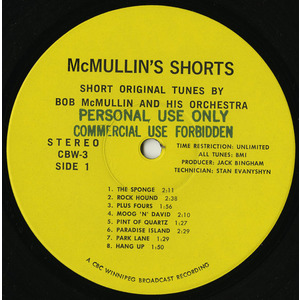
‘The Sponge’ written by Bob McMullin
‘Rock Hound’ written by Bob McMullin
‘Plus Fours’ written by Bob McMullin
‘Moog ’N’ David’ written by Bob McMullin
‘Pint Of Quartz’ written by Bob McMullin
‘Paradise Island’ written by Bob McMullin
‘Park Lane’ written by Bob McMullin
‘Hang Up’ written by Bob McMullin
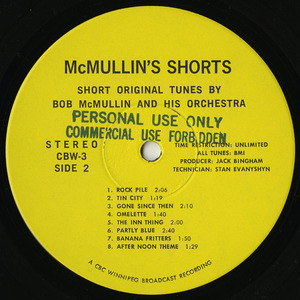
‘Rock Pile’ written by Bob McMullin
‘Tin City’ written by Bob McMullin
‘Gone Since Then’ written by Bob McMullin
‘Omelette’ written by Bob McMullin
‘The Inn Thing’ written by Bob McMullin
‘Partly Blue’ written by Bob McMullin
‘Banana Fritters’ written by Bob McMullin
‘After Noon Theme’ written by Bob McMullin
Production
Produced by Jack Bingham
Orchestra directed by Bob McMullin
Technical
Recorded at Century 21 Studios, Winnipeg, Manitoba, March 29–30, 1971
Technician: Stan Evanyshyn
Artwork
Cover design by Frank Mikuska
French translation by Claude Lavallée
Release
CBC
Recording dates: March 29–30, 1971
All compositions published by BMI (Canada) Ltd.
Original compositions written primarily for CBC Radio’s Winnipeg After Noon program
Liner notes
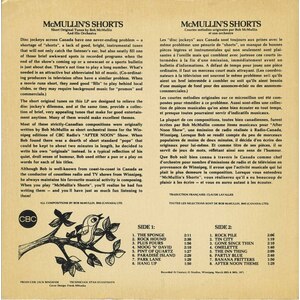
Disc jockeys across Canada have one never-ending problem – a shortage of “shorts”, a lack of good, bright, instrumental tunes that will not only catch the listener’s ear, but also neatly fill one of those brief awkward spots in recorded programs when the end of the show’s coming up or a newscast or a sports bulletin is just about due. There’s not time to play a long number. What’s needed is an attractive but abbreviated bit of music. (Co-ordinating producers in television often have a similar problem. When a movie runs short, they need good “fills” to play behind local slides, or they may require background music for “promos” and commercials.)
The short original tunes on this LP are designed to relieve the disc jockey’s dilemma, and at the same time, provide a collection of brief, very appealing tunes that make for good entertainment anytime. Many of them would make excellent themes.
Most of these strictly-Canadian compositions were originally written by Bob McMullin as short orchestral items for the Winnipeg editions of CBC Radio’s “AFTER NOON” Show. When Bob found there was a dearth of short standard “pops” that could be kept to about two minutes in length, he decided to write his own “originals” instead. In a typical reflection of his quiet, droll sense of humour, Bob used either a pun or a play on words for each of his titles.
Although Bob is well-known from coast-to-coast in Canada as the conductor of countless radio and TV shows from Winnipeg, he always maintains his favourite musical activity is composing. When you play “McMullin’s Shorts”, you’ll realize he had fun writing them – and you’ll have just as much fun listening to them!
ALL COMPOSITIONS BY BOB McMULLIN, BMI (CANADA) LTD.
FrenchMcMULLIN’S SHORTS Courtes mélodies originales par Bob McMullin et son orchestre
Les “disc jockeys” aux Canada sont toujours aux prises avec le même problème: une pénurie de “shorts”, un manque de bonnes pièces légères et instrumentales qui non seulement sont plaisantes à l’oreille mais qui comblent avec justesse ces courts intermèdes à la fin d’une émission, immédiatement avant un bulletin d’informations. A défaut de temps pour jouer une pièce ordinaire, il faut un morceau court mais attrayant. (Les coordonnateurs à la télévision ont souvent le même problème: soit qu’ils aient un bref intermède à combler ou soit qu’ils aient besoin d’une musique de fond pour des annonces-éclair ou des annonces-commerciales.)
Les courtes mélodies originales sur ce microsillon ont été composées pour remédier à ce problème. Aussi sont-elles une collection de pièces musicales qu’on aime bien écouter en tout temps, et presque toutes pourraient servir d’indicatifs musicaux.
La plupart de ces compositions, toutes bien canadiennes, furent écrites par Bob McMullin comme items musicaux pour “After Noon Show”, une émission de radio réalisée à Radio-Canada, Winnipeg. Lorsque Bob se rendit compte du peu de morceaux populaires de moins de deux minutes, il décida d’en écrire des originaux pour lui-même. Et comme titre de ses pièces, il se servit de jeux de mots, reflétant ainsi son sens de l’humour.
Que Bob soit bien connu à travers le Canada comme chef d’orchestre pour nombre d’émissions de radio et de télévision en provenance de Winnipeg, il avoue que l’activité musicale qui lui plait le plus demeure la composition. Lorsque vous entendrez “McMullin’s Shorts”, vous réaliserez qu’il a eu beaucoup de plaisir à les écrire – et vous en aurez autant à les écouter.
TRADUCTION FRANÇAISE: CLAUDE LAVALLEE
TOUTES LES SELECTIONS SONT DE BOB McMULLIN, BMI (CANADA) LTEE.
No Comments