Insight
The Munks came out of the teenage dance and club scene in Montreal in the early 1960s. Rick St. Jean, Tagg Hindsgaul and René Boileau had begun playing together by 1963, working Saturday-night dances at a local elementary school and Friday nights at a community centre. St. Jean remembers earning about $150 a night, substantial money for teenagers at the time, with his father driving the group and looking after them before they had professional management.
The group had earlier used the name Rivieras 4 and eventually became the Exit 4. Drummer Eddy Kaye was not there at the very beginning. He had been playing with a high-school band when he was approached after the group’s previous drummer left. What caught his attention was that these young musicians were already making recordings.
“They actually had gone out and they had done a little demo recording,” Kaye recalled in 2026. “I thought, wow... these guys were recording. They seemed quite ambitious.”
Kaye joined, and the lineup of St. Jean, Hindsgaul, Boileau and Kaye soon moved beyond school dances and local jobs. St. Jean remembers photographer Johnny O’Neill playing an important part in what happened next. O’Neill regularly photographed groups connected with Montreal manager Ben Kaye and had been asked to alert him when he encountered a band worth hearing. After photographing the young group, he passed the word along.
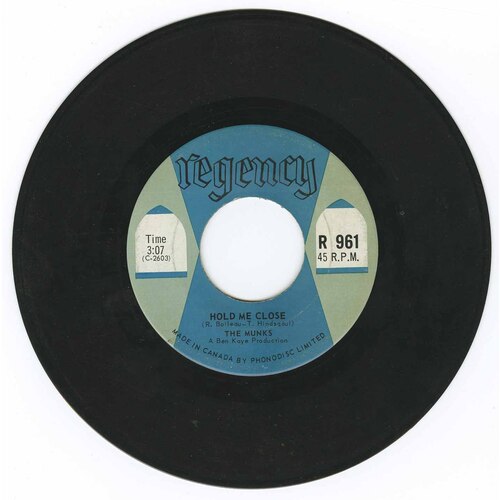
St. Jean’s father met with Kaye before turning management over to him. Kaye also became involved with the group’s publishing, and in 1965 the Exit 4 entered Stereo Sound Studios to record two original songs, ‘Hold Me Close’ and ‘Please Come Back Marie’.
“We’re in a studio for the first time. We’re nervous as hell,” St. Jean remembered. “And we’re doing our own songs.” He was seventeen or eighteen at the time and remembers roughly 500 copies being pressed for the local market. “That was something else, to be a recording group at that time in the city, because it set us aside from every other band that was in Montreal.”
Regency Records released the single as R 961 in 1965 under the name Exit 4, with ‘Hold Me Close’ and ‘Please Come Back Marie’. The surviving Regency discography confirms the Exit 4 credit; no second commercial pressing under the Munks name has yet been verified.
The change to the Munks gave the band something else that made them difficult to forget. Montreal groups of the period often worked with a visual gimmick. Les Classels appeared in white suits with white hair, César et les Romains dressed as Romans, and other francophone groups developed equally recognizable stage identities. St. Jean remembers the Munks as the only English-language Montreal group doing anything comparable.
They dressed as monks.
The costumes were made by a woman St. Jean’s mother knew. They were heavy robes with hoods, and the group would sometimes begin a performance without revealing their faces.
“We used to come on with the hoods up,” St. Jean recalled. At one show in Cornwall, the crowd began screaming before the group had even removed them. “When we’d take the hoods off, people went crazy. It worked. That gimmick worked.”
There was a price for the effect. The robes were made of heavy material and were brutally hot under stage lights. “We sweat like crazy in these things. It was nuts.”
The Munks began building a following outside the dance halls as well. Eddy Kaye remembers the band appearing two or three times on CFCF-TV’s Like Young, an important showcase for young Montreal performers. “We got some kind of local notoriety,” he recalled. “The records here and there and local teen shows on TV... people got to know us.”
One of their stranger brushes with a major international act came when the Munks were booked as one of several local groups connected with a Rolling Stones show at the Montreal Forum. Kaye remembers being specifically told that the band should not bring its instruments because equipment would be supplied. They arrived to discover that no equipment had been provided for the local groups, while the Rolling Stones understandably were not about to hand over their own gear. The Munks never played. Kaye remembers the confusion backstage and the frustration of being booked for a major show without being given the means to get onstage. The Rolling Stones appeared at the Montreal Forum on October 29, 1965.
In 1966 the Munks recorded the single that has lasted longest in the memory of collectors and listeners. Columbia C4-2688 paired ‘Long Time Waiting’, written by Tagg Hindsgaul and René Boileau, with ‘Heartaches Over My Head’, written by Hindsgaul, Boileau and St. Jean. Ben Kaye produced the session.
St. Jean sang lead and remembers ‘Long Time Waiting’ as a particularly demanding performance.
“‘Long Time Waiting’ was about as hard a song as I ever sang,” he said. “It was a lot of work, that one.” He also understands why the song has endured. “It seems to be the one that people like the most too. It’s really a driving tune.”
At the time, however, he thought the other side might be the record that broke the band.
“I thought ‘Heartaches Over My Head’ should have been a big hit. I thought, oh geez, when we release that, that’s gonna be a monster hit. I have always liked that song.”
The records were only part of their development. The Munks were working constantly, sometimes taking week-long engagements in Montreal bars. St. Jean remembers playing the Scandinavian Club from Tuesday through Sunday, with multiple 45-minute sets each night. Musicians from other Montreal groups, including members of J.B. and the Playboys, would come to hear them. The workload was demanding, but it did what constant live performance often did for young bands of the period: it made them tight.
Their next English-language single, London M 17357, appeared in 1967. ‘Make It Or Break It’ and ‘Fancy Free’ were both written by René Boileau and produced by Allan Nicholls and Bill Hill of J.B. and the Playboys. By then Boileau was playing keyboards, Del Desrosiers had joined on bass, and the Munks had expanded to five members.
St. Jean sang lead on the Munks recordings and especially remembers ‘Make It Or Break It’ for the music that was feeding into the group by then.
“It’s got a real R&B feel to it,” he said. “It’s from that era of R&B tunes, and the way it’s produced and the different parts, it’s pretty good.”
R&B had been part of the band’s live repertoire from early on. St. Jean grew up hearing Ray Charles alongside his father’s big-band records and later absorbed soul and rhythm and blues as deeply as rock and roll. The Munks played Four Tops material and other R&B covers alongside rock songs and their originals. That mixture helps explain why their records do not sit neatly inside the garage-rock label that was later attached to them.
In the summer of 1967, the Munks were part of Expo 67’s Action Time program. Billboard announced them for the August 20 to 26 run, placing the group among a long list of Canadian acts brought into Expo during the six-month event, including the Haunted, the Guess Who, the Stampeders, the Ugly Ducklings, the Rabble, Our Generation and J.B. and the Playboys.
Kaye also remembers the Munks being chosen from a field of local bands to open a Montreal concert for Paul Revere and the Raiders. For a group that had spent years sweating through monk robes while most of the English bands around them wore conventional stage clothes, there was a certain symmetry in sharing a show with an American act that had built its own unmistakable visual identity.
The group also recorded in French. In 1968, Les Munks released ‘Avancez en arrière’ b/w ‘O-o je taime’ on Phonodisque PH 312. ‘Avancez en arrière’ was written by René Boileau, while ‘O-o je taime’ was credited to B. Miller and G. Legault. Paul Martineau produced the single. Kaye remembers playing on four Munks singles altogether and specifically recalls the last of them being the French-language release.
The Munks changed considerably during 1968. That summer Lorraine Nied, later known as Lorri Zimmerman, joined as lead vocalist and the act was billed as The Munks featuring Sweet Lorraine. An RPM profile from November 1968 identified the group as Lorraine Nied with Tagg Hindsgaul on lead guitar, René Boileau on organ, John Nicole on drums and Del Desrosiers on bass. Their repertoire had broadened to include folk rock, rhythm and blues, ballads and sing-along material while retaining the dance-oriented side of the band.
The distinction between Lorraine Nied and Franki Hart is important. Both women moved through overlapping Montreal music circles and both appeared in the history of groups connected with the Munks, but they were separate singers. Nied was included on RCA Camden’s 1967 The Best Of Like Young, while Franki Hart’s group Les Siroccio appeared separately on the same album. Nied became Sweet Lorraine with the Munks in 1968. Hart entered the Munks story later, through the musicians who eventually became Freedom North.
The Sweet Lorraine lineup was managed and booked by Donald K Donald Productions. In late 1968 the group was working at André Perry Studios with writer-producer Neil Sheppard on a planned record release. RPM reported the sessions in November, although no issued Munks record from them has yet been identified.
The personnel continued to change. In January 1969 RPM reported that the Munks, still fronted by Sweet Lorraine, had appointed J.P. Lauzon as lead guitarist. Nied soon moved into Life, another Montreal group working with Neil Sheppard, and the Sweet Lorraine period of the Munks came to an end.
Rick St. Jean and Eddy Kaye were not finished working together.
Kaye remembers that after the earlier group separated, an opportunity arose in Morin Heights. The musicians rented an old vacant three-storey building that was still habitable and used it as a place to live, rehearse and put a band back together. St. Jean, Kaye, René Boileau and Del Desrosiers began playing there, and Kaye remembers them initially continuing to use the Munks name.
The music had changed. St. Jean remembers the re-formed band playing Blood, Sweat & Tears material, including music from the Al Kooper period, along with songs such as ‘Aquarius’. They were not relying on the old Munks originals. They were working toward something new.
Kaye remembers the next step clearly. The group decided that adding a female singer would strengthen the act, and Franki Hart came into the rehearsals. Even then, he remembers them still using the Munks name.
“We needed a female singer. This would really spice up our act, beef up our act,” Kaye recalled. “Frankie Hart came along.”
According to Kaye, the decisive change came with guitarist Bill Hill.
“We still stayed the Munks. It was only until Bill Hill came into the group as the lead guitarist that we evolved into Freedom.”
St. Jean, Kaye, Hart and Hill formed the core of the new group. Boileau and Desrosiers were part of its early development before leaving, with Les Leroux taking over on bass for the recordings. The name Freedom soon became Freedom North, and in 1970 the band released the first album on the newly established Aquarius Records.
For St. Jean and Kaye, Freedom North did not begin with a chance meeting in 1970. By then they had already spent years together in Montreal, moving from teenage dances to television, recording studios, club residencies, Expo 67 and the changing sound of the Munks before starting again in Morin Heights.
-Robert Williston
Gallery
Images
2 images
Munks - Hold Me Close b/w Please Come Back Marie
Hold Me Close b/w Please Come Back Marie
Media
Videos
0 videos
No videos available for this title.
Credits
Musicians
Rick St. Jean: rhythm guitar, lead vocals
Tagg Hindsgaul: lead guitar, vocals
René Boileau: bass, vocals
Eddy Kaye: drums
Songwriting
‘Hold Me Close’ written by René Boileau and Tagg Hindsgaul
‘Please Come Back Marie’ written by René Boileau and Tagg Hindsgaul
Production
Produced by Ben Kaye
Recorded at Stereo Sound Studios, Montreal, Quebec
Release
45 RPM single
Made in Canada by Phonodisc Limited
No Comments