Insight
Hailing from Meat Cove on the northern edge of Cape Breton Island, Dry Heeves conceived of themselves not as a conventional band but as cultural analysts, using electronic music as their dissemination medium of choice. Under the direction of C. MacDonald and J. D. MacNeil, the project unfolded over decades as a deliberately wide-ranging body of work that resisted genre boundaries, conventional formats, and traditional models of distribution.
Stylistically, Dry Heeves operated through collision rather than continuity. Their recordings move freely between rock, pop, tribal structures, folk elements, metal, ambient, noise, and full-scale electronica, often blending these forms in ways that are intentionally disorienting. As one contemporary reviewer observed:
“The Dry Heeves take musical bits from cultures around the world, and try to find ways to put them together in which no one else would. Some tracks are intended to be pure silliness, but others take on a more serious feel and attempt to make strong statements. It gives a breadth and depth to what they are doing in an experimental genre that is often overlooked.”
— Laura B., Sublevel 203
That balance between absurdity and seriousness sits at the core of the group’s output. Their own description framed the experience in similarly direct terms: their “meditatively eccentric compositions can be overwhelming at first, but once assimilated, they become invigorating, cleansing, genuinely hilarious and frequently gratifying,” taking listeners on “a bizarre journey that is laughable, disturbing, and strange.”
From the outset, Dry Heeves exercised careful control over both their artistic intent and how their work circulated. Their first vinyl release, the 7-inch single ‘Maggie’ b/w ‘LSD’ (Plot 002, 1986), exemplified this approach. Both tracks were recorded on 8-track reel-to-reel and mixed down to a 2-track stereo master on high-quality VHS tape, a common practice at the time. Those masters were later misplaced, leaving only a second-generation chrome cassette duplicate made in 1986 as the surviving audio source.
Pressed in a run of 500 copies, only about half of the singles ever reached record stores, radio stations, and magazines; the remainder were accidentally discarded following a basement flood at the original drummer’s home, despite being largely undamaged. Even so, the single achieved notable underground exposure, reaching #1 on CKLN-FM and #2 on WFMU-FM, receiving airplay on CBC programs Brave New Waves and Nightlines, and surfacing on radio in the Netherlands and Switzerland.
The single is also notable for the history of its picture sleeve. Due to the high cost of colour printing, early copies were issued with a photocopied black-and-white sleeve. A hand-added red circle and diagonal slash was later applied to emphasize the band’s explicit opposition to fascist and Nazi ideology, an approach the group likened to the intent behind the Dead Kennedys’ ‘Nazi Punks Fuck Off’. A small number of unfinished sleeves—estimated by the band at fewer than twenty copies—were accidentally distributed before being recovered and replaced. Subsequent pressings used a fully redesigned sleeve that removed the imagery altogether, and many radio copies were issued with no picture sleeve at all.
Across the following decades, Dry Heeves assembled an extensive catalogue that ultimately totalled nineteen albums and one single, much of it released through their own VVVU Music imprint or via early net-distribution platforms. Long before digital self-release became commonplace, the group distinguished between commercial titles, donation-only projects, and free net-albums, carefully clarifying the intent behind each.
In September 2002, Dry Heeves issued the full-length album Mockba Rockba, a release made available exclusively in Russia. This was followed in January 2003 by Everything’s Gone Pseudo, which marked a broader international release and received significant airplay outside Canada. Releases such as …And I’ll Call Rusty articulated the group’s philosophy most directly, presenting work that could feel overwhelming on first encounter but proved invigorating, humorous, and rewarding once absorbed on its own terms.
The project’s reach extended well beyond its Cape Breton origins. While the 1986 single ‘Maggie’ b/w ‘LSD’ received airplay in the Netherlands and Switzerland, later releases circulated even more widely. By the early 2000s, Dry Heeves’ recordings were receiving airplay in Iceland, South Africa, France, Macedonia, Germany, Luxembourg, Australia, and Switzerland—often without the band actively promoting the material overseas.
In September 2004, their track ‘Seasonal Séance’ was selected for inclusion in the feature film Siblings, directed by David Weaver. Around the same period, the project engaged in a series of remix and collaboration activities, including work associated with topon das, reflecting both their stylistic flexibility and their engagement with broader experimental and electronic networks.
Dry Heeves were also among the earliest artists to formally affiliate with the Museum of Canadian Music, discovering the site independently and working directly with its founder to ensure their catalogue, artwork, and contextual notes were represented accurately.
Treating music as analysis rather than product, Dry Heeves embraced humour, discomfort, contradiction, and experimentation as tools for examining culture itself. The result is one of the most distinctive and deliberately constructed bodies of experimental work to emerge from Canada, shaped as much by intent and ideas as by sound.
-Robert Williston
Songwriting
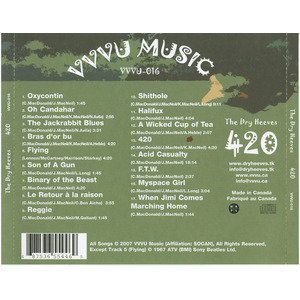
All songs written by C. MacDonald and J. MacNeil, except where noted.
Oxycontin – C. MacDonald, J. MacNeil
Oh Candahar – C. MacDonald, J. MacNeil, K. MacNeil, N. Avila
The Jackrabbit Blues – C. MacDonald, J. MacNeil, N. Avila
Bras d’or bu – C. MacDonald, J. MacNeil, K. MacNeil, A. Heble
Flying – Lennon, McCartney, Harrison, Starkey
Son of A Gun – C. MacDonald, J. MacNeil, L. Long
Binary of the Beast – C. MacDonald, J. MacNeil
Le Retour à la raison – C. MacDonald, J. MacNeil, C. Ben Aicha
Reggie – C. MacDonald, J. MacNeil, M. Gallant
Shithole – C. MacDonald, J. MacNeil, K. MacNeil, L. Long
Halifax – C. MacDonald, J. MacNeil
A Wicked Cup of Tea – C. MacDonald, J. MacNeil, A. Heble
420 – C. MacDonald, J. MacNeil, K. MacNeil
Acid Casualty – C. MacDonald, J. MacNeil
F.T.W. – C. MacDonald, J. MacNeil
Myspace Girl – C. MacDonald, J. MacNeil, L. Long
When Jimi Comes Marching Home – C. MacDonald, J. MacNeil
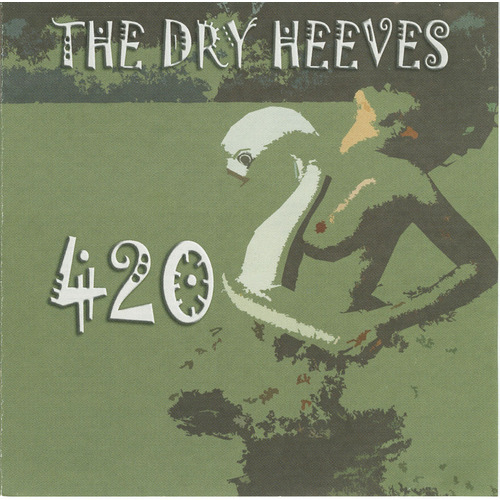
The Dry Heeves' album may be the most diverse, yet linear, album of all time. Or at least the most diverse album to come out of Meat Cove, Cape Breton. The album is 17 tracks of hard-ass dirt rock, piss and punch punk rock, and a few classic covers.
The Dry Heeves have managed to create a serious masterpiece of impressive music. The band is trying to make a strong social comment with 420....Song names like "Oxycontin," which is the source of a growing drug problem in Cape Breton, "F.T.W." (Fuck The World), which is mostly made up of incoherent cursing a pirate would admire, and "Son of a Gun," in which the band calls the Bush family a "killing machine," show that these experimentalists have something to say.
I don't think you have to be stoned to enjoy 420. Just be prepared to be blown away.
-Nick Khattar
Dalhousie Gazette (November 22, 2007)
I can tell by listening to this CD that the band has seen their fair share of garages and crowded bars. "Oh Candahar" is a brilliant, gritty song that exposes the ugly truth. This is obviously a band who are not afraid to say how they feel. The whole CD is full of great musicianship, tight playing, excellent vocals and strong lyrics. Anjali Heble provides memorable vocals on "Bras d'or bu". "Son Of A Gun" continues with the band's political awareness, and it does so with sincerity. "Reggie" is terribly original, and "Myspace Girl" is freakin' hilarious. There are many very good instrumentals on here as well. I love how this album never repeats itself. It is refreshingly varied and off the wall. Highly recommended.
-Gary Flanagan
Nightwaves (October 2007)
Gallery
Images
4 images
CD-Dry Heeves - 420 INLAY
CD-Dry Heeves - 420 INSIDE
CD-Dry Heeves - 420 CD
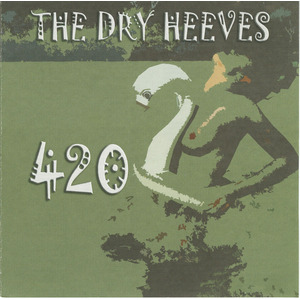
420
Media
Videos
0 videos
No videos available for this title.
Credits
In Transit
No Comments