Information/Write-up
Le Cardan were a Montreal-based rock group active between 1967 and 1970, whose brief but ambitious career reflected the rapid transformation of Quebec’s youth music scene in the late 1960s. Rooted in blues, British rock, and emerging psychedelia, the band moved quickly from amateur beginnings to international exposure, driven by strong songwriting instincts and a willingness to test themselves well beyond local stages.
The group’s origins trace back to circa 1965, when the members first crossed paths at a jam session in Mont-Laurier, Quebec. At the time, they were still amateurs, drawn together by a shared fascination with the new wave of British and American rock that was reshaping popular music. Performing under the fanciful early name Kaleidoscope, they began playing dances and small halls in suburban Quebec, honing their sound through covers of contemporary hits by The Beatles, Jimi Hendrix, and other leading figures of the era.
Their momentum accelerated dramatically in 1967, when Kaleidoscope—by then operating more confidently as a serious rock unit—earned a coveted performance slot at Expo 67, appearing at the Pavillon de la Jeunesse. Expo’s international atmosphere proved formative, exposing the group to a wide range of styles and confirming that a distinctly Quebec rock band could compete on a much larger cultural stage.
It was during this period that the group adopted the name Le Cardan, a technical term referring to a universal joint (gimbal)—a subtle but telling choice that suggested both mechanical precision and freedom of movement. The new name marked a shift away from youthful psychedelia toward a more grounded identity, emphasizing musicianship, original material, and collective purpose.
Le Cardan’s ambitions extended beyond Canada. In January 1968, the band traveled to San Juan, Puerto Rico, where they performed alongside a dozen international groups at a major youth gala held in the city’s vast municipal stadium. For a Quebec rock band still early in its career, the appearance was a rare and significant opportunity, underscoring how quickly they had progressed from regional dances to international events.
The group’s core lineup remained stable throughout its active years. Gilbert Bourgeois (Mont-Laurier) and Richard Emond (Montreal) shared front-line duties as singers, guitarists, and songwriters, providing Le Cardan with a strong dual-writer dynamic. Denis Soucy (Mont-Laurier) anchored the band on bass while also contributing vocals, while his brother Michel “Michou” Soucy supplied swirling organ textures that aligned the band with the psychedelic currents of the time. On drums, Guy Rhéaume (Quebec City) brought both drive and discipline, also taking on recording duties during the group’s studio work.
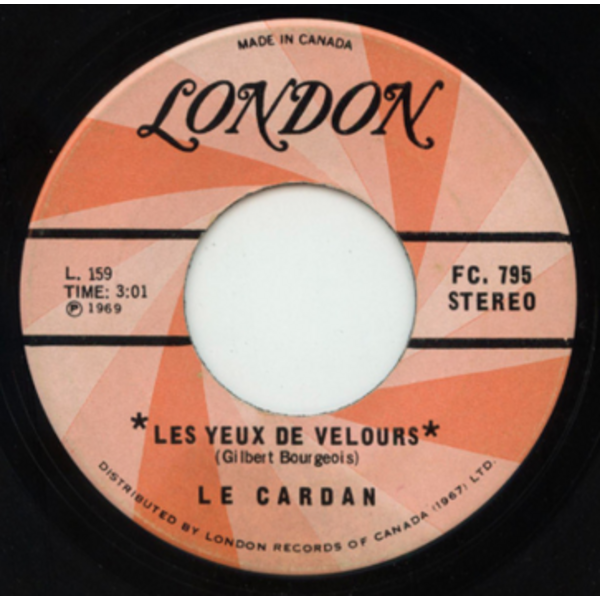
Le Cardan’s recorded legacy is modest but telling. In February 1969, the band released the single ‘La Reine Et Le Roi’ backed with ‘Le Sommeil Du Soldat’ on RCA Victor Canada, recorded at Studios André Perry. Both songs were written by Bourgeois and showcased a mature, French-language rock approach that balanced melodic sensibility with darker lyrical undertones—particularly notable at a time when many Quebec groups were still navigating the transition from English-language covers to original French material.
Though Le Cardan did not survive beyond the turn of the 1970s, their trajectory encapsulates a critical moment in Quebec rock history: the leap from amateur experimentation to professional ambition, from local halls to Expo stages and international festivals. Today, they stand as a concise but compelling example of how Quebec musicians absorbed global rock influences while forging an identity rooted in language, place, and the restless energy of the late 1960s.
-Robert Williston
(thanks to Mondo PQ for pics and tracks)
Musicians
Gilbert Bourgeois: guitar
Richard Emond: guitar
Michel Soucy: organ
Denis Soucy: bass
Guy Rhéaume: drums
No Comments