Insight
Honey West was a Canadian country singer whose recording and touring career placed her among the most active women in Ontario country music during the late 1960s and 1970s. Born Merla Arlene West on September 5, 1939, in the Grafton-Cobourg area of Ontario, she began singing at an early age and later performed with local bands around her hometown. Believing Toronto would offer greater opportunities, she moved into the city’s country-club circuit, where she became a familiar presence in local nightspots. She adopted the stage name Honey West, reportedly inspired by the popular television detective character of the same name.
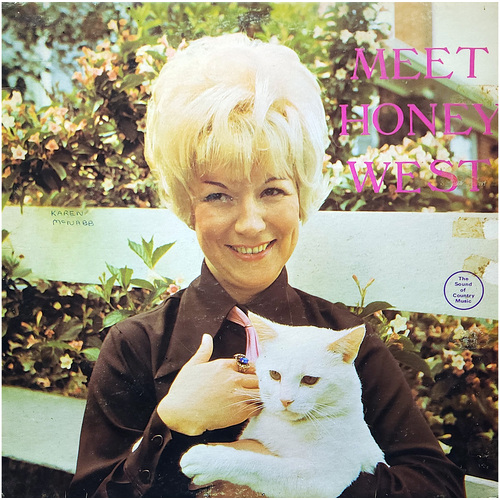
Before concentrating fully on music, West worked in the airline industry, including employment as a ticket agent. Her early professional appearances were made with several Toronto-area groups, but she eventually became the featured singer with Billy Martyn and the Country Boys. The group accompanied her on her first LP, Meet Honey West, released by Paragon in 1968.
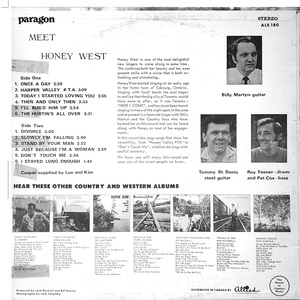
The album introduced West through a programme of country standards of the day, including material associated with major Nashville writers and performers. Billy Martyn played guitar, Tommy St. Denis played steel guitar, Roy Feener handled drums and Pat Cox played bass. The record established the approach that would characterize much of West’s early catalogue: current country material interpreted by a Canadian singer with a regular working band.
Her second album, A Touch of Honey, continued that direction while also introducing her as a songwriter. The opening selection, ‘A Country Lady,’ was written by West with steel guitarist Tommy St. Denis. The album otherwise drew largely from contemporary country repertoire. Billy Martyn and Tommy St. Denis again appeared, joined by bassist E.J. McDonald and drummer John Green. Jack Boswell and Bill Bessey produced the record.
A third Paragon LP, Sweet Dreams, followed before West achieved her first significant national recognition. Her steady recording schedule during this period made her one of the more prolific Canadian country singers working through independent labels.
West’s breakthrough came in 1971 with ‘The Moods of My Man,’ written by Canadian songwriter Arlene Gordon. The song became a Canadian country hit and provided the title of her fourth album. West received a gold plaque from CFGM radio in recognition of the single, an event later recalled in the liner notes to her next LP.
The Moods of My Man combined contemporary country material with songs by Canadian writers including Gene MacLellan and Gene Crysler. The album’s balance of familiar repertoire and Canadian compositions reflected West’s increasing role in promoting domestic songwriters.
By this time, West was fronting her own touring revue, the Honey West Show. Rather than functioning as a conventional singer with anonymous accompaniment, she led a self-contained stage act capable of moving between country, folk, rock and middle-of-the-road material. Musicians associated with the show included Wayne Rostad, Al Brisco, Terry Morin and Claude Damphous, with the group noted for its instrumental variety and multi-part vocal harmonies.
West toured Ontario extensively, appearing in hotels, clubs and country-music venues throughout the province. Contemporary reports described successful engagements and capacity audiences, while her growing profile also brought radio interviews, television appearances and promotional trips connected with the Canadian country industry.
Her momentum continued with the 1972 album Country Soul. The title song, written by Arlene Gordon and Lynn Jones, became West’s strongest documented chart success, reaching No. 12 on the RPM country chart.
The album marked an important shift toward Canadian-written material. In addition to the title track, it included songs by Doug Thomson, Dave Peever, Terry Carisse and Bruce Rawlins, Wayne Rostad and Bill Johnson. Gordon Lightfoot’s ‘Cotton Jenny’ was another notable Canadian selection.
The original liner notes portray Country Soul as the result of an exhausting schedule of radio promotion, television taping, club performances and overnight studio sessions. They also identify it as West’s fifth album and emphasize the prominence of Canadian composers within its programme.
During this period, Wayne Rostad was featured as a singer in West’s group. A 1972 engagement at the Trophy Room of Toronto’s Beverly Hills Motor Hotel was promoted under both their names, reflecting Rostad’s growing role within the act. West’s repertoire by then crossed comfortably between country and pop while retaining a strong Canadian songwriting component.
West also recorded a duet album with Canadian country singer Joe Firth. Released in 1972 as Getting Together, the record combined established country duets with several songs by Gene Crysler, including ‘Thank God We Got a Door,’ ‘The Way That I Love You,’ ‘What’s in Our Hearts,’ ‘They Stole the Dice’ and ‘Hold It Up to the Sun.’
A seasonal album, Silver Bells, also appeared in 1972, expanding West’s catalogue beyond her regular country releases. This brought her recorded output to several LPs within only a few years, an unusually sustained pace for a Canadian country artist working through independent labels.
Her 1973 album In the Shadows of the Past again placed Canadian compositions alongside current Nashville material. The title song was written by Fred Coupland, while the album also featured works by Gene Crysler, Ross Adam, Dallas Harms and Roy Payne.
‘His Coloured Television,’ written by Payne, became one of the most heavily promoted songs from this phase of her career. West travelled to Wheeling, West Virginia, to appear at Jamboree U.S.A., where she introduced the song to the American market. The appearance demonstrated that Marathon Music was attempting to extend her reach beyond Canada and that West had progressed well beyond the local Toronto club circuit.
Her recordings were regularly supported by Canadian radio and television exposure. West appeared on country programmes produced in different parts of Canada and continued touring with her own musicians. Later in the decade, she reportedly appeared on Canadian shows with established American country performers including Minnie Pearl, Bill Anderson and Stonewall Jackson.
West’s groups also provided an early professional setting for musicians who later developed substantial careers of their own. Wayne Rostad became a successful singer, songwriter and broadcaster, while steel guitarist Al Brisco became one of Canada’s most respected country instrumentalists. Guitarist Steve Piticco was also reportedly associated with a later version of her touring group.
Although her principal LP catalogue ended in the early 1970s, West continued recording. In 1976, she released the Condor single ‘I’m a Person Too’ / ‘Hurt Me Again.’ ‘I’m a Person Too’ entered the RPM country listings that year, extending her chart activity beyond the Marathon period.
Her known catalogue includes seven solo studio albums, the duet album with Joe Firth, a Christmas release and a substantial group of singles issued through Paragon, Marathon and Condor. Her best-known recordings include ‘The Moods of My Man,’ ‘Country Soul,’ ‘His Coloured Television,’ ‘The Locket’ and ‘I’m a Person Too.’
In 2003, West revisited her recording career with the 18-song retrospective I’ve Come Home. The collection helped preserve material from a career that had unfolded largely through independent Canadian labels and regional country-music networks.
Honey West’s importance rests not only on the size of her catalogue but on the working career behind it. She recorded consistently, led her own touring show, appeared on radio and television, crossed into the United States through Jamboree U.S.A. and gave considerable exposure to Canadian writers and musicians.
-Robert Williston
Gallery
Images
3 images
Honey West – Meet Honey West BACK
Honey West – Meet Honey West LABELS
Meet Honey West
Media
Videos
0 videos
No videos available for this title.
Credits
Musicians
Honey West: lead vocals
Billy Martyn: guitar
Tommy St. Denis: steel guitar
Roy Feener: drums
Pat Cox: bass
Songwriting
‘Once a Day’ written by Bill Anderson
‘Harper Valley P.T.A.’ written by Tom T. Hall
‘Today I Started Loving You’ written by Merle Haggard and Bonnie Owens
‘Then and Only Then’ written by Bill Anderson
‘The Hurtin’s All Over’ written by Harlan Howard
‘D-I-V-O-R-C-E’ written by Bobby Braddock and Curly Putman
‘Slowly I’m Falling’ written by Webb Pierce and Tommy Hill
‘Stand by Your Man’ written by Billy Sherrill and Tammy Wynette
‘Just Because I’m a Woman’ written by Dolly Parton
‘Don’t Touch Me’ written by Hank Cochran
‘I Stayed Long Enough’ written by Tammy Wynette
Production
Produced by Jack Boswell and Bill Bessey
Artwork
Photography by Jack Umphrey
Manufacturing and distribution
Distributed in Canada by Allied Record Corporation
Made in Canada
Liner notes
Honey West is one of the most delightful new singers to come along in some time. She combines both her beauty and her ever present smile with a voice that is both refreshing and stimulating.
Honey West started singing at an early age in her home town of Cobourg, Ontario. Singing with local bands she soon began to realize that the big city of Toronto would have more to offer, so it was Toronto – “HERE I COME”, and has since been heard singing in many of the night spots in the area and at present is a featured singer with Billy Martyn and the Country Boys who have backed her on this record and can be heard along with Honey on most of her engagements.
In this record she sings songs that show her versatility, from “Harper Valley P.T.A.” to “Don’t Touch Me”, a ballad she sings with soulful sincerity.
We know you will enjoy this record and meet one of the nicest people we know.
Casper supplied by Lue and Kim.
Audio and Artwork Restoration
Audio Transfer/Restoration by Scott Edward
spinningmywheelsinternational@gmail.com
226-235-6005
No Comments