
Album / Title
Elyse
By: Elyse Weinberg (Cori Bishop)
Origin: Chatham, Ontario → Montréal, Québec, 🇨🇦 → Los Angeles, California, 🇺🇸
Insight
Elyse Weinberg was one of the first artists to join the Museum of Canadian Music when we opened this website in 2010. That March she spoke with us about Yorkville, Laurel Canyon, two lost albums and the thrift-store record that brought her back, forty years after her debut.
Chatham to MontrealElyse Weinberg was born in Chatham, Ontario, on October 25, 1945. She grew up listening to the Hit Parade after school, and when she was 12 her family moved to Montreal. There she got her first guitar, a cheap Harmony with strings set so high off the fretboard that her fingers bled. She was soon reading Broadside magazine, learning Phil Ochs protest songs and singing at Moishe Feinberg's Potpourri bookstore on Stanley Street. When Rev. Gary Davis came to play Montreal's one big-name folk club, the teenage Elyse looked after him and sat watching his fingers.
YorkvilleIn 1963 she dropped out of McGill University and moved to Toronto, where the Yorkville coffeehouse scene was taking off. She played the Gate of Cleve and the Village Corner, and over the next two summers she appeared at the Mariposa Folk Festival with Ian & Sylvia, Buffy Sainte-Marie, Gordon Lightfoot and Joni Anderson, soon to be Joni Mitchell. She sang Dylan songs and her own bittersweet originals in a husky, weathered voice she called her "old gravel pit."
In the summer of 1965 she was living above the Night Owl coffeehouse at 102 Avenue Road with folksinger Vicky Taylor, Donna Warner of Three's a Crowd and Ken Koblun, who had played bass in Neil Young's Winnipeg band the Squires. Young had just broken up the Squires and was trying his luck as a solo folksinger. He slept on the living-room floor, one of a steady stream of friends in sleeping bags. Elyse later described that apartment as a place where they were "being the scene without even knowing it."
After travelling through Israel and Europe she returned to Toronto and formed the folk-rock band O.D. Bodkins & Company with Koblun, Doug Bush and Tom Okie. She was O.D. Wrapped in a plum crushed-velvet cape, she led the band through 1967 at the Youth Pavilion at Expo 67 in Montreal, at Le Hibou in Ottawa and at Mariposa. By then she was sharing a Yorkville home with Brent Titcomb of Three's a Crowd and his wife Maureen, and both of them would end up on her first album.
Los AngelesElyse went to New York first, where two different people offered to record her. Neither felt right. Neil Young was in California with Buffalo Springfield, and on his advice she went west, arriving in time to see the band's final concert at Long Beach on May 5, 1968. She stayed on Young's couch in Topanga Canyon, then moved in with Cass Elliot of the Mamas and the Papas, a friend through Toronto connections. Cass sent her to her own manager, Roy Silver.
Elyse spent the last of her money on the cab to his office. Silver heard her play and sing, signed her to a management and recording contract with Tetragrammaton, the label he ran with Bill Cosby and Bruce Campbell, and gave her money to go home to Toronto for her things. He found her an apartment in Laurel Canyon and bought her a green Pontiac Le Mans. Cash Box announced the signing in August 1968 under the headline 'Tetra Inks Canadian Lark.'
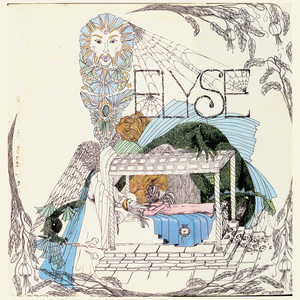
ElyseHer backing band was a Los Angeles group that would soon release its own album as Touch. Its leader, Don Gallucci, had played the organ on the Kingsmen's 'Louie Louie' at fifteen. Gene Shiveley produced, Gallucci and Jeremy Stewart wrote the arrangements, Joey Newman played guitar, and Collin Walcott, later of the group Oregon, added sitar and tabla. Brent Titcomb played harmonica. Maureen Titcomb played spoons, co-wrote 'Iron Works' and 'Mortuary Bound' under the name Morag, and drew the cover: a knight kneeling beside a dying maiden while a dragon watches, a scene from the opening song 'Last Ditch Protocol (John Velveteen).' Elyse sang and played six- and twelve-string guitar, and she wrote or co-wrote eleven of the twelve songs. The one cover was Bert Jansch's 'Oh, Deed I Do.'
Elyse remembered the sessions as over the top, with nobody really producing anything. The record swings from pastoral folk to harpsichord baroque to the sound-effects freak-out of 'Iron Works,' with strings and horns crowding in behind her. Death runs through half the songs. Her voice holds it together, cracking and wailing at the top of its range.
Tetragrammaton released Elyse (T-117) in May 1969, with Polydor handling Canada. The single 'Oh, Deed I Do' b/w 'Simpleminded Harlequin' (T-1521) had gone out in April, and Cash Box predicted it would spread from FM radio into the top forty. In Vancouver, CKLG played 'Oh, Deed I Do' for six weeks and took it to No. 9 that June. A second single paired 'If Death Don't Overtake Me' with 'Meet Me at the Station' (T-1522). The label bought full-page trade ads, one telling Billboard readers they had listened to her because Cass Elliot called and asked them to. By June the album had reached No. 31 on the Record World chart, one place behind Neil Young's Everybody Knows This Is Nowhere.
The press followed. Newsweek's July 1969 feature on the new women songwriters set her beside Joni Mitchell, Laura Nyro and Melanie, likening her songs to medieval ballads and her singing to the Dylan of John Wesley Harding. She was 23, living in Los Angeles and hating it. Harlan Ellison championed her in his column, the Globe and Mail and the L.A. Free Press wrote her up, and she played the Troubadour in Los Angeles and the Bitter End in New York, sometimes with a young Glenn Frey backing her. On The Tonight Show she sang 'Oh, Deed I Do' alone with her acoustic guitar, but the microphones were set for Johnny Carson's speaking voice and her vocal barely came through.
Band of ThievesSilver also placed her song 'Band of Thieves' with Cher, who recorded it for her 1969 film Chastity. Atco released it as a single, and the trade papers named Elyse as the writer of the film's title song. She went to the movie with friends to hear it. The song had been retitled, and when the credits rolled they read all music by Sonny Bono. The credit was never put right.
Greasepaint SmileShe was already making her second album. Greasepaint Smile was recorded in 1969 with producer David Briggs, Neil Young's longtime collaborator, and mixed in San Francisco that summer. It was a heavier, more assured rock record, with the confessional 'What You Call It,' the bluesy 'City of the Angels' and 'Houses,' about the struggle of sharing a home with other people. Young played the solo on 'Houses,' plugged straight into the board, with Elyse sitting beside him and her arm around him. Nils Lofgren, J.D. Souther and Kenny Edwards also played on the sessions. Then Tetragrammaton went bankrupt and the album went on the shelf.
Silver next signed her to David Geffen's new Asylum label, home to Jackson Browne, Linda Ronstadt and the Eagles. She recorded a third album, Wildfire, but a falling-out with Silver ended both the management deal and the record. Wildfire has never been released.
Cori Bishop"I just drifted away," she told us. She kept writing songs, turned to spiritual study and astrology, and took the name Cori Bishop, chosen through numerology. Looking back, she felt that leaving may have kept her from becoming another overdose statistic. She lived quietly in Los Angeles for years, spent time in London, moved to Santa Fe in the early 1990s and settled in Ashland, Oregon, in the late 1990s, where she worked in insurance.
The Holy GrailIn 1999 Andrew Rieger of the Georgia band Elf Power was on tour and digging through a box of records at a thrift store in Missoula, Montana, when he found the knight, the maiden and the dragon, priced at one dollar. His turntable was broken, and six months passed before he heard it. When he did, he knew he had found the record he had been hunting for. Rieger and Elf Power keyboardist Laura Carter, who ran Orange Twin Records, went looking for the singer and reached her through BMI and her old songwriting partner Rich Goldman. When Rieger called to ask about a reissue, Cori Bishop agreed on the spot.
The master tapes were gone. Warner Bros., which had inherited the Tetragrammaton catalogue, had thrown them out about two years earlier. Orange Twin found a mint copy of the LP and remastered from the vinyl. Elyse came out on CD in February 2001 (Orange Twin OT-001) with two bonus tracks from Greasepaint Smile, 'Houses' and 'What You Call It.' The first pressing of 1,000 copies sold through and a second followed.
Second LifeShe returned to the stage in Portland, Oregon. At Satyricon, Elf Power backed her on 'Oh, Deed I Do' and 'Last Ditch Protocol' after a single sound check. She walked in to hear her own record playing over the PA, looked out at a room full of tattooed twenty-somethings, strapped on her twelve-string and won them over. She said the band "played like angels." Back in Ashland she formed Baby Cori & the Buds and joined the Southern Oregon Songwriters Association.
'Houses' became the song new listeners found first. Vetiver and Dinosaur Jr. covered it in the years after the reissue, and Courtney Barnett and Jeff Tweedy later recorded it too.
Her friend John Swinnerton offered her unlimited studio time, and he co-produced, engineered and played many of the instruments on In My Own Sweet Time, released in late 2009 under her original name. All of the songs were hers, most written in the previous five years. In the old days, she told us, she had been the chick singer, surrounded by producers and arrangers who never asked for her ideas. This time she had complete freedom. "It may have taken 40 years but what is time?" She was re-forming Baby Cori & the Buds to play the new songs live, and said the plan, above all, was "to remember who I really am."
When we spoke in March 2010, a label in South Korea had just asked about reissuing Greasepaint Smile. The album finally came out on Chicago's Numero Group in September 2015, 46 years after it was shelved, with a 7-inch single pairing her 'Houses' with the Dinosaur Jr. version. Listening back, she heard a young woman wanting to be loved and reaching for a higher love, something she understood only years later.
Elyse Weinberg died of lung cancer in Ashland on February 20, 2020, at the age of 74. She was predeceased by her parents, Alex and Mary Weinberg, and her sister, Vickie Marks, and survived by her brother, Mark Weinberg. Brent Titcomb, who played harmonica on her first album half a century earlier, remembered her as intense, unorthodox and funny, and said there was no one else like her.
-Robert Williston
Gallery
Images
4 images

Elyse Weinberg - Elyse

Elyse Weinberg - Elyse LABEL 02

Elyse Weinberg - Elyse LABEL 01
Elyse
Media
Videos
0 videos
No videos available for this title.
Credits
Musicians
Elyse J. Weinberg: lead vocals, six-string guitar, twelve-string guitar
Joey Newman: guitar
Bruce Hauser: bass
John Bordanaro: drums
Don Gallucci: keyboards
Collin Walcott: sitar, tabla
Brent: Jew's harp (mouth harp)
Maureen Titcomb: spoons
The Band of Thieves: basic instrumental tracks
Songwriting
‘Band of Thieves’ written by Elyse Weinberg
‘Deed I Do’ written by Bert Jansch
‘Iron Works’ written by Elyse Weinberg and Maureen Titcomb
‘Spirit of the Letter’ written by Elyse Weinberg
‘Here in My Heart (Underneath the Spreading Chestnut Tree)’ written by Elyse Weinberg
‘Last Ditch Protocol’ written by Cynthia Friedland and Elyse Weinberg
‘Sweet Pounding Rhythm’ written by Elyse Weinberg
‘Meet Me at the Station’ written by Elyse Weinberg
‘Simpleminded Harlequin’ written by Elyse Weinberg
‘Painted Raven’ written by Elyse Weinberg
‘Mortuary Bound’ written by Elyse Weinberg and Maureen Titcomb
‘If Death Don’t Overtake Me’ written by Elyse Weinberg
Publishing
All songs published by Peyotl Music (BMI), except 'Deed I Do', published by Southern Music Publishing (ASCAP)
Production
Produced by Gene Shiveley
Arranged by Don Gallucci and Jeremy Stewart
Mastered by Dave Travis (DT)
A Tetragrammaton Records Production
Artwork
Illustrations and Drawings: Maureen Titcomb
Printing and Calligraphy: Brent
Release
1969, Polydor / Tetragrammaton Records, 543.032, Vinyl LP, Canada
Manufactured in Canada
Original United States catalogue number: T-117
Original United States release: June 1969, Tetragrammaton Records
Matrix/Runout
Side A: 543 032-A
Side B: 543-032-B
No Comments